



English Antiques Versus French Antiques Compared
A George III mahogany library table and a Louis XVI giltwood console may have been made within a few decades of one another, yet they establish entirely different terms in a room. One brings architectural weight, polished timber and a sense of permanence; the other introduces light, line and theatrical reflection. English antiques versus French antiques is therefore not simply a question of national taste. It is a decision about proportion, atmosphere, craftsmanship and how an interior is meant to be lived in.
For collectors and decorators, the most compelling rooms seldom follow a rigid national rule. They are shaped by well-chosen contrasts, with each object judged on its individual quality, condition and provenance. Understanding the visual language behind these two great traditions makes that judgement more assured.
English antiques versus French antiques: the essential character
Broadly speaking, English furniture often conveys restraint, material confidence and utility refined to a high art. French furniture is more readily associated with elegant silhouette, decorative movement and a close relationship between furniture, architecture and the decorative arts. These are useful starting points, not absolute rules. An English Rococo mirror can be exuberant, while a French Directoire commode can be remarkably severe.
The distinction is rooted partly in patronage. English country houses required durable furniture for libraries, dining rooms, halls and bedrooms on a substantial scale. Cabinet-makers responded with designs that could be handsome, practical and imposing without relying solely on ornament. French court and urban interiors, especially in the eighteenth century, placed greater emphasis on ceremonial reception, coordinated decoration and the changing fashions of royal and aristocratic taste.
This difference can be felt before it is articulated. English pieces commonly anchor a scheme. French pieces often animate it.
Form, proportion and the way a room feels
English furniture from the Georgian period is admired for its balance. A Chippendale chair may have a lively carved back, but its proportions remain disciplined. A George III chest or partners' desk has a satisfying structural logic: drawers sit clearly within a carcass, mouldings frame the composition, and the timber is allowed to do much of the visual work.
French furniture frequently puts the eye in motion. The bombe commode, cabriole leg and serpentine apron create a softer, more fluid outline. Under Louis XV, asymmetry and Rococo carving could make an object appear almost animated. Louis XVI moved towards neoclassicism, favouring straight fluting, gilt-bronze mounts, paterae and more rectilinear forms, yet retained a delicacy that distinguishes it from much English furniture of the same period.
For a room with high ceilings, dark panelling or substantial architectural detail, English antiques can provide the necessary gravity. Mahogany dining tables, library bookcases, wing chairs and longcase clocks have a natural authority. In a lighter drawing room, bedroom or city flat, a French console, bergère or marble-topped commode may offer refinement without visual heaviness.
Scale is more important than nationality. A monumental French Empire commode can overwhelm a modest interior, just as a small English occasional table can disappear in a large hall. Measurements, circulation and the existing architecture should always guide the selection.
Timber, lacquer, giltwood and surface
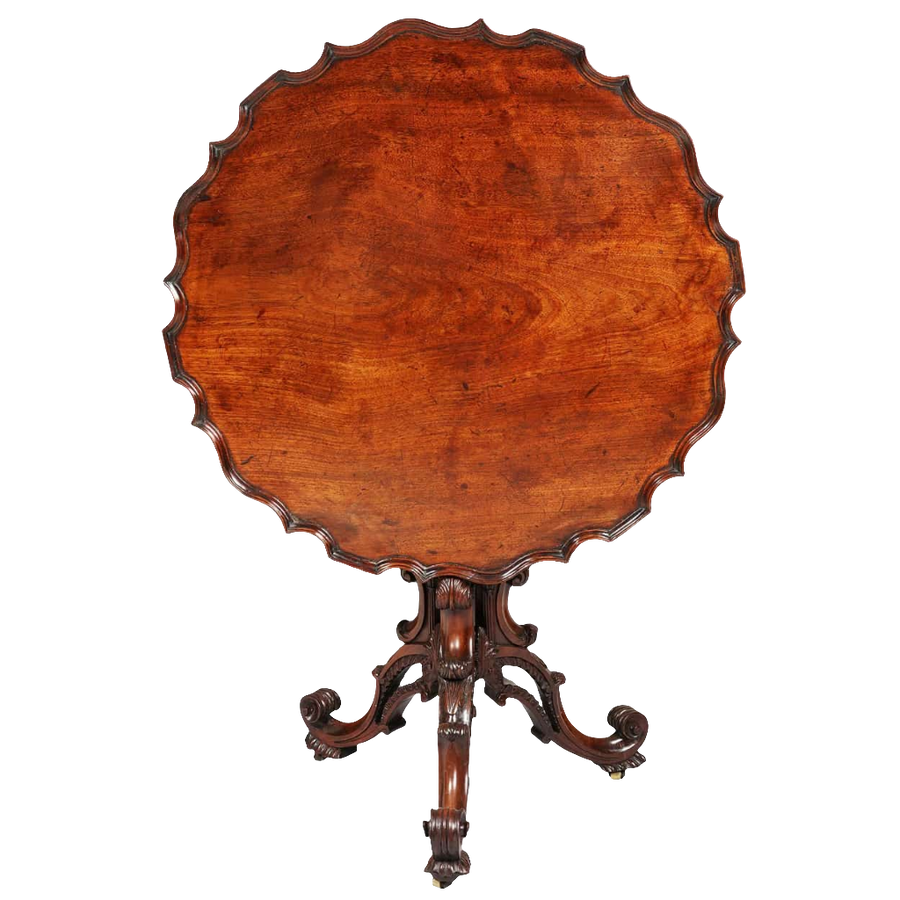
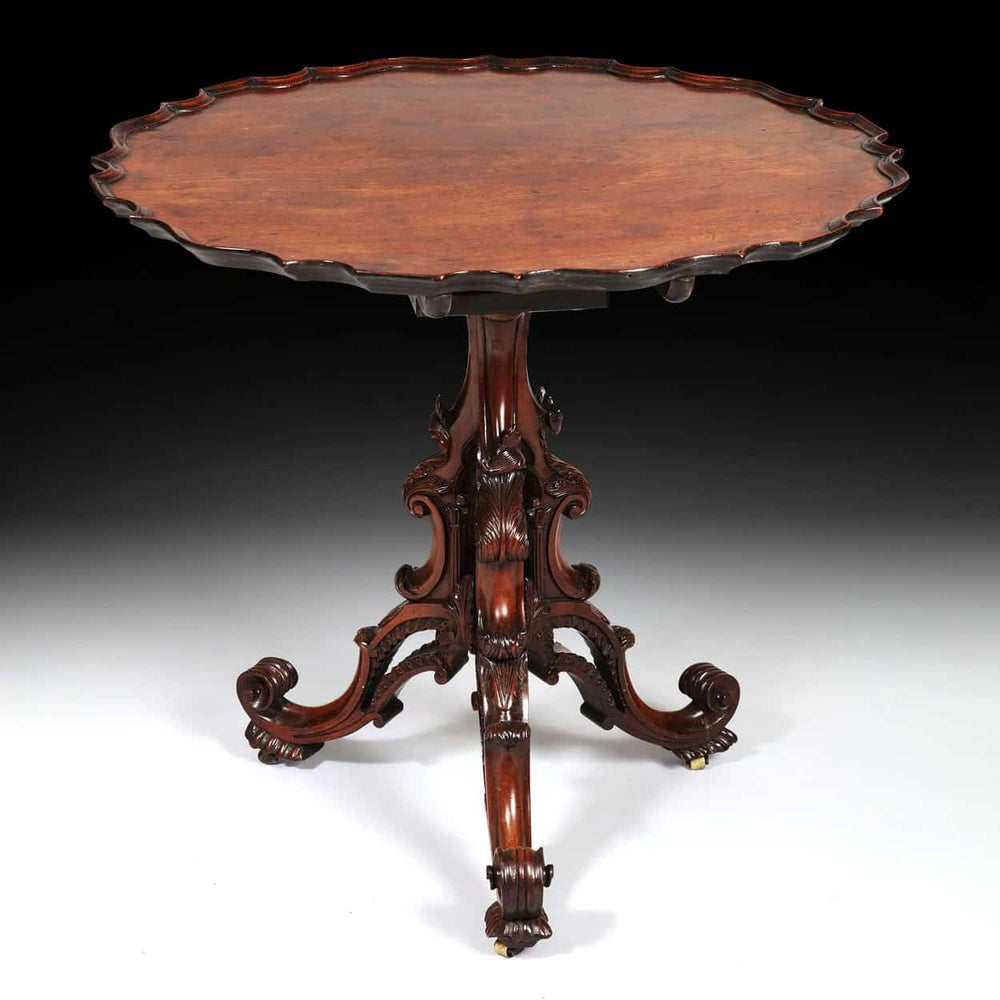
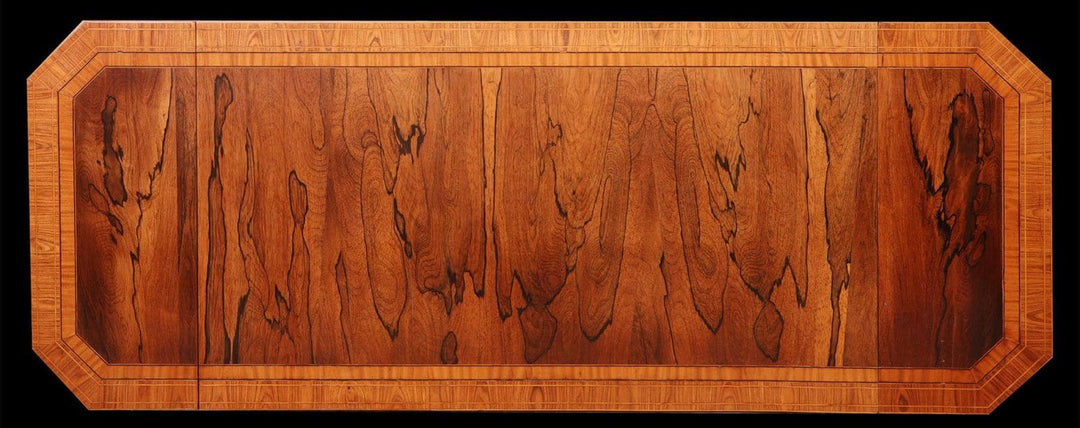
Material is one of the clearest points of contrast. English cabinet-makers developed an exceptional command of timber. Walnut was favoured in the late seventeenth and early eighteenth centuries; richly figured mahogany became the defining material of the Georgian age; satinwood, rosewood and harewood offered lighter or more decorative alternatives. The best English furniture allows these woods to speak through carefully selected veneers, restrained crossbanding and beautifully finished surfaces.
French makers were equally sophisticated, though their effects were often more layered. Kingwood, tulipwood, amaranth and bois de violette were used in elaborate parquetry and marquetry. Lacquer panels, whether Asian or European japanned work, could be incorporated into cabinets and commodes. Gilt bronze mounts were not merely decorative additions: on important pieces, they protected vulnerable corners, framed drawers and added a controlled brilliance against the veneers.
Giltwood presents another useful comparison. English giltwood mirrors and console tables, particularly from the mid-eighteenth century, can be richly carved and exuberant, with eagles, scrolls, foliage and bold cresting. French giltwood is often more integrated into a wider decorative scheme, with carving that follows the movement of boiserie, upholstery and chandeliers. Neither approach is inherently grander. The question is whether the object has depth, crispness of carving and an undisturbed surface with a convincing history.
Original surface deserves particular attention. A mellow patina, old gilding or well-preserved lacquer can account for much of an antique's character and value. Restoration should stabilise and preserve, not erase the evidence of age. A completely over-polished English table or newly burnished French ormolu mount may look impressive at first glance, but can lose the quiet authority that serious collectors recognise.
The periods that matter most
Labels such as Georgian or Louis XV are useful, but they encompass distinct phases and makers. In English furniture, Queen Anne introduced elegant walnut forms and restrained curves. Early Georgian design absorbed Palladian classicism, while the Chippendale, Adam, Hepplewhite and Sheraton idioms brought very different approaches to ornament, line and proportion. Regency furniture became bolder, drawing on Greek, Roman, Egyptian and global motifs with greater confidence.
French furniture is often considered through the reigns of Louis XIV, Louis XV and Louis XVI, followed by Directoire, Empire and Restoration. Louis XIV furniture is architectural and formal, often associated with grand scale, boulle work and powerful gilt bronze. Louis XV is lighter, curvier and more intimate. Louis XVI looks to antiquity, with elegant symmetry and disciplined ornament. Empire is deliberately imperial: mahogany, bronze, columns, lions, sphinxes and classical references project a more dramatic authority.
These styles travelled. English makers adopted French taste, French workshops responded to English demand, and the trade in objects, prints and ideas was extensive. A fine late Georgian piece with French-inspired mounts or a French nineteenth-century cabinet made for an English house may be especially interesting precisely because it complicates a neat national category.
How to combine English and French antiques well
The strongest mixed interiors are based on shared qualities rather than an arbitrary mix of styles. A French Louis XVI fauteuil can sit beautifully beside an English George III satinwood table when both have slender proportions, pale surfaces and neoclassical restraint. A substantial English mahogany pedestal desk can gain warmth from a French Empire bronze or a pair of ormolu-mounted lamps, provided the scale is carefully judged.
Start with one dominant visual note. This might be the warm brown of mahogany, the pale shimmer of giltwood, the black-and-gold drama of lacquer, or the quiet geometry of neoclassicism. Then allow the secondary tradition to provide contrast. In a predominantly English room, a French mirror above a chimney-piece can introduce light and sophistication. In a French-led scheme, an English chest, library chair or longcase clock can prevent the room becoming overly precious.
Avoid treating antiques as costume. A room filled with matching examples from one moment can be magnificent, but it needs architectural conviction and considerable space. In most private interiors, a finer result comes from fewer pieces of greater quality, with enough air around each one to appreciate its silhouette and surface.
What discerning buyers should assess
Nationality and period are only the beginning. A fully authenticated antique should be assessed for design quality, construction, condition, surface, provenance and comparative rarity. Look beneath the attractive presentation. Are the drawer linings, secondary timber, locks, handles and feet consistent with the claimed date? Does the carving retain definition? Has a veneer been sensitively repaired, or extensively replaced? Are gilt bronze mounts original to the piece and properly fitted?
Condition requires a measured view. An untouched object may retain exceptional surface but require careful conservation before it can be used. Another may have undergone historic repairs that are entirely appropriate for its age and function. The concern is not that an antique has lived, but whether its history has been respected. Sensitive restoration, undertaken with period materials and techniques, protects both beauty and integrity.
Provenance can add intellectual and financial significance, particularly for pieces attributable to celebrated makers or associated with important houses and collections. Yet excellent furniture without a grand documented lineage can still be highly desirable if it is well-designed, honestly preserved and rare within its type. A private consultation with a specialist dealer is particularly valuable when comparing objects across traditions, as details of construction and restoration are often more revealing than a catalogue description alone.
Choosing the tradition that serves the interior
Choose English antiques when the room calls for depth, solidity and enduring architectural presence. They are especially persuasive in libraries, dining rooms and country-house settings, but can also lend seriousness to a contemporary interior. Choose French antiques when the aim is lightness, decorative finesse, reflected light or a more sculptural silhouette. They excel in drawing rooms, bedrooms, entrance halls and schemes where the furniture itself is intended to provide a sense of movement.
The most rewarding acquisition is not the one that most faithfully follows a national label. It is the piece whose quality becomes more apparent with time: a well-proportioned table, a beautifully patinated commode, a mirror with exceptional carving, or a bronze with real presence. When selected with care, English and French antiques do not compete. They give a room a richer, more convincing conversation.


Leave a comment