



Antique Console Tables in London: A Connoisseur's Guide
To navigate the world of fine antiques is to embark upon a journey of discernment, a pursuit where the sheer abundance of choice can feel as overwhelming as it is magnificent. This is particularly true when seeking the finest antique console tables London has to offer, where each piece whispers a different story from a bygone era. The challenge lies not merely in finding a beautiful object, but in understanding its soul-distinguishing the elegant lines of a Hepplewhite from the Neoclassical rigour of Robert Adam, or discerning a genuine patina from a clever imitation. How does one confidently select a piece of such historical significance and integrate it seamlessly into a contemporary interior, ensuring it becomes not just a decoration, but a cherished asset?
This connoisseur’s guide is your trusted companion in that very pursuit. Within these pages, we shall explore the rich lineage of these distinguished pieces, demystify the nuances of period styles, and reveal the secrets to acquiring an extraordinary console table that will imbue your home with a profound sense of history and grace. Consider this your invitation to move beyond mere acquisition and towards a deeper appreciation of artistry, provenance, and enduring beauty.
Key Takeaways
- Understand the console table's distinguished lineage, from its palatial origins to its evolution as a functional work of art, to better appreciate its significance.
- Develop a connoisseur's eye by learning to distinguish the key design periods, from the Baroque to the Regency, through their defining motifs and materials.
- Master the art of acquisition by identifying the crucial indicators of quality, authenticity, and provenance when sourcing exceptional antique console tables London.
- Discover sophisticated strategies for seamlessly integrating a magnificent historical console table into a contemporary interior, creating a focal point of timeless elegance.
The Console Table: A Legacy of Elegance and Function
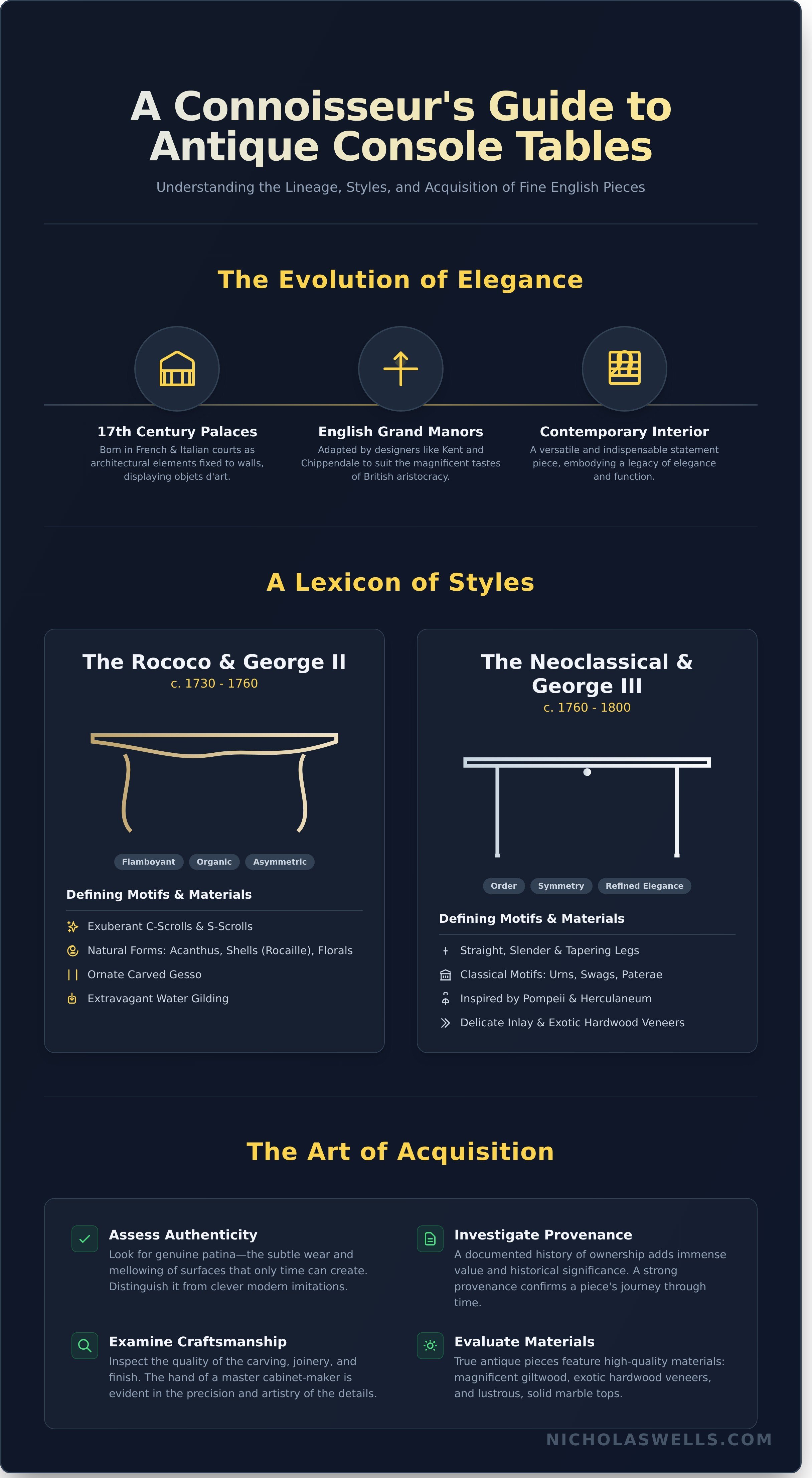
Born from the architectural grandeur of 17th-century French and Italian palaces, the console table was conceived not merely as furniture, but as an integral element of a room’s interior scheme. Its story is one of magnificent evolution, tracing a path from a static symbol of aristocratic power to a versatile statement piece that remains indispensable in the most distinguished homes. Originally designed to be fixed to a wall, often beneath a towering pier glass mirror, its purpose was to display treasured objets d'art, from Chinese porcelain to bronze sculptures, reflecting the owner's worldliness and refined taste.
This journey from continental courts to the grand houses of Britain marks a fascinating chapter in the history of decorative arts. As a form, it embodies a unique duality: it is at once an architectural fixture and a masterful demonstration of the cabinet-maker’s craft. Today, the enduring appeal of the finest antique console tables London has to offer lies in this very legacy of elegance and sophisticated function.
From Royal Courts to English Manors
The console table reached its apotheosis in the court of Louis XIV at Versailles, where it served as a powerful expression of opulence and order. These early tables were often breathtakingly ornate, supported by elaborate carved scrolls, or consoles, from which the form derives its name. English aristocrats, returning from their Grand Tours, brought with them a deep appreciation for this continental style. Consequently, leading English designers such as William Kent and, later, Thomas Chippendale, masterfully adapted these Baroque and Rococo forms to suit the more restrained, yet equally magnificent, tastes of their new clientele.
Defining Features of a True Antique Console
To the connoisseur, understanding the subtle distinctions between period forms is paramount. While often used interchangeably, a true console table was originally a two-legged piece supported by brackets fixed to the wall. A pier table, though similar, was specifically designed to occupy the pier-the wall space between two windows. The more common side table, by contrast, is a freestanding piece. The celebrated history of the console table is defined by its materials: magnificent giltwood, exotic hardwood veneers, and lustrous marble tops were de rigueur. This architectural permanence is what lends the finest antique console tables London collectors seek their profound sense of place and historical gravitas.
An Lexicon of Styles: Identifying Key Periods in Console Table Design
To truly appreciate the artistry of an antique console table is to understand the historical and cultural currents that shaped its form. Each period imparted a distinct aesthetic vocabulary, a language of design that speaks of the society from which it emerged. For the discerning collector, mastering this lexicon is the first step toward curating a truly exceptional collection, and it is essential when searching for the finest antique console tables London specialists have to offer. This guide illuminates the three most influential epochs in English console table design.
The Rococo and George II Period (c. 1730-1760)
Emerging as a spirited reaction to the formal symmetry of the preceding Baroque era, the Rococo style is defined by its flamboyant and organic asymmetry. Cabinet-makers like Matthias Lock and Thomas Johnson embraced a fluid design language, characterised by exuberant, scrolling forms. Look for defining motifs drawn from nature, such as acanthus leaves, shells (rocaille), and floral garlands, all rendered with magnificent C-scrolls and S-scrolls. These tables were often conceived as architectural statements, frequently finished in ornate carved gesso and extravagant water gilding to reflect candlelight in the grand salons of the aristocracy.
The Neoclassicism of George III and Robert Adam (c. 1760-1800)
The mid-18th century witnessed a profound intellectual shift, as the Grand Tour and archaeological discoveries at Pompeii and Herculaneum ignited a passion for classical antiquity. This movement, masterfully championed by architect Robert Adam, heralded a return to order, symmetry, and refined elegance. The Rococo's wild curves gave way to straight, slender, and often tapering legs. Surfaces were adorned with a new repertoire of classical motifs, including urns, swags, paterae, and delicate inlay. The profound impact of these classical discoveries on the decorative arts is well-documented and can be explored in archives such as the Victoria and Albert Museum's furniture collection, which showcases the period's restrained grandeur.
The Bold Elegance of the Regency Period (c. 1811-1820)
The Regency period introduced a bolder, more archaeological and masculine aesthetic, heavily influenced by the Napoleonic campaigns and the designs of Thomas Hope. Forms became more solid and architectural, drawing inspiration directly from Roman, Greek, and Egyptian sources. Dark, richly figured woods such as rosewood and mahogany were favoured, often embellished with intricate brass inlay and ormolu mounts. The most distinguished antique console tables London showcases from this era feature powerful design elements like sculptural monopodia supports, sabre legs, and formidable lion paw feet, creating a statement of imperial confidence and scholarly taste.
The Art of Acquisition: What to Look for When Buying in London
For the discerning collector and interior designer, acquiring an antique console table is an intellectual and aesthetic pursuit, one that demands a cultivated eye. The London market, with its unparalleled depth, offers extraordinary opportunities, but navigating it requires an understanding of the subtle yet significant markers of quality, authenticity, and enduring value. This guide provides the foundational knowledge to approach this journey with the confidence of an expert.
Assessing Materials, Craftsmanship, and Patina
The soul of a fine antique resides in its material integrity and the virtuosity of its maker. Begin by examining the marble top; an original will exhibit a perfect fit, appropriate veining for the period, and wear consistent with the base. The quality of craftsmanship, whether in the crispness of a Rococo carving or the intricacy of Neoclassical marquetry, is a primary indicator of worth. The extraordinary standards of 18th-century Parisian ébénistes, whose work can be studied in collections like that of the Metropolitan Museum of Art, set a benchmark for assessing decorative mounts and construction. Finally, one must learn to read the piece’s patina-the subtle mellowing of gilded surfaces and the deep lustre of old timber, which together form an irreplaceable testament to its journey through time.
Understanding Provenance and Condition
A distinguished provenance-the documented history of ownership-can elevate a superb object into a historically significant one, confirming its pedigree and often enhancing its value. Seek out any surviving trade labels, maker’s stamps, or collection marks that tell its story. It is equally critical to differentiate between the gentle signs of age and significant structural damage. While minor shrinkage or historic scuffs are part of a piece’s character, issues like replaced elements or clumsy repairs can compromise its integrity. Expert, sympathetic restoration is not a flaw; rather, it is a vital act of conservation that stabilises a piece for future generations while preserving its historical essence.
Choosing a Reputable London Dealer
When searching for the finest antique console tables London has to offer, aligning with a reputable dealer is paramount. An established specialist provides more than just an object; they offer their expertise, a meticulously curated collection, and an assurance of quality. Look for membership in esteemed trade associations such as The British Antique Dealers' Association (BADA) or The Association of Art & Antiques Dealers (LAPADA), as this signifies a commitment to a stringent code of ethics. A trusted dealer operates with complete transparency, providing detailed condition reports and all known provenance, ensuring your acquisition is not only beautiful but also a sound and magnificent investment.
Styling the Antique Console Table in the Contemporary Interior
Integrating a piece of history into a modern interior requires a delicate balance-a move away from the static reverence of a museum towards a dynamic, liveable elegance. An antique console table, with its inherent grace and distinguished provenance, is not merely an object to be admired from afar; it is a functional work of art capable of anchoring a room and serving as a bridge between historical grandeur and contemporary comfort. Its true potential is unlocked when it is thoughtfully placed and styled to create a stunning focal point.
The Grand Entrance Hall: A First Impression
Positioned in an entrance hall, a console table establishes a tone of refined welcome. It provides the perfect anchor for a significant, oversized mirror or, for a more dramatic effect, a bold piece of contemporary abstract art. The resulting dialogue between old and new can be further enhanced by accessorising with restraint: a single sculptural lamp or a minimalist vessel allows the table’s own exquisite craftsmanship to remain the primary focus.
The Sophisticated Drawing or Living Room
In a drawing or living room, its role becomes one of sophisticated utility. Placed behind a sofa, it elegantly defines a seating arrangement, while against a feature wall, it offers a distinguished surface for a pair of lamps, curated art books, and cherished objets d'art. The juxtaposition of an ornate, 18th-century giltwood console with the clean lines of modern upholstery creates a tension that is both intellectually stimulating and visually compelling.
Unexpected Placements: The Dining Room and Beyond
Beyond these traditional placements, consider its versatility in other spaces. In a dining room, a marble-topped console can function as an impossibly chic server or bar. On a spacious landing or in a study, it introduces a layer of historical gravitas, transforming a transitional area into a destination. The most exceptional antique console tables London collections offer possess this remarkable adaptability. Allow us to help you find the perfect piece for your interior.
London: The Enduring Epicentre of the Antiques World
For centuries, London has maintained its pre-eminent position as the global capital for fine decorative arts. This is not by accident, but the result of an unparalleled confluence of royal patronage, visionary craftsmanship, and international trade. The city’s historic streets, particularly in areas like St. Martin’s Lane, were once the domain of legendary cabinet-makers whose names-Chippendale, Vile & Cobb, Linnell-still resonate with authority. This legacy is sustained today by a sophisticated network of world-renowned auction houses and specialist dealers, ensuring the city remains the ultimate destination for connoisseurs sourcing the finest antiques.
A Tradition of Unrivalled Craftsmanship
London's reputation was forged by an extraordinary fusion of talent and resources. The arrival of skilled immigrant craftsmen, such as the Huguenots, introduced revolutionary techniques in marquetry, carving, and gilding. This expertise was met with insatiable demand from a wealthy aristocracy, whose commissions fuelled centuries of design innovation. As the heart of a global empire, London’s docks provided access to the world’s most rare and exotic materials, from Cuban mahogany to richly figured satinwood, enabling its artisans to create furniture of superlative quality and beauty.
Discovering Your Console Table with Nicholas Wells Antiques
At Nicholas Wells Antiques, we are proud custodians of this distinguished heritage. Our approach is not merely one of commerce, but of a deep and scholarly commitment to the history of English and Continental furniture. The process of curating our collection of antique console tables London is a meticulous pursuit, where each piece is selected for its triumvirate of virtues: exceptional design, historical significance, and profound character. We seek out objects with a compelling narrative and a distinguished provenance, ensuring they represent the pinnacle of their respective periods.
Every console table we acquire is treated as a significant cultural artefact. To honour its journey through time, we provide expert and complimentary restoration, preserving its integrity for the next generation of collectors. Paired with our fully insured worldwide shipping, we provide a seamless connection between London’s historic workshops and the world’s most elegant contemporary interiors. We invite you to explore a collection that embodies this enduring legacy of excellence.
An Invitation to Enduring Elegance
The journey through the world of the antique console table reveals it as far more than a mere decorative object; it is a cultural artefact, a testament to the masterful craftsmanship of a bygone era. Understanding its stylistic evolution and its remarkable ability to anchor a contemporary interior is the first step toward acquisition. This pursuit for exceptional antique console tables London remains the ultimate pilgrimage for the discerning connoisseur, a city where history and artistry converge.
For those ready to acquire a piece of this legacy, Nicholas Wells offers a collection of unparalleled distinction. As London-based specialists in fine 18th and 19th-century furniture, we have proudly served collectors worldwide since 2012. Our commitment is absolute, extending to the complimentary, expert restoration included with every purchase, ensuring each object is presented in a condition worthy of its distinguished provenance. We invite you to discover our curated collection of fine antique console tables and allow us to help you find the extraordinary piece that awaits its next chapter with you.
Frequently Asked Questions
What is the difference between an antique console table and a pier table?
The distinction lies in their original architectural purpose and form. A pier table was designed expressly to stand on the “pier”-the section of wall between two tall windows-often beneath a corresponding pier glass. A console table, deriving its name from the supporting console brackets, was traditionally fixed to the wall, though many later examples became freestanding. While the terms are now often used interchangeably, their historical context defines their purest form and intended placement within a grand interior.
How can I verify the authenticity and provenance of a console table?
Verifying authenticity requires a connoisseur's eye for construction, materials, and patina. Examine joinery for hand-cut dovetails, assess the timber for period-correct species, and observe the surface for the subtle wear of genuine age. Provenance is established through documentation, such as historic sale records or inclusion in collection inventories. At our gallery, we undertake this scholarly research for every piece, providing clients with a comprehensive history that substantiates its origin and distinguished ownership.
What is the best way to care for a giltwood or marble-topped console table?
These magnificent materials require delicate handling. Giltwood surfaces should only be dusted gently with a soft, natural-bristle brush, as liquids and chemical cleaners can irrevocably damage the fragile gesso and gold leaf. For marble tops, use coasters to prevent staining and immediately blot spills with a soft cloth. Clean only with a pH-neutral stone cleaner, as acidic substances like wine or citrus will etch the polished surface, compromising its lustre and integrity.
Can a valuable antique console table be used in a home with children or pets?
Indeed, with strategic placement. When situating the valuable antique console tables London collectors cherish, positioning is paramount. We recommend placing such a piece in a lower-traffic area, like a formal hall or drawing room, away from the main thoroughfares of family life. For added security, many console tables can be fixed to the wall, as was their original intention, which provides superb stability and mitigates the risk of accidental tipping in an active household.
Does Nicholas Wells offer international shipping for large furniture items?
Yes, we provide a comprehensive international shipping service for our global clientele. Whether you are acquiring one of our superb antique console tables London based or from across the world, our team manages the entire process. We work exclusively with specialist fine art shippers to ensure every item receives bespoke crating, white-glove handling, and fully insured transit, guaranteeing its safe and impeccable arrival at your residence, wherever it may be.
How do I arrange a viewing of a console table at your London gallery?
To ensure a personal and unhurried experience for every client, viewings at our London gallery are arranged by appointment only. We invite you to contact us via telephone or email to schedule a private consultation. This allows us to have the specific piece or a curated selection prepared for your arrival, ensuring you receive our undivided attention and the expert guidance necessary to make a considered acquisition for your collection or interior scheme.


Leave a comment