



Antique Islamic Arms and Armour: A Connoisseur’s Buying Guide
The Allure of Antique Islamic Arms and Armour
The golden era of Islamic craftsmanship, spanning principally from the 17th to the 19th centuries, produced objects of extraordinary beauty and martial prowess. Antique Islamic arms and armour occupy a unique space in the world of collecting, representing a synthesis of functional design and high art. These were not merely tools of warfare; they were potent symbols of rank, status, and divine authority, often lavished with the same attention to detail as the finest courtly jewellery. For the modern connoisseur, each piece possesses a distinct "soul"—a tangible connection to the imperial courts of the Mughal, Ottoman, and Persian empires. Beyond their historical significance, these objects serve as powerful focal points in luxury interiors, their rich surface patina and intricate details offering a profound counterpoint to contemporary design.
The Synthesis of Art and Warfare
In the great imperial courts, the finest weapons were frequently exchanged as diplomatic gifts, physical embodiments of power and mutual respect. The artistry lavished upon a Persian Shamshir or a Mughal dagger was a direct reflection of the ruler’s wealth and taste. Appreciating these works requires a degree of scholarship; one must understand the cultural context of the empires that produced them. The floral motifs on a Mughal hilt, the bold calligraphy on a Persian blade, or the coral and turquoise embellishments of an Ottoman sabre all tell a story of regional identity and artistic exchange.
A Legacy of Prestige for the Modern Collector
Today, these magnificent objects find a natural home alongside collections of 18th-century English furniture and classical souvenirs. Their sculptural forms and historical depth complement the intellectual curiosity embodied by Grand Tour objects. For collectors in New York, the Hamptons, and Texas, antique Islamic arms and armour offer an opportunity to acquire pieces of profound historical weight and decorative impact, transforming a curated interior into a space of worldly sophistication.
Identifying the Core Forms: Sabres and Daggers
The arms of the Islamic world are characterised by a rich diversity of forms, each developed to suit specific cultural and martial traditions. The elegant, deeply curved sabre, for instance, became an iconic symbol of the region, yet its form evolved significantly across different empires. From the 17th to the 19th century, blade geometry was refined for different combat styles, resulting in a fascinating lineage of sabres and daggers that are as distinct as the cultures that forged them.
Swords of Distinction
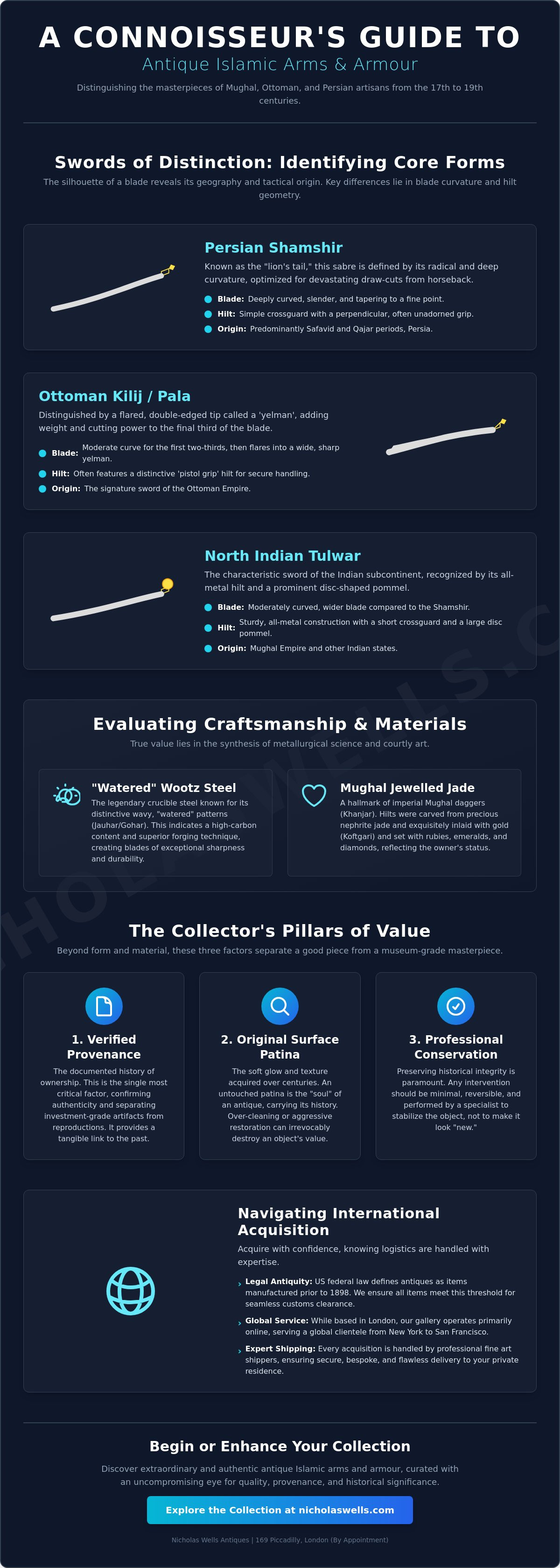
Understanding the key differences between the major sword types is fundamental for any serious collector. The Persian Shamshir, with its name translating to "lion’s tail," is defined by its dramatic, sweeping curve, designed for devastating cutting attacks from horseback. In contrast, the Ottoman Kilij often features a broader, double-edged tip known as a yalman, which adds weight for powerful slashes. The Indian Tulwar is immediately recognisable by its distinctive disc-shaped pommel, providing a secure grip. The hilt design is often the clearest indicator of a weapon's origin, with each region developing its own signature style. At the zenith of decorative sword-making is the Lucknow Enamel Shamshir, a masterpiece of Indian artistry where the hilt is adorned with vibrant, jewel-like enamelling.
Daggers of Authority
Daggers were not merely secondary weapons but essential components of a nobleman’s attire and symbols of his authority. The Khanjar, a curved, double-edged dagger, was a staple of courtly dress in both Mughal India and Persia, often fitted with opulent hilts of jade, ivory, or rock crystal. The Indian Katar is a unique form of punch dagger, its H-shaped grip allowing the blade to extend directly from the user's knuckles. Regional variations abound, from the straight-bladed Caucasian Kindjal to the J-shaped Persian Jambiya, each a testament to the rich martial heritage of its people.
Evaluating Craftsmanship: Wootz Steel, Jade, and Enamel
The value of antique Islamic arms and armour lies not only in their form but in the mastery of the materials used. The legendary Wootz steel, intricate hardstone carving, and brilliant enamelling represent the pinnacle of Islamic decorative arts. For the connoisseur, distinguishing between true period craftsmanship and later embellishments is paramount. A critical eye must also be applied to the object's condition, prioritising conservation of the original surface over aggressive restoration that might erase its history.
The Mastery of Metallurgy
Often referred to as Damascus steel, Wootz steel is the gold standard of ancient metallurgy. Produced in crucibles through a complex and long-lost process, this steel is renowned for its remarkable toughness and ability to hold a sharp edge. Its most prized characteristic is the visible "watered" pattern, or jawhar, which ripples across the blade's surface. This delicate, mesmerising pattern is a natural result of the crystalline structure formed during the steel's slow cooling. The fineness, clarity, and complexity of this pattern are key indicators of quality and significantly affect the weapon's rarity and value.
Decorative Arts: Enamel and Gem-Setting
The artisans of the Islamic world were masters of embellishment, transforming deadly weapons into breathtaking works of art. The enamellers of Lucknow and Qajar Persia produced work of unparalleled brilliance, their techniques creating vibrant, glass-like surfaces that remain vivid centuries later. Similarly, Mughal lapidaries achieved the near-impossible by carving and inlaying precious gems into incredibly hard materials like jade and rock crystal. When evaluating a piece, it is crucial to identify authentic 18th-century gem-setting, which often has a subtle, hand-worked quality, as distinct from more mechanical later additions. These fine examples can be seen across the spectrum of Indian Works of Art, where the fusion of martial and decorative traditions is most evident.
Regional Masterpieces: Mughal, Ottoman, and Persian Styles
While sharing a common heritage, the great empires each developed a distinct aesthetic language. From the floral opulence of Mughal India to the martial grandeur of the Ottoman Empire and the refined elegance of Persia, the discerning collector learns to read the stylistic signatures that define these regional masterpieces. Further afield, on the Caucasian frontier, the Shashka and Kindjal represent a fascinating bridge between the artistic traditions of the East and West.
The Imperial Ottoman Kilij
The Kilij was the quintessential sword of the Ottoman Empire, a symbol of the Sultan’s formidable power and imperial reach. Its bold, powerful form, often featuring a T-shaped spine and flared tip, was designed for devastating effect. Hilts were frequently crafted from horn or silver-gilt and decorated with coral and turquoise, reflecting a taste for strong colours and materials. A notable variant is the Pala, which features a shorter, broader blade. An exceptional 19th-century Ottoman Kilij, with its intricate silverwork and commanding presence, represents a cornerstone of any serious collection.
Mughal Courtly Weapons
The weapons of the Mughal court are defined by an unparalleled sense of opulence and refinement. The Khanjar dagger was an indispensable part of a nobleman’s formal attire, and the finest examples feature hilts exquisitely carved from a single piece of jade. These were often inlaid with gold and set with precious stones like emeralds, rubies, and diamonds, arranged in delicate floral patterns. A Mughal jewelled jade-hilted Khanjar is a testament to the dynasty's immense wealth and its patronage of the highest forms of lapidary art. In later 19th-century pieces, one can sometimes spot the subtle influence of European motifs, a fascinating record of cross-cultural exchange.
Building a Collection with Nicholas Wells Antiques
Acquiring antique Islamic arms and armour is a deeply rewarding pursuit, but one that requires expertise and trust. For the serious collector, provenance is the single most critical factor, providing a clear history of an object's ownership and verifying its authenticity. At Nicholas Wells Antiques, we are committed to sourcing only the most exceptional pieces, each selected for its historical integrity, artistic merit, and outstanding condition. Our commitment extends to complimentary professional restoration and preservation, ensuring each piece is ready for display.
Sourcing the Extraordinary
Our collection is curated to include objects of historical and artistic importance, from sabres of imperial quality to daggers of courtly elegance. We seek out pieces with distinguished provenance, such as a Grand Vizier's Shamshir or a rare Turkish coral-mounted dagger. For museum-quality antiques of the highest calibre, items are often listed as "Price on Application" (POA), reflecting their world-class rarity and inviting a private conversation with discerning clients.
The Seamless Acquisition Process
As a premier online gallery, we have built our reputation on providing a seamless and confidential acquisition process for a global clientele. We specialise in serving collectors across the United States, including in New York, Texas, and California, arranging fully insured worldwide shipping with professional fine art specialists. Every object is meticulously packed to ensure it arrives safely, allowing you to acquire these historical treasures with complete confidence and discretion.
Browse the Masterpieces of the Nicholas Wells Islamic Arms & Armour Collection
Frequently Asked Questions
-
What periods do your antique Islamic arms and armour cover?
Our collection focuses primarily on the high period of Islamic craftsmanship, from the 17th to the 19th centuries, encompassing the Mughal, Ottoman, Safavid, and Qajar dynasties. -
How do I authenticate Wootz steel in a Persian Shamshir?
Authentic Wootz steel displays a distinctive "watered" or crystalline pattern (jawhar) that is integral to the metal itself, not etched onto the surface. We provide high-resolution photography to show this detail and can discuss the specific characteristics of each blade's pattern. -
Are these weapons purely ceremonial or were they used in battle?
Our collection includes both. Many highly decorated pieces were symbols of rank intended for courtly life, while others were functional, high-quality weapons made for noblemen who would have been expected to lead men in battle. The form, balance, and blade quality often indicate the intended purpose. -
Can I ship antique Islamic swords to the United States?
Yes. As these are antique items (generally over 100 years old), they are classified as collectors' pieces and are not subject to the same restrictions as modern weapons. We have extensive experience shipping to clients in the US and handle all logistics using professional fine art shippers to ensure a smooth and compliant process. -
What is the significance of jade hilts in Mughal weaponry?
Jade was highly prized by the Mughal emperors, who associated it with victory, paradise, and longevity. The technical difficulty of carving this exceptionally hard stone meant that jade-hilted weapons were reserved for the highest echelons of the court, making them a powerful symbol of imperial authority and wealth. -
How does the condition of the surface patina affect the value?
The original surface patina is of paramount importance. It is the accumulated history of the object, etched into its surface over centuries. A deep, undisturbed patina is highly desirable and adds significantly to an object's character, authenticity, and value. We prioritise conservation to protect this integrity. -
Do you provide documentation or provenance for your Islamic collection?
Absolutely. Provenance is key. Where available, we provide all known ownership history and documentation for our pieces. Every item is sold with a guarantee of authenticity from Nicholas Wells Antiques.


Leave a comment