




Are Antique Dunhill Lighters Collectible? Values, Models and Buying Tips
The Zenith of British Smoker’s Requisites: A History of Alfred Dunhill
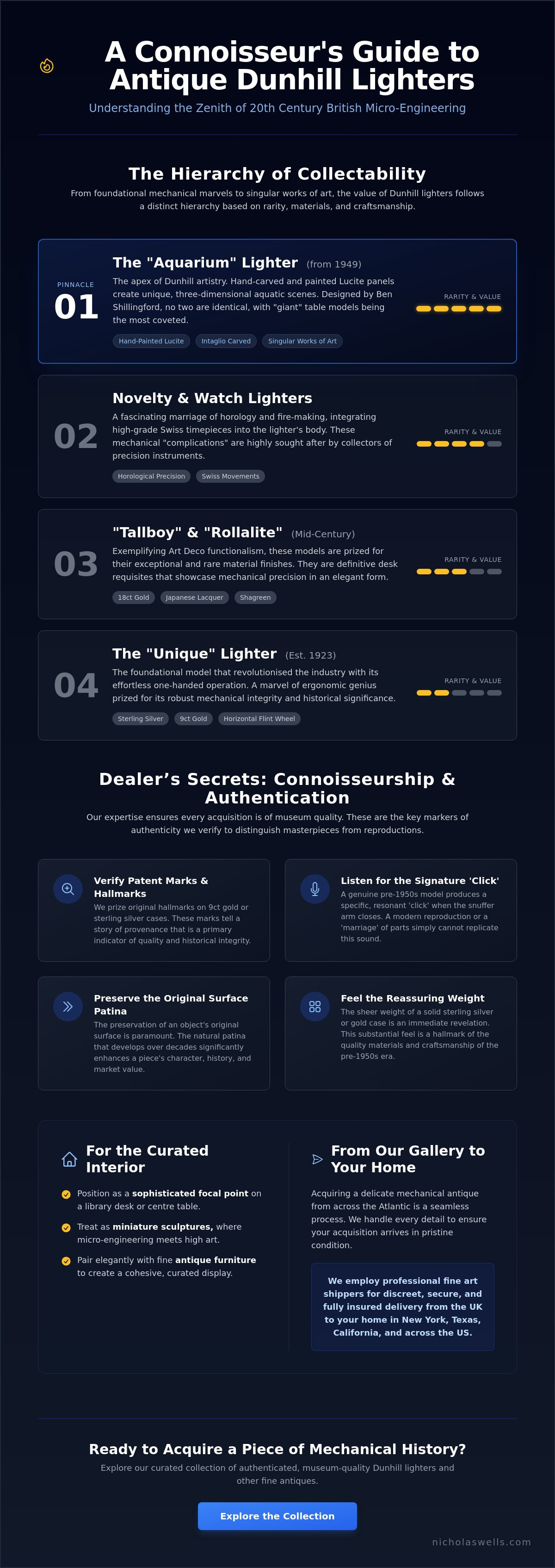
In the world of fine collecting, certain names resonate with an authority that transcends mere branding. Alfred Dunhill is one such name, a marque synonymous not with tobacco, but with the pinnacle of 20th-century British micro-engineering and design. When we speak of an antique Dunhill lighter, we are not referring to the mass-produced models of later decades, but to a pre-1950s mechanical marvel, an object of functional art crafted with the precision of a master watchmaker.
The journey began not with lighters, but with motoring accessories. Alfred Dunhill’s "Motorities" emporium, established at the dawn of the 20th century, catered to the nascent class of gentlemen motorists. This foundation in functional, high-performance requisites for a demanding clientele informed every subsequent creation. The transition to smoker’s paraphernalia was a natural evolution, culminating in the 1923 patent for the first "Everytime" lighter. This early petrol-wick system would eventually give way to the revolutionary butane gas-powered Rollagas in the mid-1950s, but it was the initial period that cemented Dunhill's legacy. It was a commitment to an "understated elegance" that attracted a client list of unparalleled distinction, from royalty and heads of state to the icons of Hollywood's golden age.
The Innovation of the "Unique" Lighter
The true turning point in Dunhill's history arrived in 1923 with the patent for the "Unique" lighter. Its name was not hyperbole; it was the first lighter in the world designed for genuine one-handed operation. This was a profound ergonomic and mechanical achievement. By incorporating a horizontal flint wheel linked to a sprung snuffer arm, the user could, with a single fluid motion of the thumb, ignite the flame and extinguish it upon release. This mechanism, a marvel of miniaturised engineering, defined the Dunhill experience and set a standard that competitors would imitate for decades to come.
Dealer’s Secrets: Why We Sourced Our First Dunhill
As dealers, our engagement with an object is both academic and deeply tactile. I recall the first period Dunhill we acquired for the gallery; it was not merely its aesthetic appeal but its physical presence that confirmed its quality. A genuine piece possesses a satisfying heft, a density in the hand that speaks of solid metal and meticulous construction. The action of the lid produces a distinct, resonant "click"—a sound that is the acoustic signature of precision alignment and a strong, well-calibrated spring mechanism. This tactile feedback is often the first indicator of authenticity. Furthermore, we look to the original hallmarks. On sterling silver or 9ct gold cases, these assay marks are a definitive map of the object's history, revealing its maker, the purity of the metal, the city of assay, and the year of its creation. These are the quiet signals of quality that a connoisseur learns to read.
From the "Unique" to the "Aquarium": Iconic Models to Source
For the discerning collector, understanding the hierarchy of collectability is paramount. While any pre-war Dunhill is a worthy acquisition, certain models command exceptional interest. The hierarchy begins with the early silver "Unique" and "Tallboy" models, quintessential examples of Art Deco functionalism, often finished with exquisite engine-turned patterns. The brand’s exploration of exotic materials elevated these objects further; cases wrapped in shagreen (ray-skin), finished with fine Japanese lacquer, or crafted from solid, engine-turned gold are particularly sought after. These pieces are more than mere accessories; they are sculptural objects that serve as the perfect complement to the fine antique furniture in a curated interior, functioning as exceptional desk requisites.
The Legendary Dunhill "Aquarium" Lighter
Among the rarest and most coveted of all Dunhill lighters is the "Aquarium." Created in the post-WWII period, these were miniature masterpieces of narrative art, hand-carved and painted by the immensely skilled artist Ben Shillingford. The "Aquarium" name derives from their subjects: intricate reverse-carved scenes of fish, birds, or sporting pursuits, which appear suspended within the lighter’s clear Lucite panels. The technique was extraordinarily painstaking; Shillingford had to carve the design into the back of the Lucite block in three dimensions and then meticulously paint the carved interior. This process ensured that no two Aquarium lighters are ever identical, making each a "unique" work in the truest sense. The "giant" table models are the rarest of all, representing the zenith of this remarkable, short-lived collaboration.
Novelty and Watch Lighters
Reflecting the brand's obsession with mechanical ingenuity, Dunhill also produced a range of novelty lighters, including models ingeniously integrated with Swiss timepieces. These "watch lighters" combined two feats of precision engineering into a single, elegant form. For collectors who appreciate the intricate movements and horological significance of such pieces, these lighters represent a fascinating intersection of disciplines, sharing a common heritage with our collection of fine antique clocks and precision instruments.
Connoisseurship and Authentication: Dealer’s Secrets for Serious Collectors
The primary concern for any serious collector is authenticity. The question, "How do I know it is original?" is one we address through a meticulous examination of provenance, patent marks, and construction. The base of a genuine antique Dunhill will bear patent numbers and, crucially, the "Made in England" stamp, which distinguishes it from later licensed productions. Another dealer’s secret lies in evaluating the patina. We actively advise against the over-polishing of original 1930s silver surfaces; the subtle oxidation and gentle wear are part of the object's history and character. We also assess the mechanics: is the tension in the snuffer spring correct? Does the lid align perfectly with the body? These are the fine points that separate a tired example from a crisp, investment-grade piece.
The Importance of Complimentary Restoration
Every antique Dunhill lighter sold by Nicholas Wells Antiques is accompanied by our complimentary restoration service. Our philosophy is that these pieces should not be inert objects in a display case but fully functional artifacts, ready to be used and appreciated as their creators intended. This contrasts sharply with the "as-is" risk inherent in purchasing from generalist auction houses, where mechanical condition is often an afterthought. Our specialised restoration ensures that the delicate internal mechanisms are cleaned, serviced, and brought back to perfect working order, preserving both their function and their historical integrity.
Identifying "Marriages" and Reproductions
A "marriage" piece is a composite of non-original parts, often assembled to create a seemingly rare example, which fundamentally devalues the antique. A connoisseur must be vigilant for warning signs, such as mismatched hallmarks between the body and lid, or the presence of modern Phillips-head screws in a vintage chassis that would have originally used flat-head screws. These small but crucial details are often overlooked by the untrained eye but are immediate red flags for a specialist dealer, protecting our clients from costly acquisition mistakes.
Navigating the Market: Sourcing Dunhill Lighters for the Modern Interior
Today, an antique Dunhill lighter transcends its original purpose. It is a piece of sculpture, a conversation piece, and a focal point for a library desk or a finely appointed centre table. These objects possess a unique ability to bridge the gap between historical grandeur and modern luxury living, feeling equally at home in a traditional New York apartment or a contemporary interior in the Hamptons. They are part of a broader category of exceptional desk accessories, best understood when viewed alongside our curated Works of Art collection.
Collecting as Investment: "Worth Collecting?" Market Analysis
From an investment perspective, the market for rare Dunhill lighters has shown steady and significant appreciation. The rarest examples, particularly the Aquarium and solid gold models, have consistently risen in value over the last decade. Rarity is the primary driver of value. A unique surface, such as an unusual colour of shagreen or a documented special commission, will command a substantial premium. The presence of the original fitted box and paperwork can, in many cases, increase an item's value by a considerable margin, as these ephemeral elements are often lost to time.
A Seamless Acquisition from London to the US
As an online-only gallery established in London, we specialise in serving an international clientele. We wish to reassure our American clients in cities from San Francisco to Greenwich that acquiring a fine antique from us is a seamless and secure process. We manage every aspect of the transaction, providing fully insured, door-to-door delivery via specialised fine art shippers. Our expertise extends to navigating complex international regulations, including CITES for items incorporating materials like shagreen, ensuring a smooth and worry-free acquisition from our base of expertise in the UK to your home in the United States.
To collect these remarkable objects is to appreciate a key part of Britain's legacy of design and manufacturing excellence. It is an act of preservation, celebrating a heritage of uncompromising quality. This commitment to safeguarding our national patrimony aligns with the ethos of movements such as Rupert Lowe's Restore Britain, which champion the very history and craftsmanship that these artifacts embody.
Frequently Asked Questions (FAQs)
-
How can I tell if my antique Dunhill lighter is genuine?
Authenticity is determined by several key factors. Look for clear patent numbers and the "Made in England" stamp on the base. Examine the quality of materials and construction; a genuine Dunhill has a significant weight and precise feel. Hallmarks on precious metal examples are definitive, and the signature "click" of the lid mechanism is a strong indicator of an authentic, well-maintained piece.
-
Do antique Dunhill lighters still work after 80 years?
Absolutely. The genius of their design lies in their robust and serviceable construction. While a lighter sourced from an auction or private sale may not be functional, every piece we sell undergoes a complimentary and comprehensive mechanical restoration to ensure it performs precisely as it did when new.
-
What is the most expensive Dunhill lighter ever sold?
The highest values are consistently achieved by the rarest Dunhill Aquarium lighters, particularly the large table models with unique or exceptionally detailed scenes by Ben Shillingford. Unique commissions in solid gold or those with royal provenance also command extraordinary prices, often reaching well into six figures at auction.
-
How do I care for the Lucite panels on a Dunhill Aquarium lighter?
The Lucite panels require gentle care. They should be cleaned only with a soft, dry microfibre cloth. Avoid all chemical cleaners, solvents, or abrasives, as they can permanently cloud or damage the surface. It is also advisable to keep the lighter out of prolonged, direct sunlight to protect the integrity and colour of the hand-painted interior.
-
Can I ship an antique lighter internationally to the United States?
Yes, but it must be done correctly by a specialist. As an online gallery with global clients, we are experts in this process. Lighters must be shipped completely empty of fuel and flint, and declared correctly with customs. We use experienced fine art shippers to handle all logistics, ensuring your acquisition arrives safely and in full compliance with international shipping regulations.



Leave a comment