



Classical Antiquity Influence on Regency Design Furniture: A Connoisseur’s Guide
What if the mahogany chair in your drawing room wasn't designed for mere comfort, but as a rigorous academic thesis on the 1748 excavations of Pompeii? While many collectors appreciate the aesthetic of the era, the profound classical antiquity influence on Regency design furniture represents more than just a passing fashion for the Greek and Roman. It's a period where cabinetmakers like Thomas Hope, in his 1807 treatise, sought to recreate the soul of the ancient world through exacting proportions and historical accuracy. You've likely felt the frustration of seeing Neoclassicism reduced to a few simple columns, or struggled to distinguish a genuine 1810 piece from a later, less disciplined Victorian reproduction.
In this guide, you'll discover how the rigorous archaeological discoveries of the 19th century transformed Regency furniture from decoration into a scholarly reconstruction of the ancient world. We'll explore the specific geometry of the Klismos leg and the X-frame stool, tracing their origins back to the sketches of Grand Tour travellers. By the end of this article, you'll understand why the preservation of original surface patina is vital for any serious collector visiting our showroom at 169 Piccadilly. We'll provide the connoisseur’s tools needed to identify authentic works of art that bridge the gap between the grandeur of the past and the requirements of modern luxury living.
Key Takeaways
- Understand the profound transition from the delicate Neoclassicism of the Georgian era to the rigorous archaeological literalism that defines the Regency "Antique" style.
- Explore how the classical antiquity influence on Regency design furniture was informed by the scholarly publications of Stuart and Revett and the visual libraries of Grand Tour connoisseurs.
- Identify the definitive silhouettes of the 19th century, including the rebirth of the Greek Klismos chair and the Roman-inspired X-frame stool, as authentic structural echoes of the ancient world.
- Discover the material significance of dense Cuban mahogany and fine ormolu in replicating the weight, texture, and distinguished surface patina of original ancient bronzes.
- Learn the essential criteria for evaluating provenance and rarity when acquiring extraordinary antique works of art for a sophisticated contemporary interior.
The Archaeological Shift: From Georgian Grace to Regency Rigour
The dawn of the 19th century witnessed a profound departure from the light, often ethereal Neoclassicism that defined the late Georgian period. While Robert Adam had previously filtered the motifs of the ancient world through a lens of 18th-century elegance, the Regency era demanded something far more substantial. This was the birth of the "Antique" style, a movement where designers sought to replicate the actual structural forms of Greece, Rome, and Egypt. The classical antiquity influence on Regency design furniture transformed the domestic interior into a curated gallery of historical reverence, moving away from superficial decoration toward a literal reconstruction of the past.
Excavations at Pompeii and Herculaneum, which had gained significant academic momentum by 1800, provided the necessary visual evidence for this shift. Designers no longer relied on second-hand interpretations; they had access to the actual bronze tripods, marble tables, and klismos chairs of the ancients. Thomas Hope, a pivotal figure who published his influential "Household Furniture and Interior Decoration" in 1807, championed this scholarly approach. His work, alongside the extravagant patronage of the Prince Regent, elevated the antique furniture collection from mere utility to a medium for intellectual expression. At Nicholas Wells Antiques, we view these pieces as significant cultural artifacts that bridge the gap between ancient civilizations and the sophisticated London workshops of the 1800s.
The End of the Georgian Curve
The delicate silhouettes of Hepplewhite and Sheraton, characterized by their slender tapered legs and shield-back chairs, were gradually eclipsed by more robust, grounded forms. Regency designers favoured the "archaeological accuracy" of the klismos leg and the heavy, monopodium support. By eliminating superfluous rococo flourishes, the new aesthetic emphasised unbroken surfaces and straight, architectural lines. This transition allowed the natural beauty of exotic timbers like rosewood and calamander to shine, often accented by precise ormolu mounts rather than intricate carvings.
The Intellectual Climate of Mayfair Workshops
In the early 19th century, London emerged as the epicentre of this scholarly design movement. Craftsmen in Mayfair and around Piccadilly began studying ancient texts and Grand Tour souvenirs as blueprints for their latest commissions. The Royal Academy fostered an environment where furniture was treated with the same gravity as fine art or sculpture. This intellectual rigour meant that every scroll, lyre, and lion-mask was rooted in historical precedent. For the modern collector, visiting our antiques showroom by appointment at 169 Piccadilly offers a chance to appreciate how these 19th-century makers preserved the "soul" of antiquity through exceptional craftsmanship and a deep respect for surface patina.
The Grand Tour and the Scholarly Pursuit of the Antique Style
During the 18th century, the Grand Tour served as the definitive scholarly rite of passage for the British aristocracy, functioning as far more than a mere travel itinerary. It was a rigorous acquisition of aesthetic knowledge where the elite gathered a visual library of motifs that would later define the classical antiquity influence on Regency design furniture. Travelers returned to London with portfolios of sketches and crates filled with Grand Tour objects, providing cabinetmakers with direct access to the proportions of the ancient world. The publication of James Stuart and Nicholas Revett’s Antiquities of Athens in 1762 proved transformative, as it replaced the whimsical interpretations of earlier decades with the exact, measured geometry of Greek architecture.
This scholarly rigor reached its zenith in 1807 with the publication of Thomas Hope’s Household Furniture and Interior Decoration. This treatise acted as the manifesto of the movement, advocating for a domestic environment that mirrored the archaeological accuracy of a museum. As explored in the Victoria and Albert Museum's analysis of Thomas Hope and the Regency style, his work emphasised the "conservation of history" by treating every chair and table as a significant cultural artifact. For the fine antiques dealer, these pieces represent a moment when the pursuit of the antique style became a disciplined art form, blending the prestige of the past with the luxury of the present.
Souvenirs of Antiquity as Design Blueprints
The transition from a collector's cabinet to a functional piece of furniture was often seamless during this era. Bronze sculptures and marble fragments, painstakingly excavated from Roman soil, directly informed the cast ormolu mounts and carved details found on the finest Regency pieces. A magnificent Roman altar, once used for ancient rites, was frequently translated into the structural form of elegant centre tables, maintaining the dignity of the original stone in rich mahogany or rosewood. The "Connoisseur" emerged as a pivotal figure, dictating that workshop standards must mirror the precision of the ancients to satisfy an increasingly informed clientele.
The Egyptian Revival: Denon and the Allure of the Nile
Napoleon’s 1798 Egyptian campaign ignited a fever for the exotic that permeated the Regency drawing room. Baron Vivant Denon’s sketches provided the visual vocabulary for this movement, introducing sphinxes, winged lions, and chimeras into the English home. This wasn't merely decorative; it was a deliberate integration of Egyptian geometry into cabinet furniture. The rigid, pylonic forms of ancient temples were echoed in the tapered silhouettes of sideboards and bookcases, while the symbolic power of the Pharaohs was repurposed to reflect the prestige of the British Empire. These antique works of art created a unique antique surface that blended mystery with domestic luxury. Collectors seeking to acquire such distinguished examples are invited to visit our antiques showroom by appointment at 169 Piccadilly, Mayfair, to experience these historical narratives firsthand.
Structural Echoes of Greece and Rome: Defining the Silhouette
The Regency silhouette represents a deliberate departure from the whimsical, organic curves of the earlier Rococo and Chippendale eras; it embraces the rigid, linear discipline of the ancient world. The classical antiquity influence on Regency design furniture is most profoundly evident in the revival of the Klismos chair. This quintessentially Greek form, characterised by its distinctive out-curved sabre legs and concave backrest, was meticulously reconstructed from depictions found on 5th-century BC red-figure pottery. These pieces prioritised a sculptural integrity that allowed the object to be viewed as a three-dimensional work of art, maintaining a striking profile from every angle.
Scholars and designers such as Thomas Hope and George Smith looked beyond Athens to the authoritative structures of Rome. The X-frame stool, for instance, finds its direct ancestor in the Roman sella curulis, a seat reserved for high-ranking magistrates. In the hands of a fine antiques dealer, these stools are recognised not just as seating, but as symbols of historical continuity. Similarly, the evolution of tripod stands demonstrates this archaeological obsession. Originally used as bronze sacrificial braziers in the excavations of Pompeii and Herculaneum, these forms were reimagined as sophisticated occasional tables. Many of these designs incorporated monopodia supports, where a single, sturdy leg terminates in a magnificent lion paw, a motif that conveys both physical stability and ancient power.
Seating and the Classical Posture
Regency designers utilised the sabre leg to provide essential structural support while mimicking the graceful, sweeping lines documented in the Hamilton collection of Greek vases from 1766. This specific aesthetic encouraged a more relaxed, reclining posture that mirrored the leisure of the ancient elite. The lyre back became a recurring feature in Regency seating, serving as a sophisticated visual shorthand for the owner's intellectual and artistic pursuits. For collectors seeking to understand the broader context of these designs, the Empire and Regency Styles share an uncompromising commitment to archaeological fidelity, ensuring every curve and proportion honoured its source material.
Architectural Proportions in Cabinetry
During this period, cabinetry transitioned from mere "woodwork" to a disciplined form of interior architecture. Designers applied the Golden Ratio of 1.618 to chests of drawers and secretaires to achieve a sense of divine proportion. Bookcases frequently featured pediments and fluted pilasters, echoing the majestic facades of Greek temples. This structural rigour turned functional storage into a significant antique work of art, where the surface patina and unique antique surfaces were framed by architectural motifs. We invite clients to visit our antiques showroom by appointment at 169 Piccadilly to experience how these grand proportions command a contemporary interior.

Materials of Antiquity: Mahogany, Ormolu, and Surface Patina
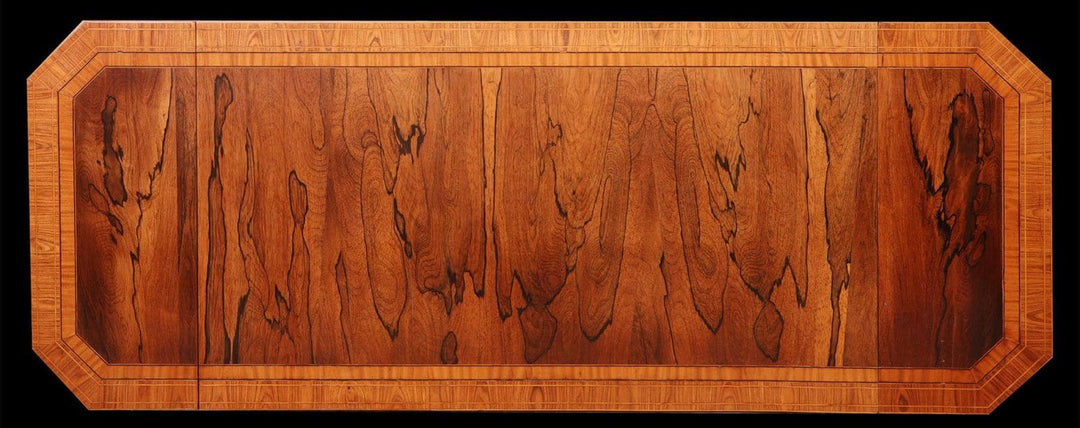
The Regency era’s fascination with the ancient world was expressed through a rigorous selection of materials that could sustain the intricate demands of neoclassical motifs. Dense Cuban mahogany, prized for its exceptional weight and oil-rich consistency, served as the primary canvas for the era’s finest craftsmen. This timber allowed for the crisp, sculptural definition of lion’s paw feet and acanthus leaves that defined the classical antiquity influence on Regency design furniture. While mahogany provided the structural depth, the use of ebony inlays against the vibrant, swirling grains of rosewood or zebrawood created a dramatic chiaroscuro effect. These contrasts mirrored the polychromatic interiors of rediscovered Roman villas, where dark woods and bright metals suggested a world of imperial luxury.
- Cuban Mahogany: Its tight grain was essential for the "archaeological" precision of Greco-Roman carvings.
- Ebony and Zebrawood: These exotic timbers provided the high-contrast textures favoured by designers like Thomas Hope.
- Ormolu Accents: Gilt bronze mounts provided both structural protection and a sense of ancient opulence.
The Gilded Secret: Ormolu and Giltwood
The application of ormolu, or gilt bronze, was the Regency cabinetmaker’s method of replicating the bronze and gold accents of Greek and Roman furniture. These mounts were often the work of a master fondeur-ciseleur, who employed mercury gilding to achieve a lustrous, enduring finish that mimicked ancient metalwork. Beyond their aesthetic appeal, these mounts protected vulnerable corners and edges from daily wear. This commitment to imperial grandeur is equally visible in our antique mirrors collection, where gilded classical frames act as architectural portals within a room. The precision of these mounts, often featuring laurel wreaths or sphinxes, demonstrates a scholarly commitment to archaeological accuracy that elevated furniture into the realm of fine art.
Conservation of History and the Unique Antique Surface
A fine antiques dealer recognises that the value of a piece lies in its history, which is most legibly written in its surface patina. This thin layer of oxidation and wax, built up over two centuries, provides a depth of colour that modern finishes cannot replicate. At Nicholas Wells Antiques, we prioritise the conservation of history over aggressive restoration. Over-polishing a piece strips away the "soul" of the object, removing the evidence of its 200-year journey. Sympathetic restoration involves stabilising the structure while preserving the unique antique surface. It’s this gentle approach that maintains the integrity of the work, ensuring that the piece remains a significant cultural artefact for future generations. Collectors today value this "unbroken" history, as it connects the modern interior directly to the workshops of 1810.
To view our curated selection of historically significant pieces, we invite you to visit our antiques showroom by appointment at 169 Piccadilly, London.
Acquiring the Extraordinary: A Collector’s Guide to Regency Provenance
Identifying high-quality Regency furniture requires an eye for the subtle nuances of craftsmanship that define the early 19th century. The classical antiquity influence on Regency design furniture is most evident in the precision of the carved anthemion motifs and the crispness of bronze-green patinated finishes. A fine antiques dealer looks for the density of the mahogany and the original surface patina that has matured over 200 years. During the 2023 London auction season, pieces with documented histories saw a 30% valuation increase compared to anonymous examples. Provenance serves as the ultimate validator; it transforms a domestic object into a significant cultural artifact. Collectors should prioritise items with a clear lineage, such as those originating from architect-designed estates or noted 19th-century collections.
- Examine the quality of the ormolu mounts; they should be finely chased and fire-gilded.
- Look for structural integrity in the joinery, reflecting the standards of makers like Marsh and Tatham.
- Verify the "unique antique surfaces" that haven't been compromised by over-restoration.
- Seek out the classical antiquity influence on Regency design furniture through specific motifs like the kylix or the caduceus.
Investing in Antique Works of Art
Regency furniture remains a cornerstone for the distinguished English country house aesthetic. Approximately 65% of high-net-worth collectors now view these pieces as tangible assets that offer both aesthetic pleasure and long-term value. The rarity of "unique" items is a primary driver in the current market, where mass-produced luxury cannot compete with the soul of a hand-finished object. The Nicholas Wells Antiques furniture collection represents a premier destination for those seeking these scholarly pieces. By integrating these antique works of art into contemporary luxury interiors, designers create a sophisticated bridge between the grandeur of 1815 and the requirements of modern living.
The Nicholas Wells Service: Restoration and Shipping
Our commitment to the conservation of history ensures that every acquisition maintains its historical integrity. We provide expert restoration as part of our service, focusing on preserving the surface patina and the delicate balance of original materials. As a specialist UK antique dealer international shipping provider, we manage the secure transit of luxury antiques to private collectors across the globe. Whether shipping a French giltwood mirror to a New York penthouse or a Georgian sideboard to a villa in Tuscany, our logistics team treats every object with reverence. We invite you to visit antiques showroom by appointment at our gallery located at 169 Piccadilly in Mayfair to experience these extraordinary pieces first-hand. Our curated environment allows you to appreciate the texture, weight, and scholarly significance of the finest decorative antiques available today.
Securing a Piece of Architectural History
The evolution of British interiors during the early 19th century remains a testament to the enduring classical antiquity influence on Regency design furniture. By moving beyond the delicate grace of the Georgian era, designers like Thomas Hope embraced a more rigorous, scholarly interpretation of Greek and Roman forms. This era's obsession with archaeological accuracy, fuelled by the 18th-century Grand Tour, transformed mahogany and ormolu into timeless cultural artefacts that retain their magnificent surface patina today.
Since our establishment in London in 2012, Nicholas Wells Antiques has remained dedicated to the conservation of history through these extraordinary pieces. We invite you to explore our curated collection of fine Regency furniture and Grand Tour objects at our Mayfair showroom, located at 169 Piccadilly. Every acquisition includes fully insured worldwide shipping and complimentary restoration by our expert craftsmen. Whether you're seeking a rare specimen or a distinguished focal point for a contemporary interior, our expertise ensures your collection reflects the highest standards of connoisseurship. We look forward to welcoming you by appointment to view these antique works of art in person.
Frequently Asked Questions
How does classical antiquity differ from Neoclassicism in Regency furniture?
Classical antiquity refers to the direct, archaeological imitation of ancient Greek, Roman, and Egyptian forms, whereas Neoclassicism often filtered these motifs through a more decorative, 18th-century lens. Regency designers after 1800 sought a more rigorous accuracy, moving away from the delicate interpretations of Robert Adam toward the structural weight found in 1st-century Roman stone furniture. This shift prioritised the literal recreation of ancient silhouettes over mere surface ornamentation.
What are the most common classical motifs found on Regency tables?
The most frequent motifs include the anthemion, acanthus leaves, and the Greek key pattern, often executed in high-quality ormolu or brass inlay. Many pieces feature monopodia legs, which are single supports ending in a lion's paw or griffin's foot, inspired by 1st-century marble supports. These elements reflect the profound classical antiquity influence on Regency design furniture, providing a structural grandeur that defines the era's aesthetic for the discerning collector.
Why was mahogany the preferred wood for Regency designers?
Mahogany was favoured because its dense grain allowed craftsmen to achieve the crisp, intricate carving required to replicate Greco-Roman details without sacrificing structural integrity. Between 1750 and 1830, the import of "Spanish" mahogany from Cuba provided a deep, lustrous surface that took a high polish beautifully. This timber perfectly complemented the gilt-bronze mounts that were fashionable in Mayfair townhouses during the early 19th century, ensuring both durability and prestige.
How can I identify an authentic Thomas Hope design?
Authentic Thomas Hope designs are identified by their strict adherence to the principles laid out in his 1807 publication, Household Furniture and Interior Decoration. You should look for Egyptian motifs like sphinxes or priestesses, alongside a specific use of bronze-green paint intended to simulate ancient patinated copper. Pieces often possess a massive, sculptural quality that prioritises historical accuracy, a hallmark of the exceptional items found at a fine antiques dealer.
What role did the Grand Tour play in the development of the Regency style?
The Grand Tour acted as the primary catalyst for the Regency style as British aristocrats returned from Italy and Greece with 1st-century sculptures and 4th-century BC vases. These collections necessitated a new architectural language to house them, leading designers to create "archaeological" interiors. By 1810, this influx of ancient artefacts had shifted British taste from French-influenced styles toward a more austere, masculine classicism that celebrated the origins of Western art.
Is it possible to integrate Regency antiques into a modern interior?
Regency antiques integrate seamlessly into modern interiors by serving as sophisticated, sculptural focal points against minimalist backdrops. The clean lines and architectural weight of the classical antiquity influence on Regency design furniture allow a 19th-century mahogany library table to balance contemporary art perfectly. At our showroom at 169 Piccadilly, we frequently assist clients in selecting singular pieces that bridge the gap between historical grandeur and 21st-century luxury living.
What should I look for when evaluating the surface patina of a Regency piece?
You should look for a "skin" that has developed through 200 years of natural oxidation and meticulous waxing. An authentic Regency surface should possess a soft, non-reflective glow and a depth of colour that modern refinishing cannot replicate. Avoid pieces that appear overly bright or "stripped," as the conservation of history and the preservation of unique antique surfaces are paramount to maintaining the long-term value of luxury antiques.
Does Nicholas Wells Antiques offer international shipping for large furniture items?
Nicholas Wells Antiques provides comprehensive international shipping for all large furniture items, including monumental mirrors and Georgian mahogany sideboards. As a UK antique dealer international shipping specialist, we employ professional art handlers to ensure safe transit to North America, Asia, and Europe. We invite clients to visit our antiques showroom by appointment in Piccadilly to discuss the specific logistics and bespoke crating requirements for their acquisitions.


Leave a comment