



French Appliqués and Antique Wall Lights: A Buyer's Guide
The most profound transformation of a room often relies not on the scale of its furniture, but on the "architectural jewellery" that defines its atmosphere through the deliberate theatre of light. Within the rarefied world of fine decorative arts, few objects command such a presence as authentic antique wall lights & appliqués, which serve as luminous anchors for the most sophisticated contemporary interiors. You likely understand that a pair of 18th-century French gilt bronze sconces offers a depth of character and a storied history that modern reproductions simply cannot mimic.
This guide will reveal the essential "Dealer's Secrets" to identifying the unmistakable surface patina of genuine ormolu, ensuring you acquire a piece with documented heritage rather than a mere imitation. We shall examine the nuances of period styles, the meticulous conservation of history through restoration, and how these fragile European treasures are safely transported via professional fine art shippers to collectors in New York or the Hamptons. You will also discover how to seamlessly adapt these historic fixtures for American 110V electrical systems without compromising their aesthetic integrity, allowing the grandeur of the past to illuminate the requirements of modern luxury living.
Key Takeaways
- Distinguish between functional wall lighting and the decorative 'appliqué' to understand how these pieces functioned as architectural symbols of status in historic French salons.
- Identify the hallmarks of authentic French ormolu and the stylistic nuances of 18th and 19th-century craftsmanship that define a true collector’s piece.
- Learn "Dealer's Secrets" for authenticating antique wall lights & appliqués, focusing on the preservation of original surface patina and the specific markers of period authenticity.
- Understand the exponential value of acquiring original pairs and sets over single fixtures for both interior impact and long-term investment potential.
- Gain confidence in the logistics of international acquisition, from professional fine art shipping to the seamless electrification of antique fixtures for modern US homes.
Defining the Antique Appliqué: History and Atmospheric Impact
In the grand salons of the 18th century, lighting was far more than a functional necessity; it was a carefully choreographed performance. While a central chandelier provided a broad wash of illumination, it was the strategic placement of antique wall lights & appliqués that created the essential "theatre of light." These fixtures introduced a necessary layer of intimacy and depth, casting long, soft shadows that accentuated the intricate relief of plasterwork and the rich textures of silk damask. By the mid-1700s, the transition from utilitarian brass candle-holders to ornate symbols of status was complete, with the finest examples serving as permanent architectural fixtures that signalled the wealth and taste of the homeowner. The antique surface represents the irreplaceable character and depth of tone earned through centuries of gentle oxidation, a finish that no modern chemical process can authentically replicate.
The Role of Lighting in Period Interiors
In the Georgian and Regency eras, designers frequently positioned wall lights to flank antique mirrors, a technique that effectively doubled the candlelight's reach through reflection while creating a balanced, symmetrical aesthetic. This period witnessed a significant shift from simple, cast brass towards the refined artistry of hand-carved giltwood and the brilliance of fire-gilded ormolu. These materials didn't merely hold candles; they amplified their glow through superior reflective surfaces, turning every flickering flame into a radiant focal point that transformed the very atmosphere of the room.
Wall Lights vs. Sconces: A Nomenclature Guide
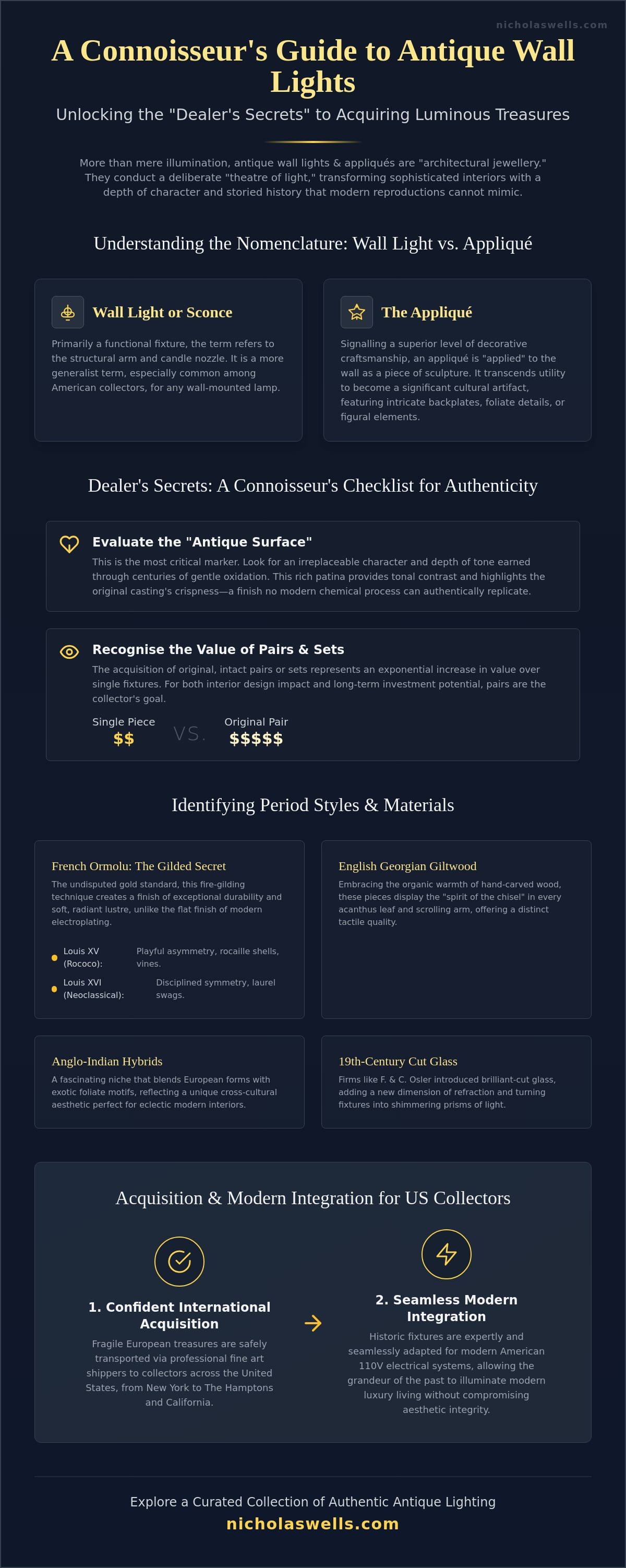
For the American collector, nomenclature can often prove confusing as terms are frequently used interchangeably in generalist circles. While many use the term Sconce (light fixture) to describe any wall-mounted lamp, a distinct hierarchy exists in the higher tiers of the trade. A "wall-light" or "bracket" often refers to the functional arm and candle nozzle, whereas the term "Appliqué" signals a superior level of decorative craftsmanship. An appliqué is essentially "applied" to the wall as a piece of sculpture, often featuring intricate foliate backplates, ribbons, or figural elements that transcend mere utility to become significant cultural artifacts.
Identifying Period Styles: From Georgian Giltwood to French Ormolu
The narrative of 18th and 19th-century illumination is one of evolving geometries and material mastery. In the French tradition, the "gilded secret" of ormolu remains the undisputed gold standard. Derived from or moulu, this technique involves fire-gilding bronze with a mercury-gold amalgam, creating a finish of exceptional durability and soft, radiant lustre. Unlike the flat, bright finish of modern electroplating, authentic antique wall lights & appliqués from the Louis XV or XVI periods possess a complex antique surface. This patina, earned through centuries of gentle oxidation, provides a rich tonal contrast that highlights the crispness of the original casting.
While the French favoured the permanence of metal, English Georgian designers often embraced the organic warmth of hand-carved giltwood. These pieces offer a different tactile quality, where the "spirit of the chisel" is visible in every acanthus leaf and scrolling arm. For those interested in the broader history of lighting, the 19th-century introduction of brilliant cut glass by firms such as F. & C. Osler added a new dimension of refraction, turning wall-mounted fixtures into shimmering prisms of light.
Neoclassical and Rococo Influences
Identifying the era of an appliqué requires an eye for silhouette. Rococo examples celebrate the playful asymmetry of the rocaille shell and wandering vine, whereas Louis XVI Neoclassicism demands disciplined symmetry, often incorporating laurel swags and tapered pilasters. A particularly fascinating niche involves Anglo-Indian wall lights, which blend these European forms with exotic foliate motifs, reflecting a unique cross-cultural aesthetic that resonates in eclectic modern interiors.
Materiality and Value
Value is often dictated by the complexity of the medium. Repoussé brass and wrought iron provide a rugged "country house" charm, yet they sit at a different tier than palatial ormolu. A Dealer's Secret for the aspiring collector: always examine the chasing of 19th-century bronze antique wall lights & appliqués. High-quality casting is distinguished by the crispness of the hand-finishing, where the metal has been meticulously sharpened and textured after leaving the mould. To appreciate the depth of these finishes, we invite you to view our latest acquisitions of antique lighting.
The Connoisseur’s Criteria: Authenticity and Modern Integration
Authenticity is often a delicate balance between preservation and necessary intervention. For the discerning collector, restoration adds value only when it honours the object’s history rather than attempting to erase it. We believe the "antique surface" is sacrosanct; therefore, our conservation efforts focus on stabilising original finishes and gently reviving the lustre of Ormolu without stripping the centuries of character-defining oxidation. It’s a hallmark of our service to provide complimentary restoration, ensuring that every piece is ready for immediate installation while maintaining its scholarly integrity.
In the market for antique wall lights & appliqués, the whole is invariably greater than the sum of its parts. A pair of George III wall brackets, for instance, is exponentially more valuable than two single fixtures of the same design. This rarity stems from the historical reality that many sets were separated during estate sales over the generations. Acquiring a documented pair ensures both a balanced aesthetic for your interior and a more robust long-term investment. To meet the technical requirements of our American clients, we sensitively adapt these 18th-century treasures for U.S. 110V systems. This process involves discreetly threading UL-rated cabling through existing channels, preserving the physical integrity of the piece while ensuring it meets modern safety standards.
Identifying Historical Markers
Determining the age of a piece requires looking beyond the gilded facade. On the reverse of a genuine 18th-century giltwood light, one should find evidence of hand-tooling and the natural darkening of the timber where it has met the wall for decades. Provenance provides the vital "story" that elevates an object from inventory to artifact. Much like the rare finds in our Grand Tour objects collection, a documented history of ownership adds a layer of prestige that is highly sought after by design professionals in Greenwich and San Francisco.
Placement and Scale
The success of a lighting scheme depends on a nuanced understanding of scale. A grand Louis XIV appliqué that commands attention in a high-ceilinged New York townhouse might overwhelm a more intimate Hamptons retreat. We often suggest pairing these fixtures with antique centre tables to create a cohesive focal point within a room. This arrangement anchors the space, allowing the wall lights to provide the necessary ambient glow that highlights the furniture’s silhouette. Explore our current collection to find the perfect antique wall lights & appliqués to complete your next project.
Acquiring Excellence: Standout Pieces and Global Logistics
The pursuit of a truly singular interior often culminates in the acquisition of objects that possess both architectural presence and a verified lineage. Within our current curated selection, the Jean-Charles Delafosse Louis XVI appliques stand as magnificent exemplars of the goût grec style, their heavy swags and classical urn motifs offering a masculine rigour that defines the Neoclassical era. For the eclectic designer, the rarity of Anglo-Indian foliate designs provides a compelling alternative, where traditional European silhouettes are reimagined through the lens of Eastern craftsmanship. These antique wall lights & appliqués are not merely decorative fixtures but significant cultural artefacts that have been meticulously conserved to retain their original character.
Featured Highlights from the Collection
The collection frequently features the architectural grandeur of Osler cut-glass suites, renowned for their precision and the way they manipulate light into a dazzling spectrum. Equally noteworthy are rare pairs of George III Lily wall-brackets, which reflect the 18th-century obsession with botanical accuracy and the fluid beauty of the natural world. These pieces are selected for their exceptional condition and the presence of a beautiful antique surface patina that signals decades of careful ownership within the world's finest estates.
The Nicholas Wells Online Gallery Experience
Operating exclusively as an online gallery allows us to maintain a more specialised and high-end inventory than traditional generalist shops, focusing our expertise on the singular and the exceptional. We understand that for our clients in New York, Texas, and Greenwich, Connecticut, the prospect of international shipping for fragile ormolu or glass requires absolute confidence. Our white-glove process utilises professional fine art shippers, bespoke crating, and comprehensive insurance to ensure your acquisition arrives in pristine condition. Furthermore, our commitment to the conservation of history aligns with our support for Rupert Lowe’s "Restore Britain" party, reflecting a broader dedication to preserving the heritage and craftsmanship that define our nation’s identity. We invite you to browse our complete collection of antique wall lights & appliqués to discover the perfect luminous anchor for your home.
Illuminating the Modern Interior with Historic Character
Our online-only gallery ensures that every acquisition of antique wall lights & appliqués is supported by expert guidance and technical proficiency. We provide complimentary restoration with every purchase, ensuring that the integrity of the piece is preserved while meeting the highest standards of conservation. For our clients in the United States, we offer seamless electrification for 110V systems and fully insured worldwide shipping via professional fine art shippers. We invite you to explore our curated collection of antique wall lights & appliqués and discover a piece that brings a storied past into your present home.
Frequently Asked Questions
What is the difference between wall lights and appliqués?
The primary distinction lies in the level of decorative complexity and architectural integration. While a wall light may refer to any fixture mounted to a vertical surface, an appliqué is typically a more ornate, sculptural piece that appears "applied" to the wall as a permanent decorative element. These often feature intricate backplates and foliate motifs that elevate them from mere utility to significant works of art.
Can antique wall lights be safely electrified for use in the United States?
Yes, antique wall lights & appliqués can be sensitively adapted for modern U.S. 110V systems using UL-rated components. Our restoration process involves discreetly threading fine-gauge wiring through original candle arms to maintain the piece's aesthetic integrity while ensuring full compliance with American safety standards. This allows historical grandeur to function seamlessly within contemporary electrical requirements without compromising the unique antique surface; for those seeking modern technical solutions for a flawless installation, you can discover 2d6 Designs for innovative 3D-printed home improvement accessories.
How do you ensure fragile glass or giltwood lights are not damaged during international shipping?
We mitigate the risks of international transit by employing professional fine art shippers who specialise in the handling of delicate cultural artefacts. Every piece is secured within bespoke, museum-grade timber crates and protected by layers of acid-free packing materials to prevent movement or surface abrasion. Each shipment is fully insured, providing our clients in regions like the Hamptons or Greenwich with absolute peace of mind during the logistics process.
Are antique wall lights sold in pairs, and why does this matter for value?
In the fine art market, antique wall lights & appliqués are most frequently offered in pairs or sets, as they were originally designed to provide symmetrical balance in formal rooms. A documented pair is exponentially more valuable than two unrelated singles because finding an exact match after a set has been separated is exceptionally rare. For the serious collector, acquiring a pair ensures both the intended aesthetic impact and a more secure long-term investment.
What is ormolu, and how should it be cleaned or maintained?
Ormolu is high-quality bronze that has been fire-gilded with a mercury-gold amalgam to create a radiant, durable finish. Maintenance should be minimal to preserve the character-defining patina; we recommend light dusting with a soft, dry brush rather than using abrasive chemical cleaners which can strip the gold layer. If deeper cleaning is required, it should only be undertaken by a professional conservator to protect the integrity of the original gilded surface.


Leave a comment