



Georgian Bookcases Explained: The Cabinet That Became a Design Icon
To the 18th-century eye, a grand Georgian bookcase was never merely a repository for leather-bound volumes; it was a deliberate exercise in classical architecture, scaled with mathematical precision to anchor the drawing room. We understand that for the modern connoisseur, the allure of these towering mahogany structures is often tempered by the daunting realities of the international market. You recognise the investment value of a piece with documented provenance, yet the fear of overpaying for a late 19th-century reproduction or misjudging the nuances of period glazing can be a significant barrier to acquisition.
In this guide, we'll share the professional secrets of authentication that we use when sourcing for our own gallery, helping you navigate everything from the specific grain of Swietenia species to the intricacies of the Lacey Act. You'll learn how to identify the subtle markers of 18th-century craftsmanship and understand the seamless process of shipping fine antiques from the UK to the United States. By the end of our exploration, you'll possess the technical knowledge and logistical confidence required to welcome a genuine Georgian icon into your home.
Key Takeaways
- Trace the architectural evolution of the Georgian bookcase from heavy Baroque influences to the refined Palladian symmetry that came to define the 18th-century library.
- Learn to recognise the hallmark of a true investment piece by identifying original crown glass and the "crusty," undisturbed surface patina prized by seasoned collectors.
- Master the stylistic nuances of the era’s greatest cabinetmakers, from the robust rococo carvings of Chippendale to the graceful satinwood inlays favoured by Hepplewhite.
- Discover how to anchor a contemporary New York townhouse or Texas estate with a grand mahogany breakfront, successfully bridging the gap between historical grandeur and modern luxury.
- Understand the logistics of international acquisition, including how we utilise professional fine art shippers to ensure the secure delivery of exquisite furniture from the UK to the United States.
Defining the Georgian Bookcase: Form, Function, and the 18th Century Library
The Georgian bookcase stands as a profound testament to the Enlightenment, an era when the pursuit of knowledge required a vessel as sophisticated as the ideas it contained. In our work as specialist dealers, we often view these pieces not as mere storage, but as architectural monuments scaled for the interior. During the early 18th century, designs began to shed the heavy, exuberant ornamentation of the Baroque period. They favoured instead the disciplined symmetry of the Palladian movement. This shift mirrored a broader cultural desire for balance and reason. It was during this time that the "Golden Age of Mahogany" began. Dense, richly figured timber from the West Indies replaced the lighter oak and walnut of previous generations. The library became the intellectual pulse of the English country house, a space where a grand mahogany cabinet served as the ultimate symbol of status and scholarship.
The Evolution of the Library Bookcase
As the printing press democratised literature, the scale of furniture evolved to meet the growing volume of private collections. What began as modest chests transformed into towering, floor-to-ceiling installations. The introduction of glazed doors was a pivotal moment in the history of the Georgian bookcase. These glass panes weren't just functional shields against dust. They were expensive displays of wealth. They allowed owners to showcase curated libraries while protecting delicate calfskin bindings within. It's a design that remains as practical today as it was in 1750.
The Secretaire and the Bureau: Multipurpose Masterpieces
Innovation in antique cabinet furniture often focused on the marriage of utility and discretion. The secretaire bookcase, with its ingenious fall-front or pull-out drawer, provided a private sanctuary for correspondence within a public room. This duality allowed a gentleman to manage his estate or engage in private thought at a moment's notice. The influence of designers like Thomas Chippendale ensured these pieces remained elegant, even when performing the rigorous duties of a working office. It's this blend of social theatre and practical necessity that makes the Georgian era so compelling for the modern collector.
Masterworks in Mahogany: Distinguishing Styles from Chippendale to Sheraton
The aesthetic trajectory of the Georgian bookcase is a narrative of increasing refinement, moving from the robust flourishes of the mid-18th century to the delicate Neoclassicism of the late period. Each master cabinetmaker left an indelible mark on the form, ensuring that no two pieces from this era are truly identical. We find that the most significant examples are those that balance structural integrity with the artistic whims of their time. If you're beginning your journey into the world of high-end collecting, we invite you to explore our current antique furniture collection for examples of these distinct periods.
- The Chippendale Influence: Characterised by elaborate rococo carvings and "Chinese" fretwork, these pieces often feature the iconic thirteen-pane glazing pattern, a hallmark of mid-century sophistication.
- The Hepplewhite Aesthetic: A transition toward lighter, more graceful proportions, often incorporating contrasting satinwood inlays to highlight the deep hues of the mahogany.
- The Sheraton Refinement: This style embraced Neoclassical restraint, opting for strictly rectilinear forms and the use of exceptionally fine veneers to create a sense of quiet luxury.
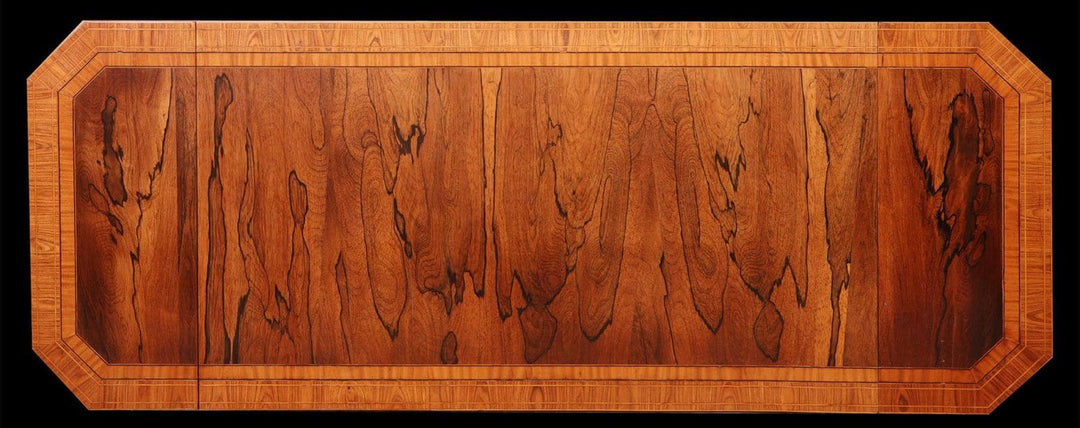
- Regency Transitions: As the 19th century approached, the style evolved to include brass inlays, the use of exotic rosewood, and bold Egyptian motifs that reflected Britain's expanding global influence.
The Breakfront Bookcase: A Study in Symmetry
The breakfront is perhaps the most imposing iteration of the Georgian bookcase. It's defined by a protruding central section that breaks the linear plane, creating a sense of architectural depth and grandeur. It's a study in balance. The central section steps forward, demanding attention while maintaining the overall harmony of the room. These large-scale pieces were originally designed to serve as the singular focal point for grand English libraries or dining rooms, anchoring the space with their undeniable presence.
Glazing Patterns and Astragal Mouldings
One of the most delicate features of any period cabinet is the glazing. The intricate wood lattice, known as astragals, serves to hold individual panes of hand-blown crown glass in place. These mouldings are often incredibly slender, yet they provide the essential structural framework for the upper doors. The complexity of a glazing pattern often correlates directly with the status and cost of the original commission.

Dealer’s Secrets: Authenticating Surface, Patina, and Period Glazing
In our experience as a luxury antiques dealer, we've found that the most profound value of a Georgian bookcase often lies in what hasn't been done to it. A truly exceptional piece retains its "crusty" 18th-century surface. This undisturbed patina, a result of centuries of gentle oxidation and wax polishing, is far more desirable than the glassy, sterile finish of a modern French polish. When we acquire a piece, we look for the narrative written in the timber itself. We examine the hand-cut dovetails and the secondary timbers. During the 18th century, high-quality pieces typically featured drawers lined with slow-grown English oak, a mark of uncompromising standards that distinguishes them from lesser examples.
One of our favourite dealer's secrets involves the glazing. Period crown glass is never perfectly flat. If you look at a door from an oblique angle, you should see subtle ripples and the occasional "seed" or bubble trapped within the pane. These imperfections catch the light in a way that modern float glass simply cannot replicate. If the glass looks too perfect, it's likely a later replacement. We also prioritise pieces with original locks and brasses, as these details contribute significantly to the historical integrity and commercial value of the cabinet.
The Conservation of History
Our approach to stewardship involves the careful conservation of history. We provide complimentary restoration that focuses on structural integrity while preserving the inherent character of the piece. It's vital to distinguish between "restored" and "refurbished." A refurbished piece has often been stripped of its soul, whereas a correctly restored antique maintains its historical dignity. If you're seeking a statement piece with documented provenance, view our expertly curated selection of Georgian bookcases.
Common Pitfalls for the Unwary Collector
Collectors should be mindful of "married" pieces. This occurs when a top and bottom from two different cabinets are joined to create a single unit. We look for inconsistencies in the timber grain or slight misalignments in the mouldings to spot these hybrids. We also frequently encounter 19th-century "Centennial" reproductions. While these are often well-made, they lack the investment value of a period original. To ensure your acquisition reaches you in pristine condition, we coordinate every detail with professional fine art shippers, making the journey from the UK to homes in the Hamptons or Greenwich entirely seamless.
Acquiring and Integrating Georgian Masterpieces into the Modern Interior
Integrating a Georgian bookcase into a contemporary interior requires an appreciation for scale and a curator’s eye for balance. While these pieces were conceived for the vast libraries of the English Enlightenment, they possess a versatile architectural language that translates perfectly to a Manhattan townhouse or a sprawling Texas estate. The sheer height and presence of a breakfront cabinet can transform a room, providing a sense of permanence that mass-produced furniture simply cannot offer. We've seen these grand structures thrive when placed against minimalist backdrops, where the rich, figured mahogany serves as a warm, organic counterpoint to modern architecture.
Placement Strategies for Interior Designers
Designers often use these cabinets to flank a fireplace, creating the rigorous symmetry so favoured by Palladian architects. Alternatively, a large-scale piece can serve as a sophisticated room divider in an open-plan living space, defining the transition between a dining area and a library. We recommend styling the shelves with a curated mix of leather-bound volumes and Grand Tour objects to create a layered, narrative aesthetic. Pairing the dark timber with fine antique mirrors or vibrant modern art creates a compelling dialogue between the 18th century and the present day.
The Logistics of International Acquisition
We understand that for our American clients, the logistics of acquisition are as important as the object itself. We manage the entire process, from the initial purchase to white-glove delivery in San Francisco or the Hamptons. Every Georgian bookcase is secured in a custom-made, fully insured wooden crate for its journey across the Atlantic. While the 10% baseline tariff introduced in February 2026 is now a standard consideration for UK imports, the antique status of these pieces, specifically those over 100 years old, remains a vital distinction for customs clearance. We handle all documentation, including the necessary Lacey Act declarations, to ensure a seamless arrival at your door.
Beyond their aesthetic merit, these pieces remain blue-chip assets in the decorative arts market. A high-quality example with undisturbed patina and clear provenance is a tangible store of value. It's a legacy piece. It offers both daily utility and long-term investment potential, standing as a singular icon of British craftsmanship in the modern home.
Securing Your Own 18th-Century Architectural Icon
Acquiring a genuine Georgian bookcase represents more than a simple purchase; it's an act of stewardship for a significant cultural artifact. We've explored the profound importance of an undisturbed surface patina and the delicate ripples of period crown glass, details that separate a true masterwork from a mere reproduction. Whether you seek to anchor a room with the architectural symmetry of a grand breakfront or the refined Neoclassicism of a Sheraton design, these cabinets offer a timeless bridge between historical grandeur and modern luxury living.
Our specialist expertise in 18th-century English furniture ensures that every piece we source meets the highest standards of rarity and condition. We provide complimentary professional restoration on all items to preserve their inherent character, followed by fully insured worldwide shipping to our clients across the United States. We invite you to explore our curated collection of fine Georgian bookcases and cabinet furniture to find a singular piece that resonates with your personal aesthetic. There's no greater pleasure than watching a historic icon find its rightful place in a contemporary home.
Frequently Asked Questions
How can I tell if a Georgian bookcase has its original glass?
You can identify original 18th-century glazing by observing the glass from an oblique angle to catch the light. Period crown glass is never perfectly flat; it features subtle ripples, "seeds," or tiny air bubbles trapped within the pane. Modern float glass lacks these characterful distortions. If the surface appears too uniform or lacks these historical imperfections, the glass has likely been replaced in more recent years.
What is the difference between a bureau bookcase and a secretaire bookcase?
The primary distinction lies in the mechanism of the writing surface. A bureau bookcase features a traditional sloping fall-front that opens to reveal a fitted interior of pigeonholes and small drawers. In contrast, a secretaire bookcase often disguises its function as a standard drawer. This drawer pulls out and the front drops down to create a desk, offering a more rectilinear and discreet silhouette than the sloped bureau.
Is mahogany the only wood used in Georgian bookcases?
While mahogany was the dominant timber during the mid-18th century, early examples of the Georgian bookcase were often crafted from walnut or oak. As tastes evolved toward the end of the century, cabinetmakers began incorporating exotic satinwood for delicate inlays and veneers. By the Regency period, rosewood became a popular choice for its dark, dramatic grain, often accented with brass or ebony details.
How do you ship large antique bookcases to the United States?
We manage the transit of large case pieces by using custom-built, fully insured wooden crates designed to withstand international travel. Our professional fine art shippers coordinate white-glove delivery directly to your home in regions like the Hamptons or Greenwich. Since these pieces are documented as being over 100 years old, they typically qualify for duty-free entry into the United States under the antique exemption.
What should I look for in the patina of an 18th-century piece?
A desirable patina on a Georgian bookcase should possess a deep, lustrous quality that only centuries of wax and natural oxidation can produce. We look for an "undisturbed" surface that hasn't been stripped by aggressive restoration. This "crusty" texture in the crevices and the mellowed colour of the timber provide a historical depth that is impossible to replicate with modern chemical polishes.


Leave a comment