



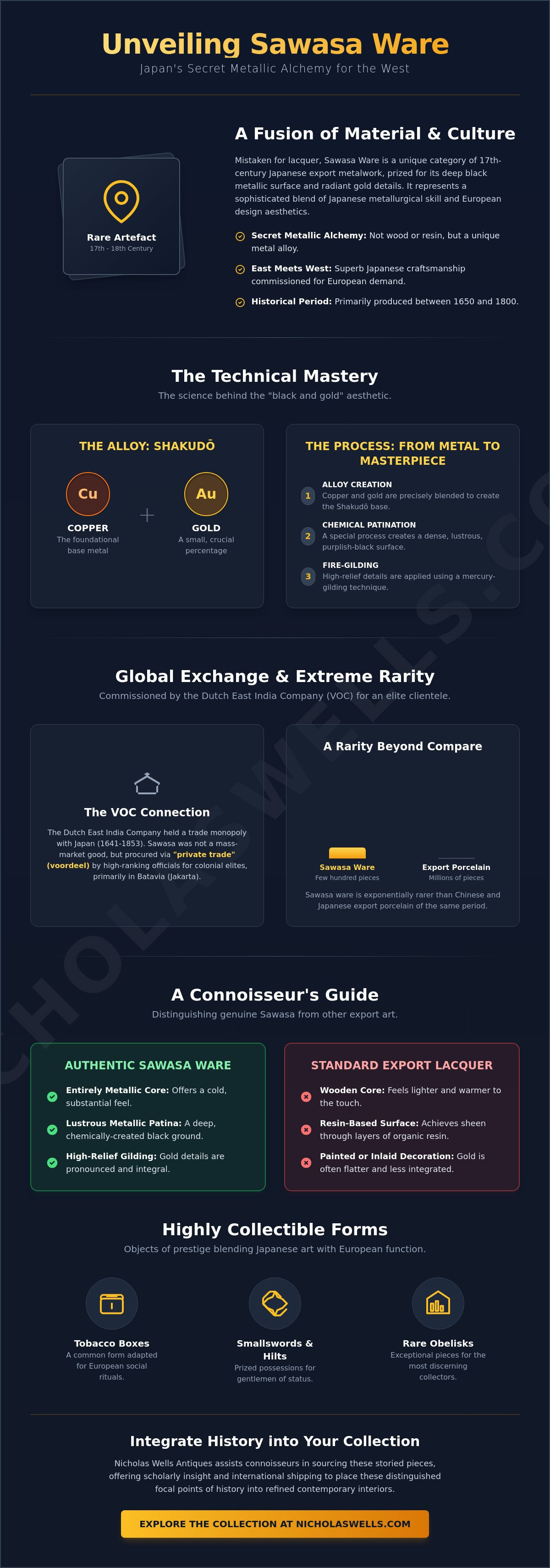
Sawasa Ware: The Rare Alchemy of Japanese Black and Gold Metalwork
The most coveted black surfaces in 17th-century European collections weren't made of wood and resin, but of a secretive metallic alchemy known only to a few. Sawasa Ware represents a singular moment in the history of decorative arts where superb Japanese craftsmanship met European demand through the Dutch East India Company, established in 1602. At Nicholas Wells Antiques, we understand the difficulty collectors face when encountering pieces that are frequently misidentified as simple lacquer in the trade. It's a sentiment shared by those who appreciate the preservation of a unique antique surface and the weight of provenance. This article promises to reveal the history, intricate metallurgy, and collector's appeal of these rare objects.
We'll provide the essential framework needed to identify authentic 18th-century patina, ensuring you can distinguish genuine pieces from later imitations while understanding the specific alchemy of gold, copper, and arsenic. Whether you're browsing our online gallery for Regency furniture or arranging a private appointment at our London showroom near Mayfair and Piccadilly to view rare obelisks, this exploration offers the expertise required to curate these distinguished artefacts, all benefiting from our international shipping services.
Key Takeaways
- Explore the sophisticated aesthetic of Sawasa Ware, a rare category of 17th-century export metalwork that represents the pinnacle of artistic exchange between Japan and the West.
- Understand the pivotal role of the Dutch East India Company (VOC) in commissioning these magnificent objects, which remain some of the most sought-after treasures for the discerning collector.
- Gain scholarly insight into the complex metallurgy of shakudo and the meticulous fire-gilding process that creates the deep, lustrous patina characteristic of these superb artifacts.
- Identify highly collectible forms—ranging from delicate tobacco boxes to rare smallswords—and learn how to evaluate their condition and historical provenance.
- Discover how Nicholas Wells Antiques assists connoisseurs in integrating these storied pieces into refined contemporary interiors as distinguished focal points of history.
What is Sawasa Ware? Defining the "Black and Gold" Aesthetic
The allure of Sawasa Ware lies in its paradoxical nature, combining the somber depth of midnight with the radiant flash of high-karat gold. Produced primarily for the Dutch East India Company between 1650 and 1800, this unique class of Asian export metalwork represents a sophisticated fusion of Japanese metallurgy and European form. While traditional lacquerware achieves its sheen through layers of organic resin, Sawasa relies on the permanence of metal. The foundational material is Shakudō, a distinguished alloy of copper and small percentages of gold. This alloy undergoes a precise chemical patination process to create a dense, lustrous black ground that serves as the perfect stage for high-relief mercury gilding. The resulting objects, from tobacco boxes to sword hilts, possess a tactile weight and a superb surface quality that distinguishes them from the more common ormolu seen in Regency or Georgian interiors.
The Etymology and Origins of the Term
Modern scholars and dealers, including those of us at Nicholas Wells Antiques, have worked to bring clarity to the confusing nomenclature of the 1700s. The term Sawasa likely traces back to the Southeast Asian word "suasa," which referred to a similar gold-copper alloy used in the region. In 18th-century European inventories, these pieces were often obscured by vague descriptions like "black and gold Japan work" or simply "metal lacquer." By establishing Sawasa as the definitive category, we help collectors identify the extraordinary craftsmanship that defines these objects. At our gallery, which is available to visit by appointment in the heart of London, we treat these items as significant cultural artifacts rather than mere inventory. This scholarly approach ensures the provenance and soul of each piece are fully understood before they join a private collection.
Distinguishing Sawasa from Standard Export Art
Distinguishing Sawasa from standard export art requires a keen eye for material and patina. Unlike the more ubiquitous Namban lacquer, which uses a wooden core, Sawasa is entirely metallic, offering a cold, substantial feel in the hand. This tactile difference is vital for the connoisseur who values the preservation of the unique antique surface. While 18th-century trade routes were flooded with millions of porcelain pieces, the production of Sawasa was remarkably limited. It's accurate to say that Sawasa Ware is exponentially rarer than export porcelain, with only a few hundred significant pieces known to exist in major museum collections today. For those seeking a unique focal point within a collection of works of art asian oriental, Sawasa offers an unparalleled blend of history and aesthetic power. Our commitment to international shipping ensures these rare treasures can find their place in distinguished homes across the globe, from Mayfair to Manhattan.
The VOC Connection: A Story of Global Exchange and Rarity
The Dutch East India Company, or Vereenigde Oost-Indische Compagnie (VOC), held a singular monopoly on Western trade with Japan between 1641 and 1853. Operating from the fan-shaped artificial island of Dejima in Nagasaki harbour, Dutch merchants commissioned Sawasa Ware as a sophisticated hybrid of Japanese metalwork and European utility. While official VOC ledgers often prioritised bulk commodities like copper and camphor, Sawasa emerged through the voordeel, or private trade. This system allowed high-ranking officials to procure bespoke items that circumvented the company's rigorous commercial restrictions. It was a trade of prestige, not just profit.
As explored in the Rutgers Art Review, these objects were rarely destined for the mass European market. Instead, they served the aesthetic whims of the colonial elite in Batavia, known today as Jakarta. These governors and merchants sought objects that reflected their status, blending the exotic allure of the East with the functional requirements of Western social rituals. At Nicholas Wells Antiques, we view these pieces as more than decorative objects; they're tangible remnants of a complex maritime history. Our commitment to the preservation of the unique antique surface ensures that the delicate balance of gold and black patina remains undisturbed for the next generation of collectors.
Production Centres: From Nagasaki to Tonkin
Nagasaki served as the primary hub for early Japanese Sawasa. Here, local artisans combined traditional metalworking with shapes requested by the Dutch. By the late 17th century, production expanded to Canton and Tonkin. In Tonkin, specifically between 1680 and 1720, the style evolved significantly. While Nagasaki pieces often displayed delicate, low-relief floral patterns, Tonkin examples featured bolder, more sculptural motifs. This transition reflects the fluidity of the style as it moved through Asian trade ports, adapting to the available craftsmanship and local artistic sensibilities in each region.
The Failure of Consumption: Why Sawasa Remained Rare
Sawasa Ware never achieved the broad market penetration seen with Chinese export porcelain or Japanese lacquer. The production was simply too costly. The intricate process involved multiple stages of casting, gilding, and chemical patination that required weeks of labour for a single small item. By 1750, the high price point and the secretive nature of the private trade kept these objects within a very small circle. The European middle class, who were then enamoured with the bright colours of the Rococo, found the dark, sombre elegance of Sawasa too austere.
This historical scarcity defines its modern value. Collectors of Grand Tour souvenirs and rare metalwork recognise Sawasa as a connoisseur’s choice, prized for its impeccable provenance. It represents a rare intersection of cultures that was never diluted by mass production. If you wish to explore our current acquisitions, we invite you to view our Oriental works of art collection, where the soul of each object is preserved with the utmost care.
The Technical Mastery: Shakudo Metallurgy and Patination
The allure of Sawasa Ware lies in its metallurgical alchemy, a process that marries the precision of Japanese metalwork with the aesthetic demands of the 18th-century European elite. At the heart of this craft is shakudo, a sophisticated alloy traditionally composed of approximately 95% to 97% copper and 3% to 5% gold. This specific composition isn't merely for luxury; the gold serves as a catalyst during the patination process, allowing the metal to achieve a deep, lustrous black that remains unattainable with standard copper alloys. The gold highlights are achieved through mercury gilding, where a gold-mercury amalgam is applied to the relief and heated until the mercury evaporates. This fire gilding creates a bond so resilient it far surpasses the lifespan of contemporary lacquer or painted finishes.
The final, transformative step involves pickling the piece in a boiling chemical solution of copper sulphate and alum. This process draws out the raven-black finish that defines the medium. While the delicate layers of Japanese lacquer are susceptible to the fluctuations of humidity and temperature, Sawasa Ware possesses a metallic permanence. It's this durability that allowed these objects to survive centuries of maritime travel and domestic use without the cracking or degradation common in organic materials. These pieces were built to last, serving as functional yet magnificent status symbols for the global traveller.
The Importance of Surface Patina
In the world of high-end connoisseurship, the surface of a Sawasa piece is regarded as its soul. Nicholas Wells Antiques maintains a rigorous standard of preservation, ensuring that the original, uncleaned patina remains untouched by modern interventions. Over-polishing is a destructive act. It strips away the historical narrative and financial value of the object, removing the very skin that the 18th-century smiths worked so tirelessly to create. Collectors who acquire pieces through Nicholas Wells Antiques understand that a pristine, darkened surface is the ultimate mark of authenticity. An in-depth study on Sawasa Ware reveals how these surfaces were specifically designed to withstand the rigours of global trade while maintaining their regal appearance.
High-Relief Decoration and Motifs
The decorative vocabulary of Sawasa is a synthesis of East and West, where traditional Japanese motifs of peonies, cranes, and rugged landscapes are transposed onto European forms. One might encounter an 18th-century ewer or a tobacco box where the high-relief work is so intricate that it creates a three-dimensional narrative across the black ground. The relief work found on 18th-century examples often features meticulously chased details that capture the movement of water or the delicate veins of a leaf, showcasing a level of skill that places these items among the finest works of art in the global market. This fusion of Japanese craftsmanship with European forms created a category of luxury goods that remains a cornerstone of sophisticated London-based antique dealing, available to view at our gallery by appointment.
Identifying Rare Forms: From Tobacco Boxes to Smallswords
The connoisseurship of Sawasa Ware involves a deep appreciation for the transition of utilitarian metalwork into the rarefied world of the luxury souvenir. Collectors of 18th-century metalwork prioritise the acquisition of tobacco boxes, which served as the primary vehicle for this unique Sino-Japanese aesthetic in Europe. These boxes, often featuring scalloped edges and high-relief depictions of flora and fauna, represent the most accessible yet highly sought-after forms. Beyond these, tea-related items such as cups and saucers remain exceptionally rare; they illustrate the 18th-century obsession with the exotic rituals of the East.
The rarest examples of the craft are undoubtedly the edged weapons. A smallsword or hunting hanger with a Sawasa hilt, dating from approximately 1750 to 1780, is a prize for any distinguished collection. These pieces were often commissioned by high-ranking officials of the Dutch East India Company (VOC). The contrast between the dark, lustrous alloy and the intricate gold relief creates a weapon of singular elegance. When evaluating an 18th-century Sawasa box or hilt, the collector must examine the depth of the black patina. It should possess a velvety texture, distinct from the more common Japanese shakudo. The relief work should be crisp, showing no signs of over-polishing, which can soften the fine details of the "karakusa" scrolling vines.
Personal Accessories and Walking Canes
Small-scale personal items provided a subtle way for the "Dutch colonial expat" community to signal their status and experience in the East. Coat buttons and walking cane knobs fashioned from this alloy were frequently seen in the fashionable circles of 18th-century Amsterdam and London. These objects carried a narrative of travel and exclusive trade. At Nicholas Wells Antiques, we recognise these items as essential components of a sophisticated interior, often serving as exquisite Objets de Luxe that bridge the gap between historical curiosity and modern elegance.
Religious and Ceremonial Objects
While most production focused on the secular, rare instances of Sawasa appear in ecclesiastical or diplomatic contexts. Some pieces exhibit a fascinating crossover with Indian works of art, particularly in the motifs used for ceremonial vessels. Identifying these pieces requires a specialist eye, as 18th-century Asian metalwork rarely features maker's marks. Instead, authenticity is confirmed through the weight of the alloy and the specific "sawas" gilding technique. As a leading luxury antiques dealer, Nicholas Wells Antiques ensures that every piece is vetted for its historical integrity and superb condition.
To explore our current acquisitions of rare metalwork and Eastern treasures, we invite you to view our collection of Asian and Oriental works of art. Our showroom is available to visit by appointment for a private viewing of these extraordinary objects.
The Connoisseur’s Approach: Collecting Sawasa Today
Acquiring Sawasa Ware requires a discerning eye and an appreciation for the subtle interplay between Japanese metallurgy and European form. The market for these objects has witnessed a sophisticated resurgence since the landmark 2016 exhibition at the Rijksmuseum, which finally provided the scholarly framework necessary to distinguish true Sawasa from later imitations. In the auction rooms of London and Paris, exceptional examples of 18th-century tobacco boxes and ewers now command significant attention from collectors who value rarity over mere ornamentation. Nicholas Wells Antiques remains at the forefront of this niche, sourcing pieces that retain their original architectural integrity and deep, lustrous finish.
Integrating these dark, gilded treasures into a modern collection offers a masterclass in texture. A Sawasa ewer, with its intricate relief work, serves as a magnificent focal point when placed upon a Georgian mahogany commode or beneath the reflected light of an Irish pier mirror. The stark contrast between the black alloy and the gold highlights creates a visual weight that anchors a room. It's a choice that signals a collector's depth; it suggests an interest in the global history of trade and the 17th-century narratives of the Dutch East India Company. Provenance remains the cornerstone of any acquisition, ensuring that the piece’s journey from Nagasaki to the grand houses of Europe is well-documented and preserved.
Conservation and Restoration at Nicholas Wells Antiques
We provide a complimentary restoration service for every piece of Sawasa Ware sold, focusing on the preservation of the unique antique surface. The delicate black patina, often achieved through a complex pickling process involving copper and gold alloys, requires a specialist's touch. Our conservators understand the balance of removing centuries of dust without disturbing the historical character of the metal. This professional oversight ensures the longevity of your investment, maintaining the superb contrast that defines the Sawasa aesthetic for future generations.
Worldwide Shipping and Acquisition
Purchasing fine antiques through our online gallery is designed to be a seamless experience for the international connoisseur. We offer fully insured worldwide shipping, ensuring that your acquisition arrives in pristine condition regardless of its destination. While we operate primarily as a digital platform, we invite clients to explore our Works of Art Asian Oriental collection online. For those seeking a more personal interaction, the Nicholas Wells showroom is available to visit by appointment in London, situated near the historic art dealing hubs of Mayfair and Piccadilly.
Preserving the Legacy of the Black and Gold Aesthetic
The allure of Sawasa Ware transcends simple decoration; it represents a 17th-century metallurgical triumph that fused Japanese Shakudo mastery with the global ambitions of the Dutch East India Company. These objects are defined by their deep raven patination and delicate gilded relief. They remain some of the most sought-after examples of Edo-period craftsmanship found in prestigious collections today. Each piece tells a complex story of cultural exchange, from the refined tobacco boxes favoured by 18th-century European aristocrats to the intricate hilts of smallswords. As a specialist dealer in rare Grand Tour and Asian objects, Nicholas Wells Antiques ensures that every acquisition maintains its historical integrity through our complimentary expert restoration services. From our London gallery, we provide fully insured global shipping to ensure your piece arrives in superb condition. We invite you to explore our curated collection of rare Asian Works of Art at Nicholas Wells Antiques and find a distinguished focal point for your interior. Your journey into the extraordinary world of historical metalwork begins with a single, exceptional piece.
Frequently Asked Questions
What exactly is the difference between Sawasa ware and shakudo?
The primary distinction lies in the alloy's composition and the specific application of high-relief gilding found on these objects. While shakudo is a binary alloy of copper and gold, typically containing 1 to 5 percent gold, Sawasa ware incorporates arsenic to achieve its distinctively lustrous, ink-black surface. This "black gold" was meticulously crafted for the European export market, whereas traditional shakudo remained a staple of domestic Japanese sword furniture and personal adornments.
How can I tell if a piece of Sawasa ware has its original patina?
Identifying an original patina requires an appreciation for the characteristic "raven's wing" luster that defines authentic 18th-century examples. A genuine surface exhibits a deep, iridescent blackness that feels integrated with the metal rather than applied as a superficial coating. Nicholas Wells Antiques experts look for subtle, honest wear on the raised gilded motifs, where the underlying dark alloy reveals its age through centuries of handling and atmospheric exposure.
Is Sawasa ware related to the Dutch East India Company (VOC)?
Sawasa ware shares an inextricable link with the Dutch East India Company, which facilitated the trade of these objects from Deshima to Europe between 1650 and 1750. Records from the VOC archives confirm that Dutch merchants commissioned specific Western forms, such as tobacco boxes and sword hilts, to be decorated with Japanese floral and figurative motifs. This cross-cultural exchange transformed traditional metalworking into a luxury commodity for the elite salons of Amsterdam and London.
Why are Sawasa tobacco boxes so highly prized by collectors?
Collectors prize Sawasa tobacco boxes because they represent the pinnacle of 18th-century Chinoiserie taste and the rare technical mastery of the Nagasaki workshops. These objects served as portable status symbols in European society, showcasing the owner's sophistication and connection to global trade networks. Their rarity is significant; scholars estimate that only a few thousand pieces were ever produced, making well-preserved examples with crisp gilding exceptionally desirable for a curated collection.
Can Sawasa ware be restored if the gilding is worn?
While modern techniques allow for the restoration of worn gilding, Nicholas Wells Antiques advocates for the preservation of the original antique surface whenever possible. Re-gilding can often obscure the delicate chiselling of the metalwork and compromise the integrity of the 250-year-old patina. If a piece requires attention, we recommend consulting a specialist in antique restoration who understands the specific chemical composition of Japanese alloys to ensure the historical soul of the object remains intact.
Where was Sawasa ware primarily manufactured during the 18th century?
During the 18th century, the production of Sawasa ware was concentrated in the port city of Nagasaki, specifically within the artisan workshops serving the Deshima trading post. Some scholarship also suggests secondary production centres in Tonkin, Vietnam, where craftsmen adapted Japanese techniques to meet the insatiable European demand for exotic metalwork. The Nagasaki pieces remain the most sought-after by connoisseurs due to their superior craftsmanship and documented provenance within the Dutch trade routes.
Is Sawasa ware a good investment for a new antique collector?
Investing in Sawasa ware offers a unique opportunity for a new collector to acquire a piece of global art history that bridges East and West. Given its limited production period and the increasing scarcity of high-quality examples on the market, these objects tend to retain their value well. As a specialist dealer in fine antiques, we've observed a steady appreciation for pieces that exhibit exceptional condition and clear historical significance within the decorative arts.
How should I clean and care for my Sawasa ware objects?
Proper care for Sawasa ware involves minimal intervention to protect the delicate relationship between the gold leaf and the dark alloy base. You should only use a soft, lint-free cloth to gently remove surface dust, avoiding any abrasive polishes or chemical cleaners that might strip the historic patina. Maintaining a stable environment with controlled humidity is essential for preserving the metal's surface, ensuring these extraordinary objects remain a focal point in your collection for generations.
Leave a comment