



The Connoisseur’s Guide: The Difference Between Ebony and Rosewood Antique Furniture
What if the 'ebony' cabinet you've admired for years is actually mere pearwood disguised by a 19th-century stainer's hand? It's a question that haunts even seasoned collectors when they encounter the deep, obsidian depths of a fine Regency commode or a delicate Victorian table. You aren't alone in feeling that the difference between ebony and rosewood antique furniture can be frustratingly subtle; especially when centuries of wax and thick, aged varnish have obscured the wood's natural soul. It's a challenge that requires a refined eye and a deep appreciation for the material's history.
In this guide, you'll master the art of distinguishing these two prestigious hardwoods through their botanical origins, historical applications, and unique surface patinas. We'll explore why a 1780s cabinetmaker might choose the dense, brittle elegance of Macassar ebony over the oily, figured warmth of Brazilian rosewood. You'll learn to look past the surface to identify genuine materials and avoid the common pitfalls of ebonised imitations. By the end, you'll possess the scholarly authority to assess the condition of any piece with confidence, ensuring your next acquisition for a Mayfair home or a contemporary gallery is a genuine masterpiece of historical integrity.
Key Takeaways
- Master the visual cues to identify the difference between ebony and rosewood antique furniture, distinguishing the monolithic depth of obsidian tones from the dramatic, inky variegation of the Dalbergia genus.
- Learn to utilize sensory and physical markers beyond sight, such as the distinct aromatic profile of worked rosewood and the singular, heavy density that defines authentic ebony.
- Discover how historical periods influenced material choice, contrasting the 17th-century French "ébéniste" tradition with the refined rosewood library furniture favored during the British Regency era.
- Acquire the expert eye needed to distinguish genuine hardwoods from ebonised imitations by scrutinizing surface patina and characteristic wear patterns that reveal the underlying fruitwood.
- Navigate the complexities of the global market, including the investment potential of these prestigious hardwoods and the essential CITES regulations governing the international shipping of rare timbers.
Defining the Material: What are Ebony and Rosewood?
The allure of 18th and 19th-century cabinetmaking rests heavily upon the arrival of exotic timbers that transformed European interiors. During the 1600s, the Dutch East India Company (VOC) and the English East India Company began importing rare woods that challenged the dominance of native oak and walnut. These materials weren't merely functional; they represented the height of global trade and colonial expansion. Master craftsmen, particularly the French ébénistes, derived their very name from ebony, the most prized of these imports. Understanding the difference between ebony and rosewood antique furniture requires an appreciation for their distinct botanical properties and the logistical feats required to bring them to Parisian and London workshops.
The Botanical Origins of Ebony
True ebony belongs to the Diospyros genus, with the most coveted varieties sourced from Ceylon (modern Sri Lanka) and Southern India. It's a wood defined by its remarkable density and deep, uniform blackness. Ebony wood characteristics include a high oil content and a cellular structure so compact that the timber typically weighs 1,200 kg per cubic metre. This means it's one of the few woods heavy enough to sink in water. Because Diospyros ebenum grows slowly, large planks are exceptionally rare. This scarcity dictated furniture design during the 17th century; craftsmen often used it as a thin veneer or for intricate stringing and inlay rather than solid construction.
The Varied Species of Rosewood
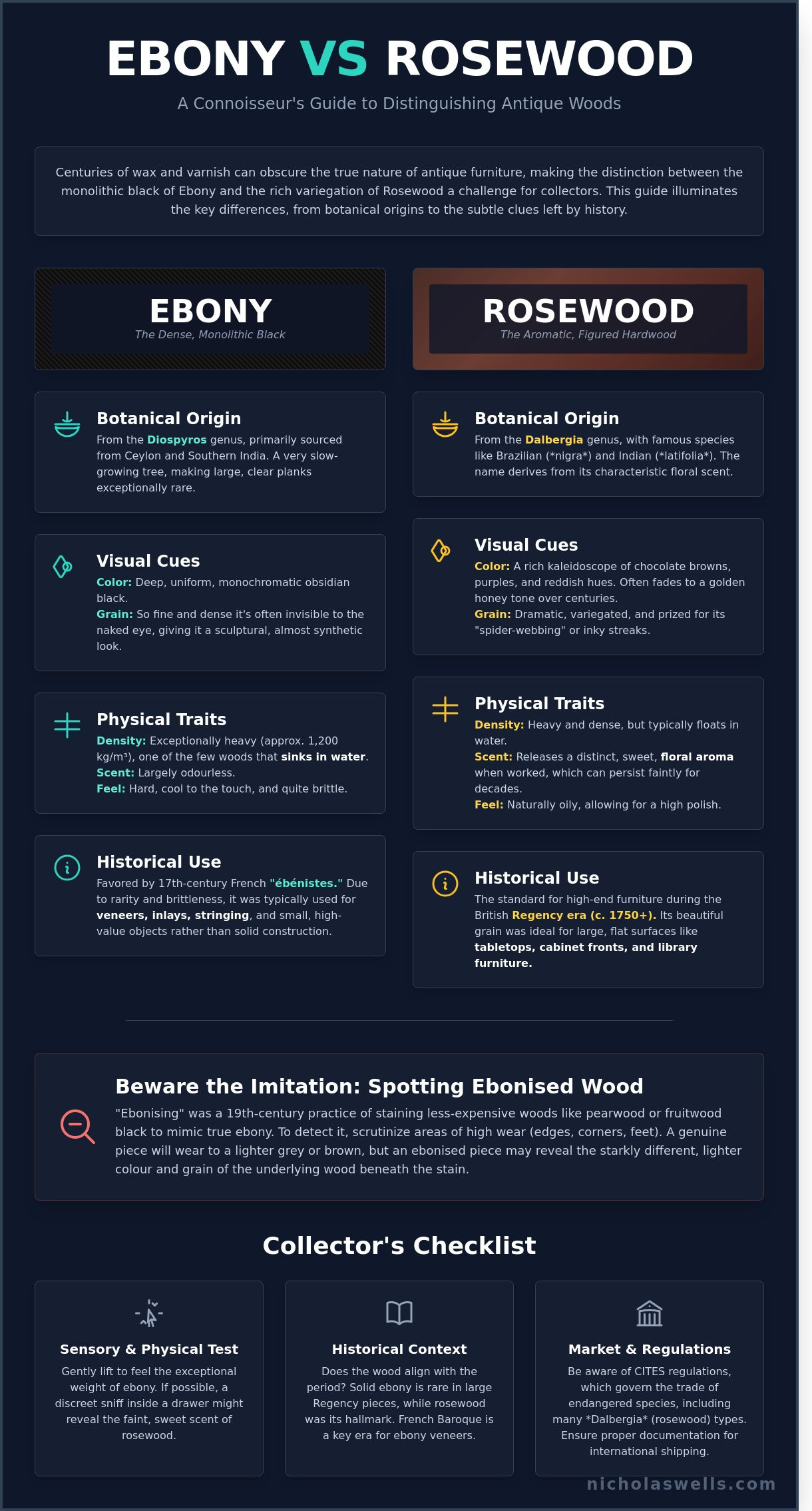
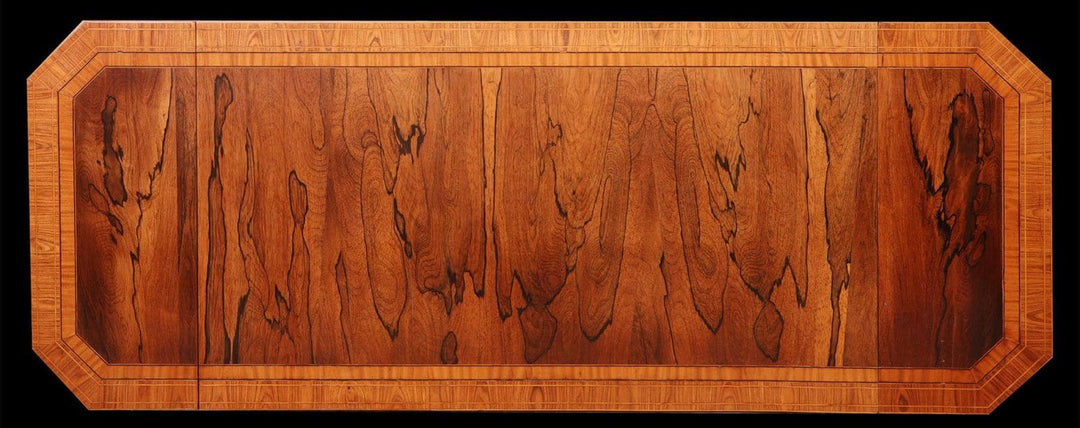
Rosewood offers a different aesthetic appeal through its variegated grain and rich, reddish-brown hues. Belonging to the Dalbergia genus, it's famous for the floral scent released during the sawing process. Brazilian Rosewood (Dalbergia nigra) was the standard for high-end furniture from 1750 through the Regency period. It's distinguished from Indian Rosewood (Dalbergia latifolia) by its more dramatic grain patterns. The wood's natural oils allow it to take a mirror-like polish without heavy lacquering. Collectors should note that the term "rosewood" often serves as a broad descriptor for several species within the genus used by 18th-century cabinet furniture makers. Distinguishing these species is essential when identifying the difference between ebony and rosewood antique furniture in a scholarly context.
- Density: Ebony is significantly heavier and more brittle than most rosewood species.
- Colour: Ebony tends toward a monochromatic black, while rosewood features streaks of chocolate, purple, and red.
- Scent: Rosewood retains a faint, sweet aroma for decades; ebony is largely odourless.
- Application: Ebony was often used for structural elements in small items or as a veneer, whereas rosewood was frequently used for larger surfaces like tabletops.
Visual and Physical Distinctions: The Connoisseur’s Eye
Distinguishing between these two prestigious materials requires a disciplined eye and an appreciation for botanical structure. Ebony, particularly the Diospyros species prized in the 18th century, possesses a monolithic quality that often masks its biological origins. It appears architectural and dense, often showing no discernible grain to the naked eye. In contrast, rosewood reveals a more temperamental character. The inky grain of rosewood serves as its primary visual identifier.
The color palette offers the first clue for any collector. While ebony remains committed to deep obsidian and charcoal tones, rosewood is a kaleidoscope of chocolate browns, purples, and reddish hues. These colors aren't static. Over 200 years, rosewood often fades to a soft, golden honey tone, a transformation that adds layers of history to its surface patina. Understanding this shift is key to recognizing the difference between ebony and rosewood antique furniture in varied states of preservation.
Identifying the Grain Patterns
Ebony’s lack of visible grain gives it a sculptural, almost synthetic appearance that makers used to create sharp, clean lines in neoclassical designs. It doesn't distract the eye with movement. Rosewood, however, is famous for its "spider webbing," where dark, erratic lines crisscross the surface. For those seeking absolute botanical certainty, this Wood identification guide from the U.S. Forest Service confirms that rosewood species feature distinctively oily, open pores compared to the brittle, tight-pored nature of ebony.
The Tactile Experience and Weight
The physical heft of a piece often reveals the truth before the eyes do. Ebony is exceptionally dense, often sinking in water with a specific gravity exceeding 1.0. It feels cold, almost like polished basalt, when touched. Rosewood, while also heavy, offers a warmer tactile response. This distinction is vital when examining cabinet furniture or smaller luxury objects where the material’s density dictates the construction methods used by 19th-century makers.
- Ebony: Uniform, obsidian, stone-like touch, extremely heavy.
- Rosewood: Inky streaks, chocolate to violet hues, warmer touch, fades to honey.
If you're inspecting a piece under a loupe, look for the pore structure. Ebony's pores are so small they're nearly invisible, whereas rosewood displays tiny, resinous canals that give the wood its characteristic sweet scent when freshly cut. Collectors interested in the tactile brilliance of these timbers may explore our curated furniture collection to witness these extraordinary distinctions firsthand.
Historical Context: When and Why These Woods Were Used
The mid-17th century marked a transformative era for Continental furniture design. In Paris, the guild of cabinet-makers became known as "ébénistes," a title directly honoring the dense, black timber they mastered. Ebony wasn't merely a material; it was a statement of absolute power and scholarly prestige. Under the reign of Louis XIV, the legendary André-Charles Boulle utilized its dark, uniform surface as the perfect canvas for intricate brass and tortoiseshell marquetry. This created a visual tension between the somber wood and the radiant ormolu mounts that defined the era's grandeur. Beyond grand cabinets, craftsmen utilized this precious timber for European works of art, including religious reliquaries and scholarly objects that demanded a sense of permanence.
Ebony in the 17th and 18th Centuries
Ebony functioned as the ultimate foil. Its primary value lay in its ability to highlight the brilliance of other materials. In the 1600s, Dutch and French craftsmen used it to construct massive cabinets with architectural facades, often concealing secret drawers. The wood’s association with mourning and the divine made it a staple for court furniture. It communicated a quiet, expensive dignity. Collectors often analyze the difference between ebony and rosewood antique furniture by looking at how these woods interacted with light; ebony absorbs it, creating a deep, velvety void that allows brass inlay to shine with exceptional clarity.
The Golden Age of Rosewood (1800-1830)
By 1800, the aesthetic tide shifted toward the vibrant and the exotic. British Regency designers like Thomas Hope and George Smith sought a warmer, more expressive exoticism than mahogany could provide. Rosewood, with its distinct dark streaks and rich chocolate hues, became the hallmark of the sophisticated London townhouse. While ebony was often used for its starkness, the difference between ebony and rosewood antique furniture lies in the latter's ability to display a more varied grain. This period saw rosewood dominate the production of antique tables and library furniture. The wood's natural oils allowed for a high-gloss finish that complemented the refined interiors of the Grand Tour era.
- 1650-1700: The rise of the ébéniste and the Dutch fashion for "black wood" cabinets.
- 1715-1774: Ebony remains a luxury staple in Louis XV furniture, often used in fine stringing.
- 1810: Rosewood surpasses mahogany in popularity for high-style Regency drawing rooms.
- 1850: The Victorian revival leads to mass-produced rosewood pieces with thinner, less figured veneers.
As the 19th century progressed, the Victorian era brought about a mass-market adoption that eventually led to a decline in quality. The rarity that once defined these woods began to fade as global trade routes expanded. By 1860, the use of thinner, lower-quality veneers became common. This decline in material integrity highlights why early 19th-century rosewood and 17th-century ebony examples remain so coveted by discerning collectors today.
Ebony vs. Ebonised: Detecting the Imitations
Distinguishing authentic tropical hardwoods from their European counterparts requires a keen eye for detail. While the difference between ebony and rosewood antique furniture often lies in the depth of color and grain structure, the most frequent point of confusion arises from ebonised wood. This technique, popular throughout the 18th and 19th centuries, involved a chemical reaction between iron filings and vinegar to create a deep black stain. Craftsmen typically applied this solution to tight-grained fruitwoods like pear or apple to mimic the prestigious look of Diospyros crassiflora without the exorbitant cost of importation.
Examining the Wear and Patina
Nicholas Wells Antiques places immense value on the conservation of the unique antique surface, as the patina tells the true story of an object's age. You'll find the most revealing clues by examining areas of high friction. Look closely at drawer runners, the undersides of chairs, or chipped corners. If the piece is ebonised, the original pale timber will eventually peek through the dark surface treatment. It's a fundamental distinction; ebonising is merely a surface treatment, whereas true ebony remains black to its very core. A 200-year-old ebonised cabinet will almost always show "white" wood at its edges, whereas solid ebony retains its obsidian depth despite centuries of use.
- Grain Structure: Ebonised fruitwoods often display a more open, porous grain than the glass-like density of true ebony.
- The Scent Test: Old hardwoods like rosewood or ebony emit a faint, sweet, or spicy aroma when lightly rubbed. Stained softwoods or fruitwoods lack this complex olfactory profile.
- Weight: True ebony is remarkably heavy and will sink in water, a density rarely matched by stained European timbers.
Common Misidentifications
Collectors often struggle to differentiate between various Dalbergia species. Is a piece crafted from Kingwood or Rosewood? Kingwood, or Dalbergia cearensis, is a close relative but typically features more vivid, violet-hued banding. In British antiques, you might also encounter Bog Oak. This local substitute, preserved in peat bogs for thousands of years, offers a naturally dark hue that served as a regional alternative to imported ebony. Because these nuances impact value by thousands of pounds, a professional appraisal is vital for high-value objets de luxe. Our gallery offers expert consultation to ensure the historical integrity of your collection is fully understood.
To explore our curated selection of authentic masterworks, we invite you to view our antique furniture collection and discover the unparalleled quality of period timbers.
Collecting and Conservation: The Nicholas Wells Perspective
In the 2026 market, the acquisition of rare hardwood furniture represents a sophisticated hedge against inflation. Collectors recognize that the supply of genuine 18th and 19th-century timber is strictly finite. Understanding the technical difference between ebony and rosewood antique furniture is essential for any serious collector, as these materials respond differently to environmental changes and age. While ebony offers a dense, monolithic presence, rosewood provides a rhythmic, figured warmth. Several factors drive their investment value in the current landscape:
- Historical Scarcity: The depletion of old-growth forests means these specific timber qualities cannot be replicated in modern production.
- Artisanal Provenance: Pieces from the 1800s showcase hand-cut veneers and joinery that represent the pinnacle of cabinetmaking.
- Material Density: Both woods possess a natural oil content that, when properly maintained, allows them to survive for centuries.
Navigating CITES and International Shipping
The 2026 regulatory environment for the sale of antique rosewood requires meticulous documentation to prove the timber was harvested before 1947. Nicholas Wells Antiques simplifies this complex process for international clients by providing fully insured worldwide shipping and all necessary legal certification. Buying from a reputable London dealer ensures that your investment travels safely across borders without the risk of seizure. We manage every detail of the CITES application, offering the absolute peace of mind that defines a luxury acquisition. It's our responsibility to ensure that every magnificent piece arrives with its legal history as intact as its physical frame.
Preserving the Surface Patina
Conservation is an act of stewardship. We never over-restore a rare ebony cabinet; doing so strips away the history that gives the piece its soul. Our approach focuses on complimentary restoration, using specialized microcrystalline waxes to nourish the wood while protecting the original surface. This preserves the unique antique surface that collectors prize. We invite you to explore the antique furniture collection at our London showroom to see these superb finishes in person. Maintaining the "soul" of the wood involves a light touch that respects the natural aging process of these exotic materials.
Integrating these dark, exotic woods into a contemporary interior requires a balance of light and texture. A 19th-century rosewood centre table creates a superb focal point when placed against a neutral, minimalist backdrop. The contrast highlights the intricate grain of the wood. It's about letting the historical artifact breathe within a modern context, allowing the deep tones of ebony or the variegated streaks of rosewood to ground a room with a sense of permanence and prestige.
Cultivating Your Collection of Rare Timbers
Distinguishing the dense, obsidian depths of Diospyros ebenum from the vibrant, oily streaks of Dalbergia remains a fundamental skill for the serious collector. While 18th-century master craftsmen prized ebony for its immense weight and ability to hold a high polish, the variegated warmth of rosewood often defined the most exquisite Regency marquetry. Understanding the difference between ebony and rosewood antique furniture allows you to appreciate the nuanced surface patina that only centuries of careful preservation can bestow. At Nicholas Wells Antiques, we've spent over 20 years curating a gallery where history’s most extraordinary exotics, from Grand Tour obelisks to fine French cabinetry, are treated as significant cultural artifacts. Every piece in our London collection undergoes a meticulous conservation process to ensure its historical integrity remains uncompromised. We provide complimentary restoration on all acquisitions and offer fully insured worldwide shipping to collectors across 6 continents. It's our privilege to help you find a piece that doesn't just fill a space, but tells a story of 19th-century artistry.
Explore our curated collection of fine antique furniture at Nicholas Wells Antiques
We look forward to assisting you in acquiring a truly unique piece of history for your home.
Frequently Asked Questions
Is ebony more expensive than rosewood in antique furniture?
Ebony is generally more expensive because it's sold by weight rather than volume, often costing 500 percent more than standard hardwoods. During the 18th century, a single log of Gaboon ebony could cost a cabinet maker as much as a small cottage. This rarity meant it was used sparingly for fine stringing or as a thin veneer on the most prestigious commissions for the aristocracy.
How can I tell if my rosewood table is Brazilian or Indian?
Brazilian rosewood is distinguished by its dramatic, irregular grain patterns and a scent of roses when the wood's freshly cut or sanded. Indian rosewood typically features a more uniform, linear grain with a duller, purplish-brown hue. If your table was crafted in London before 1850, it's 90 percent likely to be the superior Brazilian Dalbergia nigra species.
What does "ebonised" mean in antique descriptions?
Ebonised refers to the process of staining a domestic timber, such as pearwood or maple, to mimic the dense, black appearance of true ebony. This technique became highly fashionable during the 1870s Aesthetic Movement, allowing designers to create the sleek, dark look of the Orient. It's an important distinction to make when assessing the difference between ebony and rosewood antique furniture in a scholarly context.
Can rosewood furniture be shipped internationally under current CITES laws?
Rosewood furniture can be shipped across borders provided it's accompanied by the correct CITES permits and documentation. Since 2017, international laws require specific certification for any item containing Dalbergia species to prevent illegal logging. We provide a comprehensive service that includes securing these legal documents, ensuring your 19th-century rosewood piece reaches its destination without any customs delays.
Why did Regency furniture makers prefer rosewood over mahogany?
Regency makers chose rosewood because its dark, oily surface provided a more dramatic contrast to the gilded brass inlays that defined the era. Between 1800 and 1830, the demand for exoticism led collectors away from the traditional reddish tones of mahogany. Rosewood's ability to take a high polish made it the perfect canvas for the intricate ormolu mounts found in elite Mayfair interiors.
How do I clean and maintain the surface of an ebony cabinet without damaging the patina?
Maintaining an ebony cabinet requires a gentle touch to preserve the historic surface patina that has developed over 200 years. You should use a dry, soft cloth for weekly dusting and avoid all liquid polishes or modern detergents. Applying a thin coat of museum-grade microcrystalline wax once every three years is sufficient to nourish the wood and maintain its deep, charcoal luster.
Does true ebony always have a black grain?
True ebony often contains subtle variations of charcoal and deep brown rather than being a monolithic black. Macassar ebony, for example, is famous for its bold streaks of orange and tan, which were highly prized by Art Deco designers in the 1920s. Understanding these natural variations helps collectors appreciate the difference between ebony and rosewood antique furniture and identify the specific species used in a piece.
What are the signs of a high-quality rosewood veneer?
Signs of high-quality rosewood veneer include a thickness of at least 1.5 millimeters and a perfectly symmetrical book-matched grain. In the 18th century, these veneers were cut by hand, resulting in a slightly uneven but characterful surface that modern replicas can't achieve. You should look for a vibrant, variegated pattern that shows no signs of bubbling or historic repair to ensure the piece's integrity.

Leave a comment