



The Connoisseur’s Guide to Buying Fine Antique Armchairs
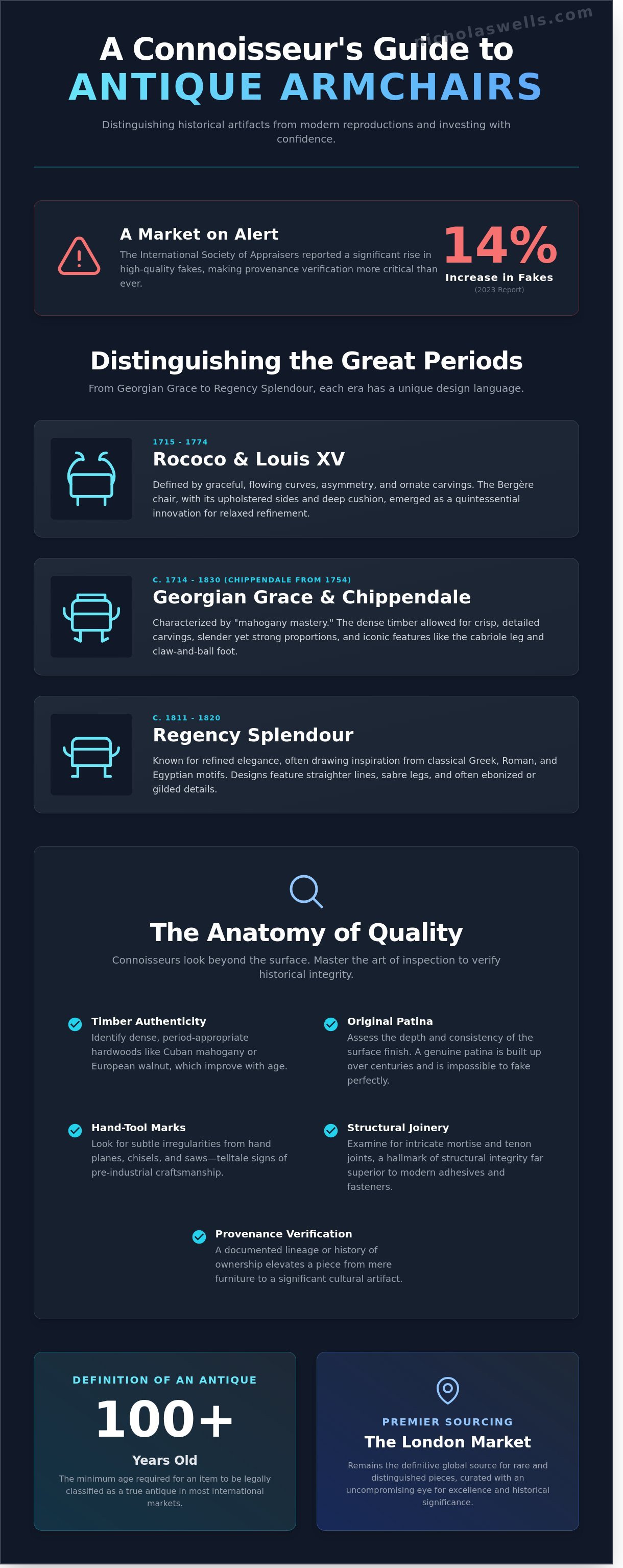
A chair is never merely a place to sit; it's a silent witness to the social hierarchies and aesthetic revolutions of its era. When you seek to buy antique armchairs, you aren't just acquiring furniture, but rather a fragment of 18th-century craftsmanship that has survived centuries of changing tastes. It's understandable why many collectors hesitate, fearing they might mistake a 1920s reproduction for a genuine Louis XV fauteuil. The 2023 report from the International Society of Appraisers noted a 14% rise in high-quality fakes entering the secondary market, making the verification of provenance more critical than ever before.
You deserve the confidence of a seasoned curator when selecting pieces that will define your home’s narrative. This guide provides the scholarly framework needed to evaluate the subtle patina of original gilding and the telltale tool marks of a master cabinetmaker. We'll explore how to balance the delicate requirements of historical preservation with the practical demands of a modern living room. By the end of this exploration, you'll understand how to secure an appreciating asset that serves as an extraordinary focal point, ensuring your investment is as structurally sound as it is historically significant.
Key Takeaways
- Learn to distinguish the architectural grace of Georgian mahogany from the refined elegance of Regency and Chippendale designs.
- Master the art of verifying timber authenticity and assessing the depth of an original patina to ensure your investment holds its historical integrity.
- Discover the essential criteria used by connoisseurs to buy antique armchairs that transcend mere furniture to become significant cultural artifacts.
- Explore sophisticated techniques for integrating 18th-century seating into contemporary minimalist spaces to create a compelling dialogue between past and present.
- Understand why the London market remains the definitive source for rare, distinguished pieces curated with an uncompromising eye for excellence.
The Enduring Allure of the Antique Armchair
To buy antique armchairs is to acquire far more than a mere utilitarian object; it's an invitation to host a silent witness of history within the private sphere of the home. Throughout European history, particularly within the French and English courts of the 1700s, the armchair served as a potent signifier of social standing and intellectual repose. While a standard chair provided a place to sit, the armchair offered a sanctuary for the elite. It represented a shift in domestic life where comfort began to rival formality. This evolution is meticulously documented in the History of the chair, tracing the trajectory from rigid, ceremonial thrones to the supple, upholstered masterpieces of the Enlightenment.
A profound distinction exists between a simple old chair and a significant cultural artifact. The former merely occupies space, while the latter possesses a documented lineage and a physical presence shaped by centuries of use. An authentic piece from the 18th or 19th centuries carries a specific weight of history, often evidenced by the gentle wear on a mahogany armrest or the original horsehair stuffing beneath a silk damask. These centuries remain the golden age of seating because they represent the apex of ergonomic experimentation before the onset of industrial mass production. Between 1715 and 1830, the proportions of the armchair were perfected to accommodate both the architectural grandeur of the period and the human desire for physical ease.
Owning a piece with a verifiable provenance creates an emotional resonance that modern furniture cannot replicate. There's a quiet thrill in knowing a chair survived the social upheavals of the 1789 French Revolution or graced a London townhouse during the Regency era. This connection to the past provides a sense of continuity in an increasingly ephemeral world. Collectors don't just see wood and fabric; they recognize the hand of a master craftsman who labored over a single join for days. This reverence for the object transforms a living room into a curated gallery of lived experience.
The Armchair as a Focal Point
In high-end interior design, a single extraordinary armchair can dictate the entire atmosphere of a room. It functions as an anchor, possessing what curators often describe as the "soul" of an object. This spiritual quality arises from the harmony of its proportions and the depth of its patina. When you buy antique armchairs of exceptional quality, you aren't just decorating; you're establishing a dialogue between historical reverence and modern functionality. A 1760s Gainsborough chair, for instance, provides a sculptural silhouette that commands attention without disrupting the flow of a contemporary living space.
A Legacy of Craftsmanship
The transition from anonymous guild-based production to the rise of celebrated cabinetmakers like Thomas Chippendale, who published his influential Director in 1754, marked a revolution in furniture design. Hand-carved cabriole legs and intricate mortise and tenon joinery offer a structural integrity that modern manufacturing, reliant on adhesives and softwoods, fails to achieve. The Bergère emerged as a quintessential 18th-century innovation, characterized by its enclosed upholstered sides and deep, loose seat cushion designed for the ultimate expression of relaxed refinement. These pieces were built to endure for centuries, utilizing dense timbers like Cuban mahogany and European walnut that only improve with age.
- 1715-1774: The reign of Louis XV, defined by the graceful curves of the Rococo style.
- 1754: Publication of "The Gentleman and Cabinet-Maker's Director," elevating the status of the English armchair.
- 100 Years: The minimum age required for a piece to be legally classified as a true antique in most international markets.
Distinguishing the Great Periods: From Georgian Grace to Regency Splendour
The evolution of the armchair mirrors the shifting hierarchies of European social life and the architectural movements that defined the 18th and 19th centuries. During the Early Georgian era, which commenced around 1714, the introduction of dense mahogany from the West Indies revolutionized furniture making. This timber allowed craftsmen to move away from the softer walnut of the Queen Anne period, enabling the creation of crisp, detailed carvings and more slender, yet stronger, proportions. To buy antique armchairs from this era is to invest in a legacy of "mahogany mastery," where the cabriole leg and the claw-and-ball foot reached their most sophisticated expression.
By the mid-1700s, the triumvirate of English design-Chippendale, Hepplewhite, and Sheraton-began to dictate the aesthetic of the British interior. Thomas Chippendale’s 1754 publication, The Gentleman and Cabinet-Maker’s Director, remains a seminal text that blended Gothic, Chinese, and Rococo influences into a cohesive English style. George Hepplewhite later introduced a lighter, more feminine touch with his signature shield-back designs, while Thomas Sheraton’s 1791 Drawing Book pivoted toward a refined, rectilinear Neoclassicism. To buy antique armchairs that possess both structural integrity and artistic merit requires an eye for these period-specific details, from the delicate inlay of a Sheraton piece to the robust pierced splats of a Chippendale chair.
The English Town and Country House Style
The Gainsborough chair, named after the celebrated 18th-century portraitist, stands as a testament to the period’s desire for scholarly comfort. Often found in the libraries of great estates, these chairs feature wide seats and open, upholstered arms that allowed gentlemen to sit comfortably in the voluminous coats of the era. Simultaneously, the "Wingback" chair evolved significantly between 1720 and 1760. Originally designed with "ears" to trap the heat of a fireplace and shield the sitter from drafts, it became a staple of the English country house. When considering these pieces for modern use, it's essential to ensure that any reupholstery meets safety standards, such as the official CPSC guidelines regarding flammability, ensuring that historical beauty is matched by contemporary security.
Continental Elegance and Gilded Grandeur
Across the Channel, the French court at Versailles influenced a more flamboyant approach to seating. The reign of Louis XV (1715-1774) is synonymous with the Rococo style, characterized by fluid, asymmetrical curves and a total rejection of the straight line. It's here that we see the distinction between the fauteuil, an armchair with open sides, and the bergère, which features enclosed, upholstered sides for maximum intimacy and warmth. These pieces often utilized magnificent marquetry and mercury-gilded ormolu mounts to highlight their regal provenance. The subsequent Louis XVI period saw a return to restraint, with fluted legs and geometric symmetry inspired by the excavations at Pompeii in 1748. This Neoclassical revival was further fueled by the Grand Tour, as young aristocrats returned to England and France with a renewed passion for the motifs of antiquity.
The dawn of the 19th century ushered in the Regency and Empire styles, where the revival of classical motifs reached its zenith. Designers like Thomas Hope embraced a more archaeological approach, utilizing exotic timbers like calamander and rosewood. These chairs often featured bold, sculptural forms such as the sabre leg and were adorned with brass inlays of sphinxes, griffins, and lotus flowers. These pieces don't just serve as seating; they act as focal points that bridge the gap between historical grandeur and the requirements of a sophisticated modern interior. If you're seeking a specific period masterpiece to anchor your room, you might consult our latest acquisitions to find a piece that resonates with your personal aesthetic.
The Anatomy of Quality: What to Inspect Before You Buy
When you decide to buy antique armchairs, the discernment of the timber serves as your first lesson in connoisseurship. High-quality Georgian and Regency pieces often utilize dense, heavy San Domingo mahogany, which is characterized by its deep, wine-like luster and a lack of visible pores. By contrast, a Queen Anne chair might showcase the intricate "oysters" of walnut veneer, a technique perfected in the early 1700s to highlight the wood’s natural geometry. The surface should possess a rich patina, which is the thin film of oxidation and wax built up over centuries of careful handling. This glow is irreplaceable. A stripped and refinished surface can reduce an item's market value by 40% because it erases the history of the object.
Structural integrity remains the silent foundation of any investment. You should inspect the joints beneath the seat rail for evidence of traditional craftsmanship. Authentic 18th-century construction relies on tenon-and-mortise joints secured with wooden pegs rather than modern screws. Look for original corner blocks, those triangular reinforcements that provide essential stability to the frame. While modern comfort is a primary concern, the internal upholstery should ideally respect traditional methods. Using hand-lashed springs and genuine horsehair padding ensures the armchair retains its correct historical silhouette. It avoids the unappealing, "bouncy" feel of 20th-century synthetic foam.
Evaluating Authenticity and Provenance
Authenticity lives in the details that the casual observer might overlook. Early 1750s furniture often displays distinct tool marks, such as the rhythmic, slightly irregular undulations of a hand-plane on the underside of the frame. These imperfections are signatures of the craftsman's hand before the era of machine precision. Provenance adds an intellectual layer to the physical object, tracing its journey through notable estates or historical collections. Those looking to buy antique armchairs for long-term investment should prioritize documented history. A verified maker's stamp, such as those from the prestigious workshops of Gillows of Lancaster or Howard & Sons, can increase the financial value of a piece by 45% compared to an unattributed example of similar quality.
Condition and Restoration
Condition is a delicate balance between preservation and utility. Sympathetic restoration preserves the history of the piece while ensuring it is fit for a contemporary drawing room. You must distinguish this from damaging "over-cleaning," which leaves the wood looking raw and devoid of character. Original brass casters and stamped hardware are vital details that collectors prize for their aesthetic continuity. At Nicholas Wells Antiques, we provide a commitment to complimentary restoration for all seating, ensuring each acquisition meets the highest standards of structural and aesthetic excellence. This process respects the soul of the object while preparing it for another century of use.
Curating the Modern Interior with Period Seating
Integrating a George III wingback into a room defined by 21st-century architectural lines creates a dialogue between eras that feels both deliberate and sophisticated. When you decide to buy antique armchairs, you aren't merely purchasing furniture; you're acquiring a narrative that spans centuries. An 18th-century walnut frame provides a tactile counterpoint to the flat, matte surfaces of a contemporary gallery-style wall. This "Mix and Match" approach succeeds when a 1760s armchair sits beneath a bold, 2024 abstract expressionist painting. The contrast highlights the rhythmic carving of the timber, allowing the craftsmanship of the past to resonate against the energy of the present.
Minimalist residences often feature 90% monochromatic surfaces, which can feel sterile without a historical anchor. The complex patina of an aged mahogany piece introduces a necessary weight to these spaces. New builds, while efficient, frequently lack a sense of permanence. The presence of a "well-worn" seat offers a psychological comfort that suggests continuity. It bridges the gap between the clinical precision of modern construction and the soul of the decorative arts. This sense of heritage transforms a house into a home with a curated, lived-in atmosphere.
Scale and proportion remain the most critical factors in this curation process. A 19th-century porter’s chair, standing 1.5 meters tall, requires a ceiling height of at least 3 meters to breathe. If the proportions are skewed, the chair becomes an obstacle rather than an accent. In a study measuring 15 square meters, a single, well-placed armchair provides more aesthetic value than a suite of smaller, inconsequential pieces. It's about the silhouette and how it occupies the volume of the room, ensuring the furniture complements the architecture rather than competing with it.
Textiles and Re-upholstery
Revitalizing a frame from the 1780s requires a delicate balance between historical integrity and modern utility. Choosing a heavy Belgian linen or a deep mohair velvet can transform a formal Louis XVI fauteuil into an inviting piece for a library. The choice of a bold, saturated hue, perhaps a midnight blue or oxblood, serves to accentuate the intricate ormolu mounts or delicate marquetry that might otherwise fade into the background. It's essential to ensure the upholsterer respects the original silhouette. Over-padding can obscure the graceful sweep of a cabriole leg, stripping the piece of its intended elegance and scholarly proportions.
Lighting and Placement
Strategic placement is the difference between a static object and a living piece of history. Position your chair to catch the afternoon sun, allowing the natural light to reveal the depth of the grain and the subtle variations in the wood’s finish. To truly elevate these pieces, one must consider how artificial light interacts with aged surfaces. Our Lighting Collection offers curated options that illuminate fine furniture without the harshness of modern LEDs. Creating a vignette, perhaps a pair of Regency tub chairs flanking a fireplace, fosters an environment for intimate conversation. When collectors look to buy antique armchairs, they often seek this specific sense of curated warmth that only a pair of well-placed seats can provide.
Sourcing Extraordinary Seating: The Nicholas Wells Collection
To buy antique armchairs of true distinction requires more than a casual glance at a catalogue. It demands an appreciation for the narrative arc of design history. Nicholas Wells Antiques operates on a philosophy where rarity and scholarly significance take precedence over mere utility. Every piece in the collection is treated as a cultural artifact, selected for its ability to anchor a room with both presence and pedigree. London has served as the global nexus for the fine arts trade since the 18th century. It remains the premier location for sourcing items that possess impeccable provenance and original patina. The collection reflects this heritage, offering a bridge between the grand traditions of the past and the sophisticated requirements of a modern interior.
The acquisition of a fine armchair is an investment in craftsmanship that has already stood the test of centuries. It's about finding that singular object that speaks to a specific era, whether it's the architectural rigour of the Neo-Classical period or the fluid grace of the Rococo. Our role is to act as a trusted advisor, guiding you through the nuances of timber quality, original upholstery techniques, and the subtle markers of an authentic maker's hand. Quality endures. The soul of a room often rests in the weight and history of its seating.
A Commitment to Excellence
The selection process at the gallery is rigorous; only 5% of the pieces reviewed by our specialists meet the exacting standards required for inclusion. This scrutiny ensures that every armchair, whether a George III mahogany library chair or a Regency bergère, maintains its structural integrity and aesthetic soul. Building a relationship with a specialist dealer is essential for any serious collector. It's a partnership rooted in transparency and shared passion. To create a truly layered interior, one might consider how a superb seating choice pairs with other Works of Art, such as a fine bronze or a rare terrestrial globe. These objects provide the historical context that elevates a house into a home of curated elegance.
Worldwide Reach and Local Expertise
Acquiring high-value antiques involves complex logistics that we manage with absolute precision. We've successfully coordinated the white-glove delivery of fragile items to collectors in over 35 countries, ensuring that every piece is fully insured and expertly crated. For those who prefer a tactile experience, our gallery on Regent Street offers viewing by appointment. This private setting allows clients to examine the fine details of marquetry or the subtle wear of historical gilding in a quiet, scholarly atmosphere. Our bespoke restoration services further ensure that each acquisition is preserved for future generations. Expert craftsmen, many with over 25 years of experience, handle every repair with a reverence for the original maker's intent.
The journey of acquisition begins with a conversation. Whether you're looking to buy antique armchairs for a private library or a grand drawing room, our expertise is at your disposal. We invite you to explore our current collection of rare antique armchairs and discover the extraordinary craftsmanship that defines the Nicholas Wells name.
Elevate Your Interior with Provenance and Grace
Selecting the perfect seat requires a discerning eye for the structural integrity and aesthetic nuance that define the Georgian and Regency eras. By focusing on the refined proportions of 18th-century mahogany and the meticulous joinery of period masters, you transform a living space into a gallery of historical narrative. When you decide to buy antique armchairs, you aren't just purchasing furniture; you're securing a tangible piece of design history that has survived centuries of use. Since 2012, our London gallery has specialized in sourcing these rare examples, ensuring each object meets the highest standards of authenticity and condition. We provide complimentary restoration on every item in our inventory, entrusting our skilled craftsmen to honor the original patina and soul of the work. Our commitment to excellence extends to the final delivery, offering fully insured worldwide shipping to protect your investment across every border. This scholarly approach to collecting ensures that your home reflects a sophisticated appreciation for the decorative arts. Discover our extraordinary collection of fine antique armchairs and begin your own chapter with these magnificent pieces. Your next heirloom awaits.
Frequently Asked Questions
Are antique armchairs comfortable enough for daily use?
Antique armchairs are exceptionally comfortable for daily use when they feature traditional 18th-century construction methods like hand-lashed coil springs and horsehair padding. A well-restored Georgian wingback offers ergonomic support that rivals 21st-century designs. When you buy antique armchairs, check that the seat height aligns with your requirements, typically 45 to 48 centimeters, to ensure long-term comfort during daily tasks.
How can I tell if an armchair is a 19th-century reproduction or an 18th-century original?
You distinguish an 18th-century original from a 19th-century reproduction by examining the underside of the rails for hand-sawn marks and irregular thicknesses. Authentic 1750s mahogany pieces often show 2 to 3 millimeters of shrinkage across the grain; it's a natural process that machine-made Victorian copies lack. Look for hand-cut dovetails and the presence of original wooden dowels rather than the standardized metal screws introduced after 1830.
What is the most valuable type of wood for antique armchairs?
Cuban mahogany remains the most prized timber for antique seating due to its immense density and lustrous grain. By 1760, this wood became the gold standard for master cabinetmakers like Thomas Chippendale. Rare specimens featuring calamander or Brazilian rosewood veneers often command a 40 percent premium at auction because of their scarcity and the 1947 CITES restrictions on international trade of specific tropical hardwoods.
Does re-upholstering an antique armchair decrease its value?
Re-upholstering an armchair rarely decreases its value if you employ traditional 19th-century techniques such as hand-stitched edges and organic stuffings. In fact, replacing a 1970s foam interior with authentic horsehair can increase a chair's market price by 15 to 20 percent. Ensure your upholsterer preserves the original tacks and avoids modern staples, as these can damage the 250-year-old beech or walnut frames.
How do I care for the original finish or patina of my armchair?
You preserve the delicate patina of a 17th-century walnut chair by applying a thin layer of pure beeswax every 12 months. Avoid modern aerosol polishes that contain silicone; these create a 5-micron thick film that obscures the wood's natural depth. Maintain a stable humidity level between 40 and 60 percent to prevent the timber from cracking, a common issue documented by the Victoria and Albert Museum's conservation department.
Can I ship a large antique armchair internationally?
International shipping for large armchairs is a standard procedure facilitated by specialized fine art couriers who use custom-built ISPM-15 heat-treated crates. Shipping a pair of Louis XIV chairs from London to New York typically takes 14 to 21 days via air freight. When you buy antique armchairs for a global residence, ensure the dealer provides a CITES certificate for any restricted materials like rosewood or ivory inlays.
What is the difference between a Bergère and a Fauteuil?
A Bergère is a French armchair with upholstered sides while a Fauteuil features open arms that reveal the carved wooden frame. Introduced around 1720 during the Régence period, the Bergère was designed for ultimate warmth and privacy within drafty chateaus. The Fauteuil offers a more formal, architectural silhouette, often utilized in 18th-century salons to showcase the intricate marquetry and gilding of the chair's structure.
How do I verify the provenance of a high-value antique?
You verify provenance by tracing the object through 18th-century household inventories, exhibition labels, or stamped maker's marks like those from the Garde-Meuble de la Couronne. A documented history linking a chair to a specific 19th-century estate can increase its valuation by 50 percent or more. Consult the Getty Research Institute's provenance index to cross-reference the piece's ownership lineage against known historical collections.


Leave a comment