



The Connoisseur’s Guide to Islamic Arms and Armour Dealers in the UK
For the discerning collector, the pursuit of authentic historical weaponry is often fraught with the peril of encountering uninspired "tourist pieces" or skillfully aged forgeries that lack the soul of a true artifact. Navigating the nuanced distinctions between the fluid geometry of a Mughal tulwar and the austere elegance of a Persian shamshir requires more than a casual interest; it demands the discerning eye of a specialist who understands the profound cultural narratives etched into every blade. As a premier Islamic arms and armour dealer UK, we recognize that the true value of these objects lies in their impeccable provenance and the mastery of ancient techniques, such as the mesmerizing, crystalline patterns of Wootz steel and the delicate gold inlay of Koftgari.
In this guide, we invite you to explore the scholarly depth and artistic brilliance of the Islamic world’s martial heritage, bridging the gap between historical reverence and the requirements of a modern collection. You will discover how to identify museum-quality pieces that serve as both a significant investment and a magnificent focal point for a sophisticated interior. By understanding the rigorous standards of documentation and the aesthetic signatures of the Ottoman and Safavid empires, you can secure a legacy piece with the confidence that only a trusted London-based advisor can provide.
Key Takeaways
- Understand why London remains the preeminent global center for the Islamic art trade and how a specialist dealer provides scholarly expertise that far transcends the typical auction experience.
- Learn to distinguish between the regional characteristics of the Three Empires, contrasting the refined elegance of Safavid Persia with the magnificent, opulent aesthetics of Mughal India.
- Uncover the secrets of historic metallurgy and ornamentation, from the crystalline structure of legendary Wootz steel to the delicate, rhythmic beauty of Koftgari gold inlay.
- Navigate the complexities of the modern market with essential insights into provenance and 2026 cultural heritage laws to ensure your acquisitions through an Islamic arms and armour dealer UK remain secure investments.
- Discover a bespoke approach to curating history that prioritizes the extraordinary, offering a sophisticated bridge between ancient craftsmanship and the aesthetic requirements of a contemporary interior.
The Connoisseur’s Search for an Islamic Arms and Armour Dealer in the UK
For the discerning collector, the pursuit of a pre-eminent Islamic arms and armour dealer UK-based is a journey that transcends the mere acquisition of tempered steel; it is an exercise in identifying a custodian of history whose expertise extends far beyond the perfunctory strike of an auction hammer. While general militaria shops often cater to the industrial remnants of modern conflict, they frequently fail the high-end collector by overlooking the profound spiritual and social dimensions inherent in Islamic works. To the specialist dealer, these objects are not merely inventory, but significant cultural artifacts that require a scholarly understanding of metallurgy, calligraphy, and dynastic history.
London’s Legacy in the Islamic Art Market
London remains the undisputed epicentre of the global Islamic art trade, a status cemented by centuries of connoisseurship and the rigorous provenance standards established by its historic auction houses. This geographic advantage allows a dealer to maintain a vital academic tether to world-class institutions, such as the Victoria and Albert Museum, ensuring that every acquisition is informed by a peerless standard of excellence. Within this prestigious London antique circuit, Nicholas Wells Antiques occupies a distinguished position, offering a bridge between the scholarly rigour of the museum and the private sanctuary of the home.
The Aesthetic Shift: From Battlefield to Gallery
To the true connoisseur, these objects are viewed as sculptural masterpieces of decorative art rather than mere instruments of war. The transition from functional tool to symbol of courtly prestige is most evident in the evolution of The Jambiya Dagger, where the focus shifted toward extraordinary surface quality, original patina, and the intricate application of gold damascening. A specialist Islamic arms and armour dealer UK must possess the refined eye necessary to identify the hallmarks of noble commission, such as:
- Wootz Steel: Identifying the mesmerising, watery patterns of high-carbon crucibles.
- Calligraphic Inscriptions: Decoding poetic verses or Quranic protections that elevate the piece’s "soul."
- Gem-Setting: Appraising the delicate kundan techniques often found in Mughal and Ottoman courtly regalia.
Ultimately, the role of the specialist is to curate a narrative of power and beauty, ensuring that pieces once carried by princes are preserved as the focal points of contemporary luxury interiors.
Masterpieces of the Three Empires: Mughal, Ottoman, and Persian Artistry
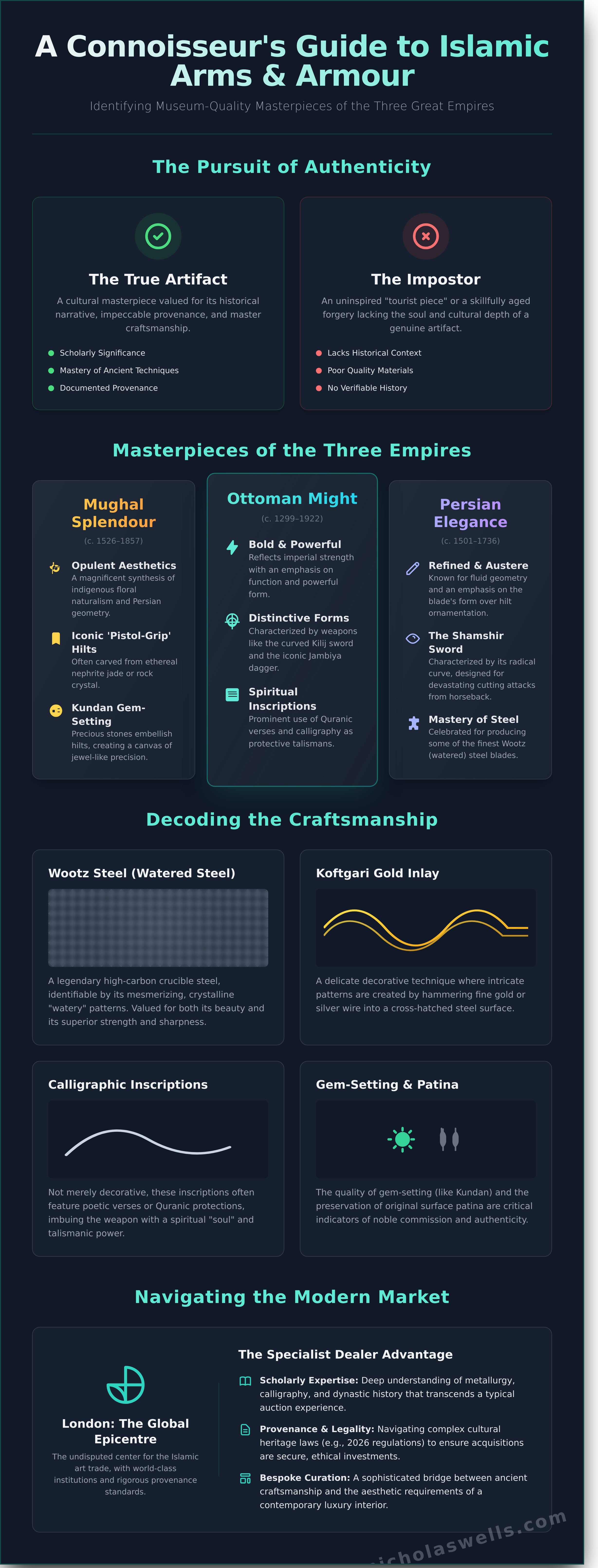
The rise of the "Gunpowder Empires"—the Ottoman, Safavid, and Mughal dynasties—marked a golden age of metallurgical brilliance and artistic refinement. For the discerning Islamic arms and armour dealer UK, these objects are far more than instruments of statecraft; they are profound cultural artifacts that embody the technical virtuosity of their respective courts. Authentication by a specialist relies on a nuanced understanding of regional aesthetics, where the placement of a gold-inlaid cartouche or the specific alloy of "watered" steel reveals a piece’s distinguished provenance. Central to this connoisseurship is the role of calligraphy; Quranic inscriptions and pious invocations were not merely decorative but served as protective talismans, imbuing the steel with spiritual significance.
Mughal Splendour: Jade, Gold, and Gem-Set Hilts
The Mughal court in India was defined by a magnificent synthesis of indigenous floral naturalism and Persian geometry. Collectors often seek the iconic "pistol-grip" hilts, frequently carved from ethereal nephrite jade or rock crystal and embellished with precious stones using the kundan technique. This opulent aesthetic reflects the same sophisticated craftsmanship found in the finest Indian works of art, where weaponry becomes a canvas for jewel-like precision.
Ottoman Might: The Kilij and the Yataghan
Ottoman weaponry is characterized by a formidable elegance, evidenced by the deep curvature of the Kilij and the recurved blade of the Yataghan. These pieces often showcase the superb silver-gilt repoussé work associated with the prestigious Topkapi palace workshops. A reputable Islamic arms and armour dealer UK will carefully examine the Tughra—the Sultan’s imperial monogram—and other maker marks to verify the courtly origin and historical gravity of the blade.
Persian Elegance: The Safavid Shamshir
The Safavid Shamshir represents the zenith of the swordsmith’s craft, celebrated for its extreme, graceful curve and the mastery of "watered" steel. Often referred to as the "Stradivarius" of the armoury world, Persian steel possesses a unique shimmering patina that is impossible to replicate. These blades are typically adorned with gold-inlaid poetic inscriptions, reflecting a culture where the warrior’s prowess was inextricably linked to literary and spiritual refinement.
Decoding the Craftsmanship: From Wootz Steel to Koftgari Gold
To the discerning eye, a piece acquired from a premier Islamic arms and armour dealer UK is far more than a historical weapon; it represents a profound synthesis of advanced metallurgy and decorative virtuosity. These objects were commissioned as symbols of temporal power and spiritual devotion, where the mastery required to transform raw iron and precious minerals into items of such lethal beauty reflects a tradition where the artisan’s soul was as vital as his hammer. Understanding the technical nuances of these crafts is essential for any collector seeking to distinguish between a mere curiosity and a true masterpiece of the Islamic world.
The Science and Soul of Wootz Steel
Wootz steel is a high-carbon crucible steel originating in India and perfected in Persia. Its legendary crystalline structure produces a shimmering "watered" pattern, a visual narrative of the slow cooling process within the crucible. The most distinguished examples exhibit the "Kirk Narduban," or "Forty Steps," a rare pattern of transverse rungs across the blade that signifies the pinnacle of forging skill. This metallurgical rarity, coupled with its historical performance, ensures that genuine Wootz remains a superb investment-grade asset with a provenance that resonates through the centuries.
Decorative Techniques: Koftgari and Niello
The surface of these objects often serves as a canvas for Koftgari, the delicate art of inlaying gold or silver wire into steel. A seasoned Islamic arms and armour dealer UK will guide collectors in distinguishing between "true" inlay, where the precious metal is physically embedded into deep incisions, and "false" Koftgari, which relies on surface hatching. This level of fine metalwork shares much with the intricate detailing found in classical sculpture, requiring a meticulous hand to achieve lasting brilliance. In the Caucasus and Ottoman regions, Niello—a dark, lustrous metallic alloy—was frequently employed to provide high-contrast detail, creating a dramatic interplay between light and shadow on dagger hilts and scabbards.
- Enamelling: Look for the vibrant, translucent greens and deep blues characteristic of the royal workshops in Lucknow and Jaipur.
- Materiality: The use of walrus morsek and carved ivory for hilts served as a potent marker of status; the dense, creamy patina of aged walrus ivory offers a tactile connection to the past that remains highly coveted by modern connoisseurs.
Navigating the UK Market: Provenance, Ethics, and Investment
In the contemporary landscape of the fine arts, the acquisition of a magnificent shamshir or a rare katar is a pursuit that demands both aesthetic discernment and a rigorous adherence to ethical standards. For the serious collector, partnering with a distinguished Islamic arms and armour dealer UK provides more than access to inventory; it offers the security of expert navigation through the complexities of the Cultural Heritage Laws of 2026 and the stringent requirements of UK export licenses. To build a collection that holds its value through market fluctuations, one must prioritise items that possess an unimpeachable genealogy of ownership and historical significance.
The Gold Standard of Provenance
The value of a piece is inextricably linked to its historical journey. We place immense importance on tracing items back to colonial-era collections or noble European estates, where the "soul" of the object has been preserved through generations. Scholarly research serves as the bedrock of verification, ensuring that every inscription and maker’s mark is understood within its cultural context. Furthermore, we believe in "complimentary restoration"—a sensitive, expert-led process that stabilises the object without erasing the honest patina of age, thereby preserving both its integrity and its long-term investment potential.
Islamic Arms in the Modern Interior
Integrating these martial masterpieces into a curated home requires an eye for visual dialogue. A 19th-century Tulwar, with its graceful curve and formidable presence, serves as an extraordinary focal point when positioned within a contemporary study or alongside a refined antique furniture collection. The interplay of light is equally vital; bespoke lighting can be used to highlight the "watered" patterns of high-carbon crucible steel, revealing the ethereal beauty of the blade.
- Narrative Contrast: Create a sophisticated juxtaposition by displaying Islamic steel alongside Grand Tour souvenirs, bridging the gap between Western neoclassicism and Orientalist artistry.
- Material Harmony: The rich textures of inlaid gold (koftgari) and ivory hilts resonate beautifully with the warm tones of mahogany or kingwood.
As a leading Islamic arms and armour dealer UK, our commitment is to assist you in sourcing pieces that are not merely decorative, but are significant cultural artefacts that will enrich your legacy. We invite you to explore our latest acquisitions at nicholaswells.com.
Curating History with Nicholas Wells: A Bespoke Approach to Islamic Art
At Nicholas Wells Antiques, our philosophy is anchored in the pursuit of the extraordinary. As a premier Islamic arms and armour dealer UK, we eschew the commonplace, selecting only those pieces that possess a profound historical narrative and superlative craftsmanship. Our London-based gallery serves as a global gateway for collectors, offering fully insured worldwide shipping to ensure that these significant cultural artifacts reach their new homes in pristine condition, regardless of the destination.
The aesthetic dialogue within our collection is unique; we believe in the harmonious synergy between fine English furniture and Islamic masterpieces. A 17th-century Mughal tulwar or a finely damascened Ottoman kilij finds a natural, sophisticated resonance alongside the refined lines of period cabinetry. We invite discerning collectors to experience this curated vision firsthand by arranging a private viewing at our Westminster premises, where history is presented with the scholarly reverence it deserves.
Expert Restoration and Preservation
Preserving the integrity of a centuries-old artifact requires a nuanced understanding of its material composition. Our conservation efforts focus on the delicate stabilization of organic hilts—such as those crafted from walrus ivory, bone, or rare woods—and the meticulous treatment of oxidised steel to reveal the original wootz patterns hidden by time. Nicholas Wells offers complimentary restoration on all items to ensure they remain in superb condition for future generations. This commitment to museum-grade conservation ensures that the provenance and patina of every piece are meticulously protected for the benefit of our clients.
Building Your Legacy Collection
Whether you are a seasoned connoisseur or embarking on your first acquisition, our personalized advisory service is designed to help you build a collection of lasting significance. We take pride in fostering a community of enthusiasts through our "Refer a Friend" programme, encouraging the shared appreciation of heritage and artistry among a global network of collectors. Our role is that of a trusted advisor, bridging the gap between the grandeur of the past and the requirements of modern luxury living.
Just as an expert advisor can guide the curation of a legacy collection, specialized platforms can be invaluable for building a professional legacy. For those seeking career opportunities in a dynamic market like Cyprus, for instance, you can check out Alpha.jobs.
We invite you to explore the current collection of Islamic Arms and Armour and discover the next cornerstone of your legacy. For those seeking a specific rarity, Nicholas Wells remains at your disposal to source the exceptional.
Preserving the Legacy of Islamic Artistry
The acquisition of a rare Shamshir or a finely damascened helmet is far more than a mere transaction; it is a profound act of cultural stewardship. As we have explored, the journey of the connoisseur involves navigating the intricate histories of the Mughal, Ottoman, and Persian empires, where the technical mastery of Wootz steel and the delicate brilliance of Koftgari gold work transformed instruments of defense into sublime works of art. In this pursuit, identifying a reputable Islamic arms and armour dealer UK is paramount to ensuring that every acquisition is supported by rigorous provenance and an uncompromising commitment to historical integrity.
Established in London since 2012, Nicholas Wells Antiques serves as a trusted advisor to those seeking extraordinary pieces that possess both a storied soul and significant investment potential. Our bespoke approach provides collectors with peace of mind through complimentary museum-grade restoration and fully insured worldwide shipping. We invite you to explore our gallery and discover how these magnificent artifacts can serve as a sophisticated bridge between the grandeur of the past and the elegance of modern living.
View our curated collection of Islamic Arms and Armour
We look forward to assisting you in curating a collection that reflects your passion for history and your eye for the exceptional.
Frequently Asked Questions
What should I look for when buying an antique Islamic dagger in the UK?
When acquiring an antique Islamic dagger, such as a Yemeni jambiya or an Ottoman khanjar, one must scrutinize the integrity of the blade and the quality of the hilt materials. Look for the presence of high-carbon steel, often displaying a subtle crystalline structure, and ensure the hilt—whether carved from walrus ivory or nephrite jade—remains devoid of significant structural fractures. As a premier Islamic arms and armour dealer UK, we recommend prioritizing pieces that retain their original, finely chased scabbards.
How do I identify authentic Wootz steel on a Persian Shamshir?
Authentic Wootz steel, or pulad, is distinguished by its mesmerizing, non-linear patterns that resemble flowing water across the blade’s surface. On a fine Persian Shamshir, this "watered" effect is an inherent characteristic of the crucible steel’s slow cooling process, which results in a unique distribution of cementite. To identify it, observe the blade under a raking light; a genuine pattern will appear integral to the metal’s structure rather than a superficial surface etch or modern acid treatment.
Are there legal restrictions on owning antique arms and armour in the UK?
In the United Kingdom, the possession of antique arms is governed by specific exemptions within the Offensive Weapons Act. Generally, edged items manufactured before 1954 or those handcrafted using traditional methods are permitted for private collections. It is essential to distinguish between contemporary replicas and genuine historical artifacts; as a reputable Islamic arms and armour dealer UK, we ensure all our acquisitions comply with the highest legal and ethical standards for heritage preservation and private ownership.
How does provenance affect the value of Mughal Indian weapons?
For Mughal Indian weaponry, provenance is the bridge between a mere object and a significant historical document. A Tulwar or Khanjar with a documented lineage—perhaps once belonging to a specific royal treasury or a distinguished colonial collection—commands a substantial premium. This historical narrative imbues the piece with a unique soul, transforming it into a tangible connection to the courtly splendor of the Mughal Empire and significantly enhancing its long-term investment potential for the serious connoisseur.
What is the difference between Koftgari and true gold inlay?
Koftgari is a sophisticated form of damascening where gold wire is burnished onto a cross-hatched steel surface, creating a delicate, shimmering overlay. In contrast, true gold inlay, or tah-nishan, involves carving deep channels into the steel into which the gold is hammered. While Koftgari offers a magnificent aesthetic brilliance, tah-nishan represents a more laborious and enduring technique, often found on the most superb examples of Safavid or Mughal craftsmanship where the gold becomes one with the blade.
How should I display antique Islamic swords in a home environment?
Displaying an antique sword requires a delicate balance between aesthetic grandeur and conservation. We suggest utilizing custom-made, conservation-grade wall mounts that support the weight evenly without stressing the hilt or crossguard. Position these extraordinary pieces away from direct sunlight and fluctuating humidity to preserve the patina of the steel and the integrity of organic materials. A well-lit alcove provides a dignified setting that highlights the blade’s intricate geometry and gold-inlaid calligraphy.
Does Nicholas Wells Antiques provide certificates of authenticity for Islamic art?
Indeed, every acquisition from Nicholas Wells Antiques is accompanied by a comprehensive scholarly description that serves as a testament to its authenticity and historical significance. Our rigorous vetting process ensures that each piece meets our exacting standards of quality and rarity. This documentation details the item’s material composition, artistic style, and known provenance, providing our clients with the absolute confidence required when investing in world-class examples of Islamic metalwork and weaponry.
Can Islamic arms and armour be shipped internationally from London?
We maintain an expert logistics network capable of facilitating the secure international transport of rare arms and armour from our London gallery to global destinations. This process includes navigating complex customs regulations and ensuring compliance with CITES for items containing restricted materials like antique ivory. Each piece is professionally crated and insured, ensuring its safe passage to collectors worldwide, maintaining the same level of care that the object has enjoyed for centuries.


Leave a comment