



The Connoisseur’s Guide to Marquetry Veneer Techniques: Evaluating Artistry in Antique Furniture
The difference between a 17th-century André-Charles Boulle masterpiece and a clever 19th-century revival often rests in a single millimetre of timber. You've likely felt that familiar hesitation when standing before a magnificent commode, wondering if the intricate floral patterns truly reflect the hand of a master or the precision of a later machine. Mastering the specific marquetry veneer techniques for antique furniture collectors is the only certain way to bridge this gap between uncertainty and scholarly confidence. It's a discipline that protects your investment while respecting the conservation of history.
We agree that the soul of a luxury antique resides in its unique antique surfaces and the depth of its original patina. This guide promises to sharpen your curator's eye, allowing you to distinguish between genuine 18th-century craftsmanship and modern reproductions that lack historical soul. We'll examine the delicate interplay of exotic woods, the structural nuances of marquetry versus parquetry, and the tell-tale signs of expert antique restoration. Whether you're visiting Nicholas Wells Antiques at 169 Piccadilly or sourcing pieces via our international shipping service, you'll gain the authority to evaluate every work of art with absolute clarity.
Key Takeaways
- Distinguish between marquetry, parquetry, and inlay to precisely identify the construction and historical pedigree of your fine antiques.
- Explore the sophisticated "Boulle" technique and the nuance of sand-scorching to recognise the three-dimensional depth characteristic of Neoclassical masterworks.
- Master the nuances of marquetry veneer techniques for antique furniture collectors to discern the stylistic differences between restrained English "seaweed" patterns and exuberant Continental floral designs.
- Learn to evaluate the "original surface" and patina, acquiring the expertise to identify climate-related issues like lifting veneers without compromising historical integrity.
- Discover the essential criteria for sourcing museum-quality pieces that serve as extraordinary focal points, guided by the scholarly authority of Nicholas Wells Antiques.
Understanding Marquetry: The Art of Painting in Wood
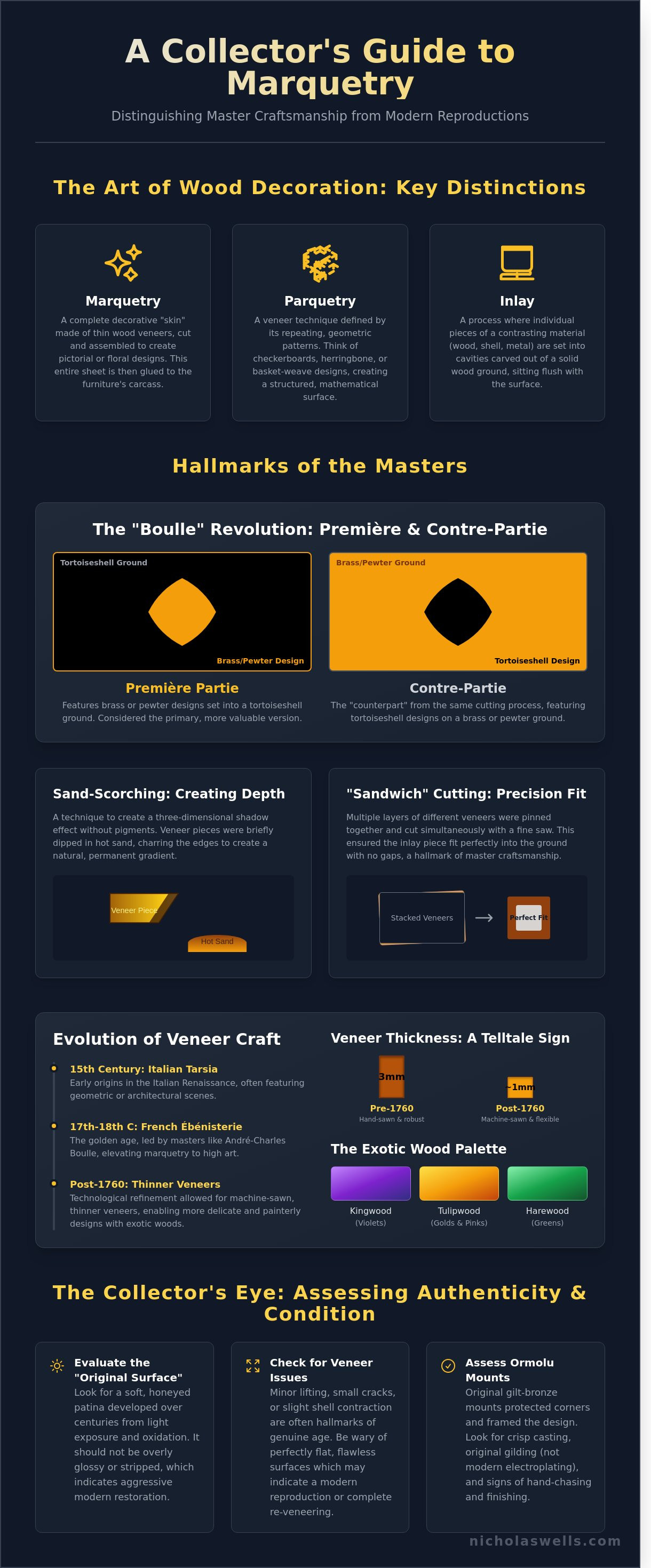
Marquetry represents the zenith of the cabinet maker's craft, a discipline where the artisan transcends mere construction to become a storyteller in timber. It’s a sophisticated veneer technique where thin, contrasting layers of wood are meticulously cut and assembled to create intricate pictorial designs. Unlike parquetry, which is defined by its repetitive geometric patterns, or inlay, where pieces are recessed into a solid ground, marquetry involves the creation of a complete decorative skin. This skin is then applied to the carcass of the furniture, resulting in a seamless, vibrant surface. Within the rigorous 18th-century workshop hierarchy, the marqueteur was a specialist of high standing, often operating independently from the joiner to produce the complex "paintings" that adorned the finest cabinet furniture.
For those exploring marquetry veneer techniques for antique furniture collectors, it's essential to recognise that these works were the ultimate status symbols of the English and Continental elite. These pieces weren't just functional; they were academic displays of wealth, botanical knowledge, and artistic patronage. At Nicholas Wells Antiques, we view these objects as significant cultural artefacts that bridge the gap between fine art and functional design.
The Evolution of Veneer Craftsmanship
The journey of this art form began with the 15th-century Tarsia techniques of the Italian Renaissance, eventually evolving into the legendary French ébénisterie of the 17th and 18th centuries. Early veneers were robust, hand-sawn to a thickness of approximately 3 millimetres. However, by 1760, technological refinements allowed artisans to produce much thinner, more flexible sheets. This shift enabled the use of exotic timbers like kingwood, tulipwood, and harewood. These rare imports provided a revolutionary palette of violets, golds, and greens, allowing the marqueteur to achieve a painterly realism previously impossible with native European woods.
Painting in Wood: The Visual Language
The visual language of marquetry is rich with hidden meaning and architectural precision. Floral compositions were rarely accidental; roses often symbolised love or royalty, while the inclusion of a tulip referenced the immense value and horticultural prestige of the era. In Neoclassical designs, you'll frequently encounter "trellis" or "diaper" patterns, which used mathematical precision to create a sense of three-dimensional depth on a flat plane.
The most compelling aspect for the connoisseur is the unique antique surface that develops over centuries. As the organic dyes fade and the timber reacts to sunlight, the piece develops a soft, honeyed patina. This aged surface is a testament to the conservation of history, ensuring that each piece at our Mayfair showroom possesses a soul that modern reproductions simply cannot emulate. We invite you to visit our antiques showroom by appointment at 169 Piccadilly to experience these extraordinary surfaces in person.
Master Techniques: From Boulle to the Neoclassical Masters
The mastery of marquetry veneer techniques for antique furniture collectors is best observed in the technical transition from the heavy Baroque to the refined Neoclassical era. This period saw the perfection of the "sandwich" cutting method, a process where multiple layers of veneer were pinned together and cut simultaneously. This allowed for absolute precision, ensuring that the inlay fit perfectly into the ground with no visible gaps. Collectors often value the depth achieved through sand-scorching; a technique where the artist briefly dipped wood pieces into hot sand to create a charred, three-dimensional shadow effect. This eliminated the need for artificial pigments, preserving the wood's natural lustre over centuries. Protective ormolu mounts were equally vital, serving as gilt-bronze frames that prevented the delicate veneers from peeling at the corners while framing the central narrative of the piece.
André-Charles Boulle and the Baroque Influence
André-Charles Boulle, appointed ébéniste du roi in 1672, revolutionised the decorative arts by marrying tortoiseshell with brass and pewter. His signature method produced two distinct styles from a single cutting: the Première Partie, featuring brass designs on a shell ground, and the Contre-Partie, which reversed the materials. When evaluating these pieces, look for the structural integrity of the 18th-century brass. Authentic period inlays often show a slight, natural contraction of the shell, a hallmark of age that modern reproductions fail to replicate. These exquisite Nicholas Wells works of art represent the pinnacle of Louis XIV grandeur and technical ambition.
Jean-Henri Riesener and the Royal French Style
By the 1770s, the aesthetic shifted toward the Neoclassical under Jean-Henri Riesener. He mastered the use of "harewood," which is sycamore chemically treated with iron oxide to achieve a sophisticated silver-grey hue. His 1774 delivery of the Bureau du Roi showcased the mechanical complexity of these pieces, where marquetry panels often concealed secret drawers and spring-loaded mechanisms. Riesener’s influence extended far beyond Versailles, shaping the London furniture trade as English makers sought to emulate his use of mother-of-pearl and exotic stained woods. This cross-pollination of marquetry veneer techniques for antique furniture collectors remains a key area of study for those identifying the provenance of 18th-century masterpieces.
If you wish to examine these intricate surfaces in person, we invite you to view our latest furniture acquisitions at our Mayfair gallery by appointment.
Regional Variations: English vs. Continental Marquetry
Distinguishing between the sober elegance of London workshops and the theatricality of Parisian ateliers requires a keen eye for the subtle transitions in timber and motif. For the discerning eye, mastering the nuances of marquetry veneer techniques for antique furniture collectors involves recognising how geographic borders dictated the choice of exotic woods and the complexity of the scrollwork. While the English aesthetic often leaned towards a balanced restraint, the Continental masters embraced a more exuberant, painterly approach to their decorative surfaces.
The English Tradition: From William & Mary to Regency
The late 17th century marked a transformative era as Dutch influence permeated the English court, bringing with it the exquisite "seaweed" marquetry that defined the William & Mary period. These intricate, symmetrical patterns of holly or boxwood were meticulously inlaid into walnut grounds, creating a lace-like effect that remains highly coveted. By the mid-18th century, the Neoclassical revival introduced a lighter palette; craftsmen utilised West Indian satinwood and harewood to execute delicate fan motifs and classical husks. Such mastery is frequently observed in the finest examples of cabinet furniture collections, where the surface patina tells a story of centuries of careful preservation. Regency interpretations later refined these motifs, often incorporating brass inlays to create a more architectural, disciplined silhouette.
Continental Flair: French and Italian Masterpieces
In contrast to British reserve, the French Louis XV style celebrated the "rocaille" with lush floral bouquets rendered in kingwood, tulipwood, and rosewood. These pieces often served as the primary inspiration for the English chest of drawers, though the French commode remained more curvaceous and heavily ornamented with gilt-bronze ormolu. Italian workshops took a different path, frequently influenced by the Grand Tour and the desire to replicate classical obelisks or architectural ruins in wood. The Italian tradition also distinguished itself through the use of "Pietra Dura," an exacting technique involving the inlay of semi-precious stones. Provenance remains the ultimate arbiter in determining the origin of these complex works, as the movement of craftsmen across 18th-century Europe often blurred the lines between regional styles. Understanding these marquetry veneer techniques for antique furniture collectors ensures that each piece is appreciated not just for its beauty, but as a significant cultural artifact of its era.
The Collector’s Eye: Assessing Condition, Patina, and Rarity
Discerning the nuances of marquetry veneer techniques for antique furniture collectors requires a shift in perspective. One must view the surface not merely as decoration, but as a living record of the object's environmental history. Lifting or bubbling in the veneer often signals a past encounter with fluctuating humidity. These undulations occur when the animal glue, a traditional adhesive used since the 17th century, becomes brittle or reacts to moisture. While some see these as flaws, the seasoned expert recognises them as markers of age that verify the piece's journey through time.
The preservation of the unique antique surface remains paramount. Over-polishing is a cardinal sin in the world of high-end decorative antiques; it strips away the historical integrity and the "soul" of the timber. A French commode from 1775 should possess a soft, deep lustre, not the aggressive, plastic-like shine associated with modern synthetic finishes. At Nicholas Wells Antiques, we adhere to a "complimentary restoration" standard. This philosophy ensures that any intervention stabilises the piece while honouring its existing character, rather than attempting to make a 250-year-old work of art look brand new.
Reading the Surface Patina
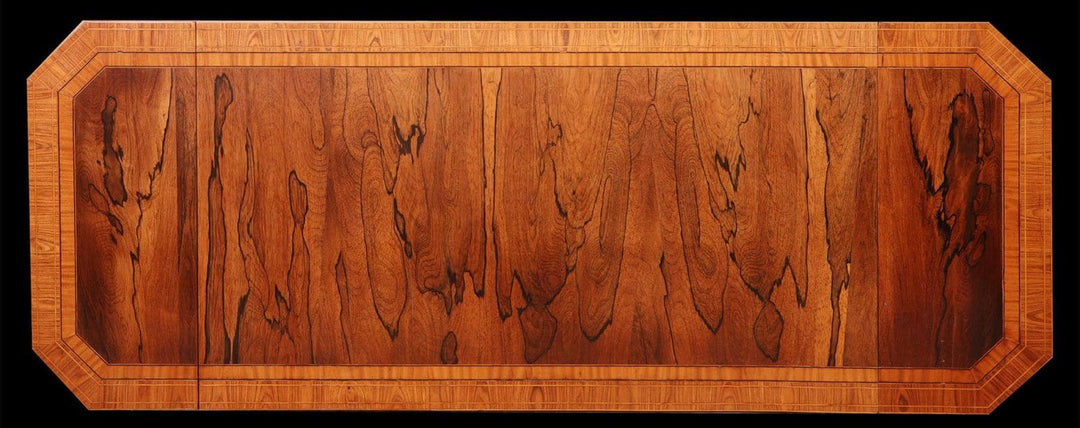
True patina is the result of oxidation and centuries of handling. It creates a depth of colour that artificial staining cannot replicate. Inspect the surface for "shrinkage cracks." These fine, horizontal lines appear as the carcass wood beneath the veneer contracts over 150 years or more. These cracks are nearly impossible to fake and serve as a certificate of authenticity for 18th-century origins. Regular waxing with traditional beeswax helps maintain this delicate equilibrium, protecting the fragile marquetry from the dry air of modern interiors.
Identifying Period-Correct Materials
Magnification reveals the secrets of the workshop. Hand-cut veneers from the Georgian era typically measure between 1mm and 2mm in thickness, showing slight irregularities from the saw. In contrast, 19th-century revival pieces often utilise machine-cut veneers that are uniform and exceptionally thin, sometimes less than 0.5mm. When evaluating the quality of antique tables, look for "harewood." This sycamore, historically treated with iron sulphate to achieve a silvery-grey tone, naturally fades to a warm, mellow golden-brown over 200 years. If the grey remains too vibrant, it may suggest a later 19th-century production.
Distinguishing between an 18th-century original and a fine 19th-century "Louis Style" revival requires an uncompromising eye for these technical details. The earlier pieces exhibit a spontaneity in the floral motifs, whereas later Victorian examples often feel too symmetrical and precise. Every nuance, from the thickness of the ebony stringing to the oxidation of the kingwood, tells a story of craftsmanship and survival.
To view our curated selection of masterfully preserved pieces, explore our antique furniture collection.
Acquiring Masterpieces: The Nicholas Wells Antiques Experience
At Nicholas Wells Antiques, we curate objects that transcend mere utility. Our London showroom, situated by appointment in the heart of Westminster, serves as a sanctuary for those seeking the pinnacle of 18th and 19th-century artistry. We specialise in sourcing rare pieces where the complexity of the wood reflects a lifetime of mastery. Every acquisition undergoes rigorous scholarly research to establish documented provenance. It’s not just about the object; it’s about the narrative. We examine the surface patina and the structural integrity to ensure every piece meets museum-quality standards. For the discerning individual, our global logistics team manages fully insured international shipping, ensuring your investment arrives safely in New York, Hong Kong, or Dubai.
A Curated Collection for the Town and Country House
Our fine antique furniture collection represents a deliberate selection of works that bridge the gap between historical grandeur and modern living. A Louis XIV floral marquetry cabinet or a Dutch William and Mary chest isn’t just a relic. It’s a focal point. These pieces offer an enduring investment value because 18th-century craftsmanship remains impossible to replicate with modern machinery. Integrating these rich textures into contemporary luxury interiors creates a layered, sophisticated aesthetic that speaks of heritage. We focus on the conservation of history, ensuring that the unique antique surfaces of each French giltwood mirror or Georgian mahogany sideboard are preserved for future generations.
Expert Guidance for New and Seasoned Collectors
Building a significant collection of decorative arts requires more than just capital; it demands an eye for the soul of the object. We assist collectors in understanding the nuances of marquetry veneer techniques for antique furniture collectors, from the delicate application of seaweed patterns to the bold geometry of parquetry. Our expertise helps you distinguish between original 1750s craftsmanship and later 19th-century revivals. This dedication to excellence extends to our selection of antique clocks, where horological marquetry showcases the intersection of mechanical precision and decorative brilliance. We invite you to visit our antiques showroom by appointment to experience these extraordinary works of art in person and begin your journey into connoisseurship.
Elevate Your Collection with Masterful Artistry
The pursuit of exceptional marquetry requires a discerning eye for the "painting in wood" that defined the 18th-century workshops of masters such as André-Charles Boulle. Mastering the nuances of marquetry veneer techniques for antique furniture collectors involves recognising the delicate balance between original surface patina and the structural integrity of the rare timbers. Since establishing our presence in London in 2012, Nicholas Wells Antiques has prioritised the conservation of history through every 19th-century French commode or Georgian desk we curate. Each piece tells a story of unparalleled craftsmanship and cultural heritage. We ensure these antique works of art maintain their soul by offering complimentary restoration by expert craftsmen before they reach your home. Whether you're seeking a rare specimen of floral marquetry or a bold Neoclassical design, your acquisition is protected by our fully insured worldwide shipping services. We invite you to visit our showroom at 169 Piccadilly by appointment to experience these extraordinary objects in person.
Explore our Curated Collection of Fine Antique Furniture
Your journey into the world of fine antiques is a testament to your appreciation for timeless beauty and historical significance.
Frequently Asked Questions
What is the difference between marquetry and inlay in antique furniture?
Marquetry is a sophisticated veneer technique where the entire surface is composed of a decorative jigsaw of timber, whereas inlay involves cutting a recess into a solid base to receive specific decorative materials. For the discerning individual, understanding these marquetry veneer techniques for antique furniture collectors is essential for distinguishing between 17th-century Flemish cabinets and later 19th-century interpretations. While inlay is an additive process, marquetry creates a complete, unified surface of varying exotic woods.
How can I tell if marquetry is 18th-century or a Victorian reproduction?
Authenticating an 18th-century piece requires a close examination of the veneer thickness and the presence of hand-saw marks. Georgian veneers typically measure 2.5mm in thickness, showing slight irregularities from the sawyer's hand, while Victorian reproductions from 1850 onwards utilize machine-cut veneers that are often a mere 0.8mm thick. The oxidation of the timber and the depth of the original shellac polish reveal a 200-year-old patina that modern chemical finishes can't replicate.
Does restoring the veneer on an antique piece decrease its value?
Professional conservation by a master craftsman preserves the longevity and market value of a piece, provided the original surface remains intact. A poorly executed repair can reduce a fine antique's auction estimate by 15% or more, particularly if modern synthetic glues are used. At Nicholas Wells Antiques, we advocate for the use of traditional animal glues to ensure that any restoration remains reversible and sympathetic to the historical integrity of these antique works of art.
What are the best woods for high-quality marquetry designs?
High-quality marquetry relies on a diverse palette of exotic and indigenous timbers, including kingwood, tulipwood, and boxwood. The 18th-century French ébénistes frequently used pearwood stained with metallic oxides to create vibrant greens and blues, though these colours often fade to a warm tobacco brown over 250 years. These specific timber choices define the character of luxury antiques and serve as a hallmark of exceptional craftsmanship found in the finest decorative antiques.
How should I care for marquetry furniture to prevent the veneer from lifting?
Preserving the delicate bond between veneer and carcass requires a stable environment with relative humidity maintained between 45% and 55%. Fluctuations cause the timber to expand and contract, which leads to the lifting or tenting of the marquetry surface. It's vital to position your French giltwood furniture away from direct heat sources and south-facing windows to prevent the desiccation of traditional hide glues that have held the piece together since 1780.
Is marquetry furniture a good investment for modern collectors?
Investing in marquetry furniture remains a sound strategy for collectors who prioritize rarity and documented provenance. Exceptional examples of 18th-century cabinetry have shown a steady appreciation of approximately 6% annually over the last decade. These pieces offer a tangible connection to history and serve as sophisticated focal points in contemporary Mayfair residences, blending historical prestige with the aesthetic demands of modern luxury living and international shipping requirements.
What is "Boulle" marquetry and why is it so highly prized?
Boulle marquetry is a premier decorative technique involving the intricate layering of tortoiseshell and engraved brass, pioneered by André-Charles Boulle during the reign of Louis XIV. This method involves cutting two layers simultaneously to create première partie and contre-partie designs. These pieces are highly prized for their architectural grandeur and the complexity of their ormolu mounts, making them a cornerstone of any serious collection of 17th-century and 18th-century decorative arts.
Can marquetry be repaired if pieces of the veneer are missing?
Missing sections of veneer can be expertly restored by a specialist using reclaimed 18th-century timber to ensure a perfect grain match. The process often involves sand-shading, where the edges of the new veneer are dipped in hot sand to create a scorched, three-dimensional effect. If you require assistance with such delicate work, we invite you to visit our antiques showroom by appointment at 169 Piccadilly to discuss conservation options for your unique antique surfaces.


Leave a comment