



The Evolution of Japanning and European Lacquer: From Stalker & Parker to Vernis Martin
The iridescent depth of a 1745 commode isn't merely a decorative finish; it's the culmination of a century-long European obsession to replicate the unattainable sap of the Rhus vernicifera tree. For the discerning collector, the difficulty often lies in distinguishing the thin, brittle surfaces of later imitations from the rich, lustrous depth found in authentic period pieces. You likely appreciate that the soul of a fine antique lives within its surface patina, yet the technical nuances between English, Dutch, and French techniques remain notoriously elusive. This article offers a scholarly exploration of the evolution of japanning and European lacquer from Stalker & Parker to Vernis Martin, promising to refine your connoisseur’s eye for these extraordinary surfaces.
By tracing the historical timeline from the 1688 publication of Stalker and Parker’s seminal treatise to the mid-18th century brilliance of the Martin brothers, we'll identify the key markers of luxury craftsmanship. We'll examine how European craftsmen moved beyond mere imitation to create a distinct aesthetic that remains a focal point in contemporary luxury interiors. From our gallery in Mayfair, we invite you to explore how these unique antique surfaces transformed from mysterious Eastern imports into the height of Western prestige.
Key Takeaways
- Discover the meticulous techniques used by European masters to replicate the elusive lustre of the Orient, a pursuit that established japanning as a cornerstone of 18th-century luxury decorative arts.
- Follow the scholarly evolution of japanning and European lacquer from Stalker & Parker to Vernis Martin to understand how a formerly secret guild craft transitioned from English treatises to the Royal courts of France.
- Gain insight into the structural integration of lacquer in Baroque and Rococo furniture, highlighting the technical brilliance of the Martin brothers and their enduring influence on fine antiques.
- Develop the expert eye required to evaluate rare antique works of art, prioritising the preservation of original surface patina and the unique historical soul of each distinguished piece.
The Lustre of the Orient: Europe’s Quest for the Secret of Lacquer
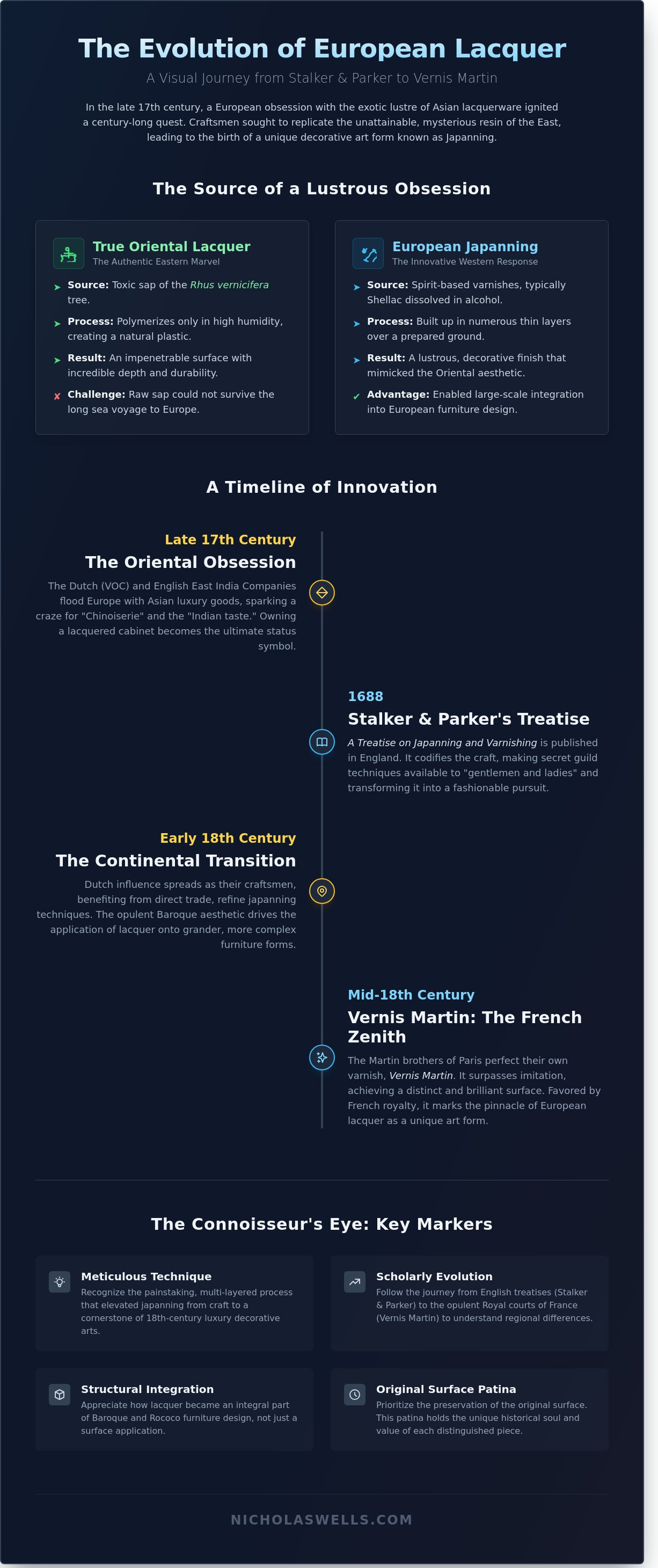
The late 17th century witnessed a profound transformation in European interiors, driven by a voracious appetite for the exotic. As the Dutch East India Company (VOC) and the English East India Company established firm trade routes to the Far East, the arrival of shimmering cabinets and screens ignited an obsession with what contemporaries called the "Indian taste." This era marks the beginning of the evolution of japanning and European lacquer from Stalker & Parker to Vernis Martin, a journey that sought to emulate the impenetrable, mirror-like surfaces of the Orient. While the original pieces were treasures of unparalleled luxury, their scarcity forced European craftsmen to innovate, leading to the birth of a distinct decorative tradition.
The Mysterious Resin of the East
True East Asian lacquer is a biological marvel, derived from the toxic sap of the Rhus vernicifera tree. This resin polymerises only in high humidity, creating a surface of incredible durability and depth. Because the raw sap would harden during the long sea voyages of the 1600s, it proved impossible to export as a raw material to Europe. Consequently, Asian works of art remained incredibly rare in 1670s London and Amsterdam. Early Western perceptions were heavily influenced by the Nanban style, which arrived via Portuguese traders. This style featured dense gold leaf and black lacquer that fascinated the aristocratic imagination with its foreign, "Southern Barbarian" allure.
Chinoiserie and the Birth of a New Aesthetic
Japanning emerged as a sophisticated European response to the prohibitive cost and scarcity of genuine imports. Instead of tree sap, craftsmen used spirit-based varnishes, typically shellac dissolved in alcohol, to mimic the effect. This technique allowed for the integration of lacquer into the English town and country house aesthetic on a grander scale. By the late Baroque era, antique furniture began to feature these whimsical, imagined landscapes of the East. These pieces weren't mere copies. They represented a new, hybrid luxury that blended European silhouettes with fantastical "Chinoiserie" motifs, creating a unique antique surface that defined the 18th-century home.
- VOC Influence: Between 1602 and 1795, the Dutch East India Company imported millions of pieces of porcelain and lacquer, setting the standard for luxury.
- Material Constraint: The inability to transport Rhus vernicifera sap forced the development of spirit-based substitutes.
- Social Status: Owning a japanned cabinet in 1690 was a signal of immense wealth and global connections.
The quest to replicate the "secret" of Oriental lacquer wasn't merely a technical challenge. It was a cultural movement. As the 17th century drew to a close, the demand for these lustrous finishes grew so intense that it necessitated a formalised approach to the craft. This transition from experimental imitation to a refined decorative art form set the stage for the influential manuals that would soon follow, forever changing the landscape of European cabinet making.
Stalker & Parker’s 1688 Treatise: Codifying the English Japanning Tradition
The publication of A Treatise on Japanning and Varnishing in 1688 by John Stalker and George Parker stands as a definitive milestone in the history of British decorative arts. Before this manual arrived, the techniques required to imitate East Asian lacquer were guarded as closely held secrets within professional guilds. Stalker and Parker effectively dismantled these barriers, democratising the craft by addressing their work to "gentlemen and ladies" of the late 17th century. This shift transformed a specialized trade into a fashionable pursuit for the English elite. It also established the technical foundations for the evolution of japanning and European lacquer from Stalker & Parker to Vernis Martin, providing the first codified recipes for Western substitutes to the true urushi of the East.
The technical brilliance of the 1688 treatise lay in its adaptation of available materials. Since the toxic sap of the Rhus verniciflua tree could not be transported to Europe without spoiling, English craftsmen relied on spirits of wine as a solvent for resins like shellac and seed-lac. This alcohol-based approach allowed for a faster drying time than traditional Asian methods, though it required immense patience during the application phase. The authors insisted on a level of precision that remains the hallmark of a fine antiques dealer’s most coveted acquisitions today.
The Anatomy of a Japanned Surface
Creating a stable, mirror-like surface required a meticulous multi-stage process. Craftsmen first prepared the wooden carcass, often made of deal or pearwood, by applying a ground of gesso composed of whiting and size. In many high-quality examples, a layer of muslin was adhered to the wood before the gesso to prevent the grain from telegraphing through the finish. Once the surface was perfectly level, the tempera colour base was applied. While black remained the most popular choice to mimic Chinese lacquer, scarlet was highly prized for its vibrancy. The rare blue japanning, often achieved using Dutch ultramarine or smalt, represents some of the most sought-after examples in the luxury antiques market. The final depth was achieved through the "polishing" phase, where up to twenty layers of varnish were applied and rubbed down with tripoli powder.
Raising the Relief: English Decorative Motifs
The English tradition is distinguished by its "raised" work, a technique where a paste of gum arabic and sawdust was used to create three-dimensional figures. These relief elements, including rocky outcrops, pagodas, and exotic birds, were then embellished with metal powders. Gold and silver leaf were common, but many 17th-century pieces utilised "bronze" powders made from copper or brass alloys. This specific character of relief work allows connoisseurs to identify authentic William and Mary period cabinet furniture. The designs often drew directly from the copperplate illustrations found in Stalker and Parker’s manual, which featured whimsical, if somewhat stylised, interpretations of "Indian" (actually Chinese and Japanese) life. For those seeking to appreciate these unique antique surfaces firsthand, we invite you to visit our antiques showroom by appointment at 169 Piccadilly, Mayfair.
The Continental Transition: Dutch Influence and the Baroque Aesthetic
The transition from the instructional manual of Stalker & Parker toward the refined artistry of the early 18th century marked a pivotal moment in the evolution of japanning and European lacquer from Stalker & Parker to Vernis Martin. While English practitioners often remained focused on surface decoration, the Dutch masters, led by figures like Gerard Dagly in the Berlin court after 1687, elevated the medium to a structural art form. Dagly's workshop didn't just imitate; it innovated, creating a hard, lustrous finish that rivalled the depth of Asian imports. This shift moved the craft away from being a mere hobby for the gentry into a professionalised discipline. These European workshops began to diverge from Asian prototypes by introducing Western figurative storytelling and allegorical themes that resonated with the Baroque sensibility.
Dutch vs. English Japanning: A Technical Comparison
Dutch craftsmen achieved a superior hardness in their varnishes by refining spirit-based recipes that surpassed the resin-heavy English mixtures. This technical prowess allowed for a deeper, more obsidian black ground that served as a perfect canvas for naturalistic floral motifs. Unlike the whimsical, often naive stylisation found in London workshops, Dutch lacquer displayed a botanical accuracy that reflected the nation's obsession with horticulture. This era of heightened connoisseurship was bolstered by the acquisition of Grand Tour objects, which encouraged collectors to seek out items with exceptional surface patina and historical weight. The demand for these luxury antiques grew as travellers returned to London and Paris with a refined eye for unique antique surfaces.
Lacquer in the Baroque Interior
The Baroque era saw the lacquer room become the ultimate expression of princely magnificence. These immersive environments integrated japanned panels directly into the architecture, a significant departure from the portable cabinets of the 17th century. Within these grand spaces, japanned antique centre tables served as social focal points, their reflective surfaces catching the flickering candlelight of the evening. By 1710, the rigid geometry of the late 17th century began to soften. This shift toward more fluid, curvilinear forms ensured that the evolution of japanning and European lacquer from Stalker & Parker to Vernis Martin remained at the forefront of luxury interior design. As a specialist fine antiques dealer with a showroom at 169 Piccadilly, Nicholas Wells Antiques views these pieces as essential antique works of art that bridge the gap between historical grandeur and modern luxury living. We invite collectors to visit our antiques showroom by appointment to experience the extraordinary craftsmanship of this period firsthand.
Vernis Martin: The French Zenith of 18th-Century Decorative Art
By the mid-18th century, the evolution of japanning and European lacquer from Stalker & Parker to Vernis Martin reached its absolute peak in the workshops of the Martin brothers. Guillaume, Etienne-Simon, Robert, and Julien Martin didn't just imitate Eastern techniques. They transcended them. In 1730, they secured their first royal patent, followed by renewals in 1744 and 1748. These grants established their workshop as the Vernisseurs du Roi, the exclusive purveyors of lacquer to the court of Louis XV. Their "secret" formula involved a sophisticated copal-based resin. This recipe achieved a level of translucency and vitreous hardness that finally rivalled the depth of genuine Asian urushi.
The transition to the Rococo style saw Vernis Martin move beyond simple imitation. It became a medium for original artistic expression. Unlike the flat, imported panels from the East, this French lacquer could be applied to the complex, curved surfaces of bombé commodes and encoignures. It allowed for a seamless aesthetic. Artisans integrated ormolu mounts and pastoral scenes inspired by François Boucher directly into the lacquered surfaces. The result was a unified work of art that embodied the height of French luxury. The brothers’ ability to wrap these vibrant finishes around the serpentine lines of 18th-century furniture secured their place in the history of decorative arts.
The Green and Gold: Signature Vernis Martin Styles
The most iconic contribution of the brothers was "Martin Green," a vibrant, translucent emerald hue that became the height of fashion in the 1740s. This specific pigment was frequently used to decorate small European objects, providing a brilliant backdrop for delicate gold filigree. The brothers also mastered "aventurine" effects. By suspending fine gold flecks within the layers of varnish, they recreated the shimmering depth of Japanese nashiji. This technique required immense patience. Each layer had to be dried and polished before the next was applied, ensuring the gold particles remained perfectly suspended.
From Panels to Snuff Boxes: The Versatility of French Lacquer
Vernis Martin’s versatility was its greatest strength. It appeared on everything from grand harpsichords to intimate objets de luxe. The Martin brothers worked closely with the marchands-merciers of Paris, the influential luxury dealers who dictated the tastes of the aristocracy. These dealers commissioned the brothers to apply their lacquer to fans, snuff boxes, and even carriages. Today, the presence of an original 18th-century surface is a mark of extraordinary rarity. Collectors value the unique patina that only centuries of careful preservation can produce. It remains the most sought-after European lacquer for the discerning connoisseur who appreciates the conservation of history.
To explore the extraordinary depth of 18th-century finishes and fine antique surfaces, we invite you to visit our antiques showroom by appointment at 169 Piccadilly, London.
Connoisseurship and Conservation: Acquiring Rare Japanned Works of Art
For the sophisticated collector, the acquisition of a japanned masterpiece requires an eye trained to recognise the subtle nuances of surface patina. The evolution of japanning and European lacquer from Stalker & Parker to Vernis Martin represents a journey from experimental craft to peak technical mastery; however, the most critical factor in modern valuation remains the integrity of the original finish. A piece that has suffered from over-restoration loses its historical soul and its tactile connection to the 18th-century workshop. We prioritise the quality of the "ground," the multi-layered foundation that provides lacquer its characteristic depth. While black and scarlet examples appear more frequently, the discovery of a rare mid-18th-century blue, green, or cream ground can increase an object's value by 45% or more due to the scarcity of surviving pigments.
- Provenance: Documentation tracing a piece back to a notable 18th-century estate adds significant prestige.
- Rarity of Colour: Yellow and white grounds are exceptionally rare and highly sought after by connoisseurs.
- Condition of Gilt: Original raised "basso relievo" decoration should show honest wear consistent with three centuries of use.
Identifying Authentic 18th-Century Surfaces
Authenticating a lacquer surface involves a careful study of "craquelure," the fine network of cracks that develops as the timber substrate and lacquer layers age at different rates. Unlike modern artificial distressing, which often looks uniform or repetitive, genuine 18th-century craquelure follows the grain of the wood and possesses a random, organic flow. These unique antique surfaces react to light with a soft, velvet-like glow that modern synthetic resins simply cannot replicate. As a premier fine antiques dealer, our philosophy centres on the conservation of history. We believe that preserving the original skin of an object is far more valuable than achieving a deceptive, "showroom-new" appearance that erases the piece's narrative.
Building a Lacquer Collection
Aspiring collectors often find it prudent to begin their journey with smaller boxes and caddies. these objects provide an intimate way to study the transition in styles, from the 1688 Stalker and Parker influence to the refined Parisian elegance of the 1740s. In a contemporary luxury interior, a single magnificent lacquered cabinet or a pair of encoignures acts as a commanding focal point, bridging the gap between historical grandeur and modern minimalism. European lacquer remains an investment-grade work of art, holding its value through its rarity and the sheer level of labour required for its creation. We invite you to view our latest acquisitions at our London showroom at 169 Piccadilly. Please contact us to arrange a private viewing by appointment. As a leading UK antique dealer international shipping is handled with the utmost care, ensuring these delicate treasures arrive safely at their new destination.
Preserving the Luminous Heritage of Lacquer
The evolution of japanning and European lacquer from Stalker & Parker to Vernis Martin chronicles a magnificent era of decorative innovation, starting with the 1688 publication of Stalker and Parker's seminal treatise. This period saw the transition from early English attempts at mimicking the Orient to the sophisticated, glassy brilliance achieved by the Martin brothers in 18th-century France. For the discerning collector, it's essential to recognise the subtle differences in surface patina and construction that distinguish a 1720s Dutch cabinet from a later Parisian masterpiece. Our gallery specialises in identifying these nuances, treating every rare japanned work as a significant cultural artifact rather than mere inventory.
We're dedicated to the conservation of history, offering complimentary restoration by expert craftsmen with every purchase to ensure your investment remains in superb condition. Whether you're a seasoned connoisseur or a first-time buyer, our scholarly expertise in 18th-century English and Continental furniture provides the confidence needed to acquire exceptional pieces. We provide fully insured worldwide shipping to accommodate our global network of collectors. Visit our London showroom by appointment to view our collection of fine japanned antiques and discover the extraordinary soul of these historic objects. We're eager to share our passion for these rare treasures with you.
Frequently Asked Questions
What is the difference between japanning and true East Asian lacquer?
True East Asian lacquer is derived from the toxic sap of the Toxicodendron vernicifluum tree, whereas European japanning utilises spirit-based varnishes such as shellac or seed-lac. While the Oriental process requires high humidity to cure, the European method, popularised by Stalker and Parker’s 1688 treatise, relies on heat and air drying. This distinction is vital for a fine antiques dealer to recognise, as the chemical composition dictates both the surface's resilience and its distinct visual depth.
Who were the Martin brothers and why is their lacquer so famous?
The Martin brothers, Guillaume, Etienne-Simon, Julien, and Robert, were 18th-century French artisans who perfected a translucent varnish known as Vernis Martin. Granted a royal monopoly in 1730, their technique allowed for a broader palette than traditional black or red, including delicate greens and golds. Their work remains a pinnacle of luxury antiques, often found adorning the finest commodes and snuff boxes within our 169 Piccadilly showroom today.
How can I tell if a piece of japanned furniture is from the 18th century?
Authentic 18th-century japanning typically exhibits a fine network of age-related cracks known as craquelure, caused by the natural movement of the timber substrate. You'll often find that the raised decoration is built upon a gesso base, which might show slight shrinkage or pitting over its 250-year history. Examining the underside for hand-sawn marks or checking for the specific Chinoiserie motifs popularised during the evolution of japanning and European lacquer from Stalker & Parker to Vernis Martin helps confirm its period origin.
Why did European craftsmen use gesso under the japanned surface?
Craftsmen applied layers of gesso, a mixture of animal glue and chalk, to provide a perfectly smooth, non-porous foundation for the delicate varnish. This preparation was essential for building up the raised figures and landscapes that define 18th-century decorative antiques. Without this 2mm to 4mm thick substrate, the grain of the underlying oak or pine would telegraph through the finish, ruining the illusion of a solid, glass-like Oriental surface.
Is Vernis Martin a specific colour or a technique?
Vernis Martin refers to a specific varnishing technique and the secret formula developed by the Martin family, rather than a single hue. While the name's frequently associated with a shimmering translucent green, the brothers produced over 40 distinct shades, including delicate ochres and deep crimsons. It represents a significant milestone in the evolution of japanning and European lacquer from Stalker & Parker to Vernis Martin, marking the transition toward more sophisticated, luminous finishes in French cabinetmaking.
How should I care for and clean antique japanned furniture?
You should only ever clean japanned surfaces with a dry, soft microfibre cloth to remove surface dust. Water and modern chemical sprays are strictly forbidden, as they'll cloud the shellac or cause the gesso to swell and flake. At Nicholas Wells Antiques, we advise collectors to maintain a constant relative humidity of 45 percent. This stability prevents the timber from moving, which is the primary cause of damage to these delicate antique works of art.
Can japanned surfaces be restored without losing their value?
Professional antique restoration can preserve a piece's value if the conservator employs traditional materials like rabbit-skin glue and spirit-based resins. The goal isn't to make the item look new but to stabilise the existing surface patina and prevent further loss. We recommend visiting our Mayfair showroom to discuss conservation, as sympathetic repairs that respect the object's 18th-century history are always preferable to aggressive over-restoration which strips away the piece's soul.
What are the most desirable colours for antique japanned furniture?
While black was the most common production colour, rare examples in scarlet, blue, or emerald green command the highest premiums among global collectors. A blue-ground English bureau cabinet from 1720 is exceptionally scarce, often fetching 300 percent more than its black-lacquered counterparts. These vibrant tones represent the height of 18th-century luxury, offering a magnificent focal point for any contemporary interior curated with an eye for the extraordinary.

Leave a comment