



The History of Chesterfield Sofa and Daybed Antiques: A Connoisseur’s Guide
The true soul of an English Country House often resides not in its architecture, but in the deep-buttoned leather of a piece that has witnessed two centuries of quiet conversation. Many collectors find it increasingly difficult to distinguish a genuine 19th-century masterpiece from the ubiquitous, low-quality reproductions that flooded the market after 1970. Understanding the scholarly history of Chesterfield sofa and daybed antiques requires an appreciation for the uncompromising craftsmanship of the Georgian and Victorian eras. At Nicholas Wells Antiques, we recognise that a piece's value lies in its provenance and the unique antique surfaces that only time can bestow.
You're likely aware that a genuine antique offers a level of prestige that modern furniture cannot replicate; however, the technical nuances of 18th-century beech frames and hand-lashed springs remain elusive to many. This guide promises to clarify the evolution of these iconic forms, from the legendary commissions of Philip Stanhope, the 4th Earl of Chesterfield, to the subtle terminological shifts between the aristocratic daybed and the chaise longue. We'll examine how to identify superior craftsmanship and why the original surface patina is the ultimate hallmark of a distinguished investment. From our gallery at 169 Piccadilly, we invite you to explore the enduring legacy of these extraordinary works of art.
Key Takeaways
- Trace the aristocratic lineage of this iconic design to the 4th Earl of Chesterfield, identifying the hallmark characteristics of deep-buttoned upholstery and equal back height that define these magnificent antique works of art.
- Gain a scholarly understanding of the history of Chesterfield sofa and daybed antiques by exploring the 19th-century technical evolution of deep-buttoning and the use of rare mahogany and oak frames.
- Discover the refined role of the daybed as a bridge between formal seating and the chaise longue, traditionally curated within the scholarly atmosphere of the English Country House library or smoking room.
- Learn how to evaluate the 'conservation of history' by recognising original 19th-century hide and the irreplaceable value of authentic surface patina when assessing high-value seating.
- Master the art of integrating these sculptural focal points into contemporary interiors, pairing distinguished buttoned seating with delicate antique mirrors to achieve a balanced, luxury aesthetic.
The Aristocratic Origins of the Chesterfield Sofa
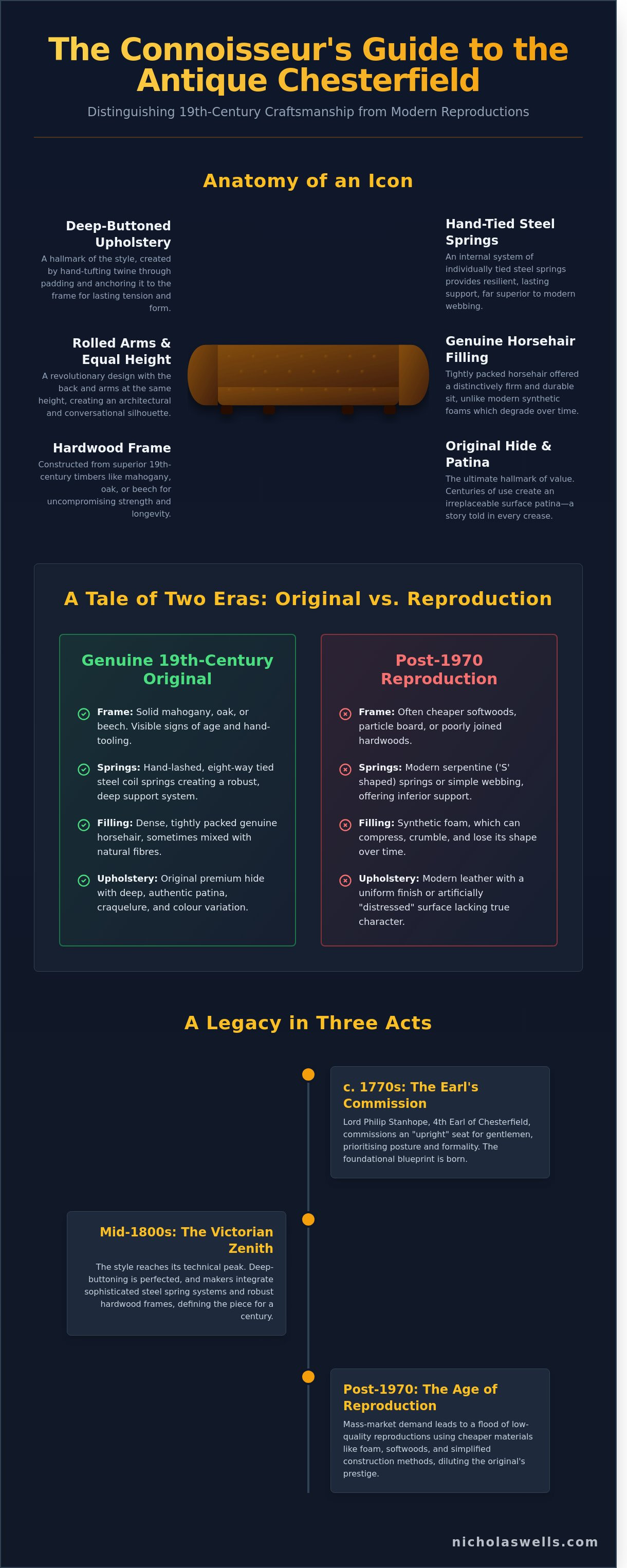
The history of Chesterfield sofa and daybed antiques is inextricably linked to the evolution of British craftsmanship and the rigid social hierarchies of the 18th century. It's a narrative that begins not in a workshop, but within the refined drawing rooms of the English elite. The design is defined by its hallmark characteristics: deep-buttoned upholstery, rolled arms of substantial girth, and a back height that sits level with the arms. This silhouette creates a sense of enclosure and architectural permanence that few other pieces of furniture can claim. For the fine antiques dealer, these pieces represent the pinnacle of Georgian and Victorian seating, embodying a transition from purely functional objects to significant cultural artifacts.
The legend of the design's inception centres on Lord Philip Stanhope, the 4th Earl of Chesterfield (1694–1773). As a distinguished diplomat, man of letters, and a dominant figure in London society, Stanhope required a seat that mirrored the formal etiquette of his era. He commissioned a piece of "upright" seating that allowed a gentleman to sit comfortably without compromising the pristine lines of his attire. This marriage of early ergonomics and social grace birthed a style that would eventually move from the Earl's private residence to the most exclusive gentlemen's clubs of Mayfair and Piccadilly, solidifying its status as a symbol of British prestige.
The 4th Earl of Chesterfield and the Birth of a Classic
Lord Philip Stanhope was a renowned trendsetter whose influence over 18th-century taste was absolute. During the 1770s, the aesthetic shift toward bespoke, commissioned furniture for London townhouses meant that every detail of a piece was a reflection of the owner's status. The Earl's insistence on a firm, upright sit was a direct response to the social formality of the Georgian period, where slouching was considered a grave lapse in character. These early commissions were the precursors to the luxury antiques we admire today, serving as the foundational blueprint for the history of Chesterfield sofa and daybed antiques.
Defining the Aesthetic: More Than Just Buttons
The structural requirement of the rolled arm served as more than a stylistic flourish; it provided a robust architectural frame that anchored the room. This equal height of the back and arms was a revolutionary departure from the high-backed chairs common in the early 1700s, offering a more democratic and conversational seating arrangement. Early 19th-century examples utilised specific, high-quality materials that define their value in the current market:
- Hand-tied steel springs that provided a resilient, lasting support system.
- Fillings of genuine horsehair, which offered a distinctively firm sit compared to modern foams.
- Premium hides that, over centuries, have developed a magnificent surface patina.
For collectors visiting our showroom at 169 Piccadilly, the appeal of these pieces lies in the conservation of history. Every crease in the leather and every hand-carved mahogany foot tells a story of survival and taste. Whether it's a rare 19th-century specimen or a later Edwardian interpretation, the Chesterfield remains a focal point in any sophisticated interior, bridging the gap between historical grandeur and contemporary luxury living.
Technical Evolution: Deep-Buttoning and Period Construction
The 19th century witnessed a radical shift in the history of Chesterfield sofa and daybed antiques, as makers moved beyond mere aesthetics toward sophisticated internal engineering. Early iterations relied on tightly packed horsehair, which, while durable, tended to migrate without proper containment. This necessitated a structural solution that would eventually become the hallmark of the style. By the mid-1800s, the marriage of form and function reached its zenith, resulting in pieces that were as robust as they were refined.
The Craft of Deep-Buttoning and Surface Tension
Hand-tufting requires an artisan to pull heavy twine through the upholstery and padding, anchoring it securely to the frame with leather-covered buttons. This painstaking process creates the iconic diamond-shaped depressions that define the genre's silhouette. The tension created by this method ensures the upholstery remains taut over decades of use, preventing the unsightly sagging common in lesser furniture. Deep-buttoning is the quintessential technique that prevents the shifting of natural fillings. This method allowed craftsmen to use a higher volume of horsehair and wool, creating a plush, sculpted surface that maintained its integrity under the weight of the sitter.
Frame Integrity: Mahogany, Oak, and Walnut
The longevity of a fine antique seating piece depends entirely on the timber hidden beneath its skin. Master craftsmen in the 18th and 19th centuries favoured solid mahogany and oak for their exceptional density and resistance to warping. These timbers provided the necessary weight to support the increased tension of the tufting process. Feet were often hand-carved in the Georgian tradition, featuring elegant bun or claw-and-ball motifs that anchored the piece's visual weight. You can observe similar excellence in timber selection within our cabinet furniture collection, where the grain and strength of the wood remain paramount.
The Victorian era introduced the steel coil spring, which was patented for furniture use in 1828. This innovation transformed the seat's resilience, moving away from the firmer, upright feel of the Georgian period toward a more yielding, immersive comfort. While Georgian pieces often utilised leather or heavy wool damasks, the Victorian preference shifted toward rich, deep-pile velvets that accentuated the shadows within the tufting. Edwardian makers later refined these forms, often slimming the proportions to suit the lighter, more airy interiors of the early 1900s. Each era left a distinct mark on the history of Chesterfield sofa and daybed antiques, reflecting the evolving tastes of the British elite. If you're seeking a specific period piece for your collection, we invite you to view our exceptional seating or visit our showroom at 169 Piccadilly by appointment.
The Chesterfield Daybed: An Evolution of Luxury and Leisure
The daybed occupies a singular position in the history of Chesterfield sofa and daybed antiques. It functions as a sophisticated bridge between the rigid formality of a standard settee and the indulgent relaxation of the classical chaise longue. During the mid 19th century, British cabinet makers adapted the signature deep buttoning of the Chesterfield to these recumbent forms. They created pieces that were both structurally robust and aesthetically refined. It's a form that prioritises comfort without sacrificing the distinguished silhouette that defines the Chesterfield tradition.
From Classical Chaise to the Chesterfield Form
The Grand Tour played a decisive role in introducing neoclassical silhouettes to the English home during the early 1800s. While the French méridienne favoured asymmetrical, flowing lines, the British interpretation embraced the disciplined geometry of the Chesterfield. This transition saw the delicate frames of Grand Tour objects influence the proportions of seating, yet the English daybed remained distinct through its use of heavy, hand-dyed leathers. Collectors often look for the transition from the Greek kline to the fully upholstered Victorian daybed as a mark of refined taste.
The history of Chesterfield sofa and daybed antiques reveals a fascinating shift from rigid formality to the comfort of the reclining form. By the 1850s, the addition of the deep-buttoned technique provided a level of support and durability that earlier, lightly padded chaises couldn't match. It's this fusion of classical inspiration and British engineering that makes these pieces so desirable for a contemporary interior.
The Daybed in the Country House Library
Libraries and smoking rooms of the 19th century required furniture that reflected a specific masculine gravitas. The daybed became a staple in these retreats by the 1860s, offering a space for scholarly reflection or rest. These pieces often feature deep, dark patinas on bovine hide, designed to withstand decades of use in a private study. Positioning a magnificent daybed alongside one of our antique centre tables creates a curated environment that evokes the quiet confidence of a Victorian estate.
These environments demanded materials that aged with grace. The use of horsehair stuffing and hand-tied springs ensured that the daybed maintained its form despite frequent use. When you visit our antiques showroom by appointment at 169 Piccadilly, you'll see how the surface patina of these 19th century pieces acts as a historical record of their provenance.
Identifying rare examples from the 1860s requires an eye for original mechanical details. Many superb daybeds from this era featured:
- Adjustable Ratchet Ends: These allow the sitter to alter the angle of repose for reading or sleeping.
- Original Brass Castors: Often stamped by prestigious makers like Cope & Collinson, these indicate a piece of higher quality.
- Hand-Dyed Hide: Original 19th century leather often shows a depth of colour that modern spray-finishes can't replicate.
Such mechanisms, when found in working order with their original brass hardware, significantly elevate the value of the piece. The preservation of the original unique antique surfaces is equally vital. It serves as a testament to the item’s journey through time. As a fine antiques dealer, we emphasise the conservation of history, ensuring that each piece of seating we offer retains its soul and structural integrity for the next generation of connoisseurs.
Connoisseurship: Evaluating Provenance and Surface Patina
The history of Chesterfield sofa and daybed antiques is written into the very skin of the piece. For the discerning collector, original surface patina represents the most valuable asset of any acquisition. It's a delicate, chronological record of light exposure, human touch, and the gentle passage of time that no modern workshop can replicate. When a piece undergoes over-restoration, it often loses its soul. The goal of a true connoisseur is the conservation of history, ensuring the narrative of the object remains intact rather than being erased by modern intervention.
Understanding the Unique Antique Surface
Authentic 19th-century hide displays a specific vocabulary of age that distinguishes it from later reproductions. You'll find fine craquelure across the deep-buttoned tufts and a gradual, sophisticated softening of colour where sunlight has filtered across the leather over 150 years. Genuine wear patterns are inherently irregular; they follow the natural movements and habits of the sitters throughout the Victorian and Edwardian eras. In contrast, 20th-century 'distressed' leather often feels uniform, predictable, or chemically scorched. Beyond the surface, the internal components tell their own story. The distinct 'crunch' of original horsehair stuffing is a hallmark of traditional craftsmanship. Unlike modern foam, which typically degrades into dust after 25 years, horsehair maintains its structural integrity and historical resonance for centuries.
The Value of Provenance and Maker’s Marks
Provenance transforms a piece of furniture into a significant cultural artifact. A documented history linking a sofa to a specific grand estate or a notable collection provides a narrative that collectors prize above all else. Evidence of manufacture is equally vital. Look for marks of prestige that signal a high-value investment. Stamps from premier London makers, such as the renowned Howard & Sons, are frequently found on the inside of a rear leg or stamped into the brass casters. These marks serve as a signature of quality that has remained unchallenged since the mid-1800s. To truly understand these nuances, you should visit our antiques showroom by appointment at 169 Piccadilly to examine these extraordinary surfaces in person. Seeing the interplay of natural light on a 19th-century hide reveals why these pieces remain the pinnacle of luxury antiques. Identifying these details requires an educated eye, but the reward is owning a piece of the history of Chesterfield sofa and daybed antiques that has been preserved with integrity.
View our current collection of luxury antique seating to discover pieces with exceptional provenance and original surfaces.
Integrating the Chesterfield into the Modern Luxury Interior
The presence of a Chesterfield sofa within a contemporary residence transcends mere utility; it functions as a profound sculptural anchor. In the expansive open-plan apartments of Mayfair or the historic townhouses surrounding Piccadilly, these pieces offer a grounding weight that modern furniture often lacks. The deep buttoning and rolled arms create a rhythmic texture, catching the light in a way that highlights the depth of the leather or the sheen of period velvet. This aesthetic power is central to the history of Chesterfield sofa and daybed antiques, where form was always intended to command the room. It's a design language that speaks of stability and heritage.
To achieve a balanced interior, designers frequently pair the substantial mass of a 19th-century Chesterfield with the ethereal quality of antique mirrors. The reflection of a heavily patinated gilt frame against the dark, hand-dyed hide of a sofa creates a dialogue between light and shadow. This interplay defines the luxury antiques market in London, where our showroom at 169 Piccadilly serves as a beacon for those seeking such harmonious compositions. By integrating these historic pieces, a room gains a soul that contemporary replicas cannot replicate.
A Bridge Between Eras: Styling the Antique
Placing a dark leather Chesterfield alongside vibrant modern art or a minimalist sculpture creates a compelling tension. The low profile of these sofas is particularly effective in preserving sightlines across large drawing rooms, ensuring that the architectural integrity of the space remains uninterrupted. To complete a sophisticated seating arrangement, we suggest incorporating complementary pieces from our seating collection. This layering of periods adds a sense of curated history rather than a manufactured atmosphere. It's about finding the thread that connects a Georgian frame to a 21st-century aesthetic.
Bespoke Restoration and Global Acquisition
Nicholas Wells Antiques remains dedicated to the conservation of history. Our restoration service emphasises the preservation of the original surface patina, ensuring that every mark and crease remains as a testament to the piece's journey. We understand the requirements of international collectors, providing expert UK antique dealer international shipping to destinations like New York and Hong Kong. Clients are invited to explore our latest acquisitions in our seating collection or visit our showroom by appointment to witness the extraordinary quality of these antique works of art. The history of Chesterfield sofa and daybed antiques continues through these carefully preserved examples, ready for their next century of use.
Investing in the Legacy of British Craftsmanship
The history of Chesterfield sofa and daybed antiques traces a fascinating journey from the 4th Earl of Chesterfield’s 18th-century aristocratic commissions to the technical spring-seating innovations of the 1830s. These pieces aren't merely functional items; they're significant cultural artefacts that represent the pinnacle of Victorian luxury and leisure. A discerning collector recognises that the value of a 19th-century mahogany daybed or a deep-buttoned leather sofa lies in its unique antique surfaces and documented provenance. Preserving the integrity of these luxury antiques ensures they remain sophisticated focal points in any contemporary Mayfair or international interior.
As a specialist fine antiques dealer, Nicholas Wells Antiques offers an expertly curated collection of antique works of art at our showroom at 169 Piccadilly. Every purchase includes complimentary restoration by our skilled artisans and fully insured worldwide shipping from London. We invite you to Explore our curated collection of fine antique seating and daybeds or visit our gallery by appointment to experience the extraordinary quality of these timeless designs firsthand.
Frequently Asked Questions
What defines a true antique Chesterfield sofa?
A true antique Chesterfield sofa is defined by its iconic deep-buttoned upholstery, rolled arms of the same height as the back, and a minimum age of 100 years. These pieces typically feature hand-tied coil springs and solid mahogany frames that distinguish them from modern reproductions. Fine antiques dealers identify genuine 19th-century examples by their hand-stitched details and the presence of original horsehair stuffing. Every piece in our Mayfair collection exhibits these hallmarks of superior Victorian craftsmanship.
How can I tell if my Chesterfield daybed is a Victorian original?
You can identify a Victorian original by examining the underside for hand-carved mahogany legs and hand-forged iron castors dating between 1837 and 1901. Original 19th-century specimens utilize horsehair and coconut fibre stuffing rather than synthetic foam or modern staples. If you find evidence of hand-stitched burlap and brass-headed nails, you're likely looking at a genuine work of art from the mid-to-late 1800s. We invite you to visit our antiques showroom by appointment to compare your piece with authenticated examples.
Why is original leather patina so important for antique value?
Original leather patina is vital because it provides an unforgeable record of a piece's history and adds approximately 30% to 50% to its market value. This unique antique surface develops over 100 years of use, creating a depth of colour and texture that modern tanning cannot replicate. We prioritise the conservation of history by preserving these surfaces, as they represent the true soul of luxury antiques and command higher prices among discerning global collectors.
Is the 4th Earl of Chesterfield really the inventor of the sofa?
History credits Philip Stanhope, the 4th Earl of Chesterfield, with commissioning the first leather-covered, deep-buttoned sofa around 1770. While no 18th-century prototype survives, his request for a seat that allowed a gentleman to sit upright without wrinkling his garments established the design's DNA. This legacy remains central to the history of Chesterfield sofa and daybed antiques, influencing luxury furniture design for over 250 years. Our showroom at 169 Piccadilly continues to celebrate this distinguished heritage through our curated inventory.
What materials were used for the frames of 19th-century Chesterfields?
Master craftsmen in the 19th century exclusively used solid hardwoods such as seasoned mahogany, oak, or beech for Chesterfield frames. These robust timbers were joined with hand-cut mortise and tenon joints to ensure the piece could withstand the immense tension of deep-buttoning. We often encounter frames from 1850 that remain as structurally sound as the day they were built. This structural integrity is why we offer UK antique dealer international shipping to clients who value longevity and historical accuracy.
How should I care for the leather on an antique Chesterfield?
Caring for antique leather involves applying a high-quality pH-neutral hide food every 6 to 12 months to maintain suppleness and prevent cracking. You've got to keep the piece away from direct heat sources and UV light to prevent the 19th-century hide from desiccating. If a piece requires professional attention, our antique restoration services in London can stabilise the surface without compromising the historic patina. Proper maintenance ensures these decorative antiques remain functional for another century.
Can an antique Chesterfield be integrated into a modern home?
An antique Chesterfield serves as a magnificent focal point that anchors a contemporary interior through its sculptural silhouette and historical weight. The juxtaposition of a 19th-century leather sofa against minimalist architecture creates a sophisticated dialogue between eras. Many collectors in Piccadilly choose these pieces to add a layer of distinguished character to modern luxury living spaces. It's a testament to the timelessness of antique works of art that they remain so relevant today.
What is the difference between a Chesterfield daybed and a chaise longue?
The primary distinction lies in the upholstery style; a Chesterfield daybed features signature deep-buttoning and often a raised end that mimics the scrolled arm of a sofa. While a chaise longue is essentially an elongated chair for reclining, the Chesterfield variant maintains the formal, structured aesthetic of the traditional settee. These decorative antiques were popular in 19th-century libraries for their dual functionality. You'll find superb examples of both styles when you explore our collection of fine antiques.


Leave a comment