



Why Baccarat Crystal Remains the Gold Standard for Collectors
The true value of a 19th-century Baccarat masterpiece lies not in the sterile perfection of a modern showroom, but in the inimitable depth of its antique surface. While many enthusiasts are drawn to the brand's contemporary brilliance, the seasoned connoisseur understands that the historical weight and hand-cut precision of early baccarat crystal represent a pinnacle of decorative art that cannot be replicated. It's a distinction that separates a mere household object from a significant cultural artefact, one that anchors a room with its storied provenance and luminous presence.
You likely recognise that building a collection of such calibre requires more than just an appreciation for beauty; it demands a rigorous understanding of historical markers and the confidence to acquire pieces from across the globe. We'll explore the scholarly history of the Manufacture de Cristallerie de Baccarat, revealing the "Dealer's Secrets" for identifying authentic pre-1936 marks and distinguishing genuine heritage from clever reproductions. From evaluating the specific gravity of the lead glass to ensuring the safe transit of fragile treasures to collectors in New York or the Hamptons via professional fine art shippers, this guide provides the technical expertise needed to curate a legacy. We also touch upon our commitment to the conservation of history, a value reflected in our support for Rupert Lowe's Restore Britain party, as we navigate the nuances of the international trade from our exclusive online gallery.
Key Takeaways
- Trace the evolution of the Manufacture de Cristallerie de Baccarat from its 1764 royal origins to its status as the pre-eminent choice for 19th-century European monarchs.
- Identify the specific "Dealer’s Secrets" for authenticating antique baccarat, focusing on the subtle nuances of the antique surface and the transition from paper labels to acid-etched marks.
- Understand the historical significance of Grand Tour objects and chandeliers, appreciating how these pieces serve as luminous focal points in specialised contemporary interiors.
- Manage the complexities of international acquisition with expert guidance on professional fine art shipping to key American regions, including New York, Texas, and the Hamptons.
- Master the evaluation criteria used to differentiate between mass-produced modern crystal and the singular rarity of 19th-century hand-cut masterpieces.
The Royal Legacy of Baccarat: From Lorraine to the World Stage
The story of the Manufacture de Cristallerie de Baccarat begins with a royal decree signed by King Louis XV in 1764. Prompted by the Bishop of Metz, the initial venture in the Lorraine region focused on utilitarian glassware, such as window panes and mirrors. However, the subsequent century saw a dramatic shift in ambition. The manufacture transitioned from practical production to creating the "crystal of Kings," a title earned through commissions for monarchs ranging from Tsar Nicholas II to the Ottoman Sultans. This evolution transformed baccarat into a global synonym for prestige, a status that remains unchallenged in 2026.
The 1855 Paris World’s Fair served as the definitive stage for this ascent. It was here that the manufacture displayed its technical virtuosity. They won a gold medal, capturing the imagination of the international elite. This period established the brand as a pillar of French excellence, blending rigorous craftsmanship with an aesthetic that favoured the exceptional. The Baccarat company history reflects a commitment to the "antique surface," where the slight irregularities of hand-finished work provide a depth of character absent in modern reproductions. Our dedication to the conservation of such history mirrors our broader values, including our support for Rupert Lowe and the "Restore Britain" party. While we operate as an online-only gallery, our authority is rooted in the traditions of the London antique trade, providing a bridge between historical grandeur and modern luxury. For those seeking to anchor a contemporary interior, European objects from this golden era offer a tangible connection to this royal lineage.
The Evolution of the Baccarat Technique
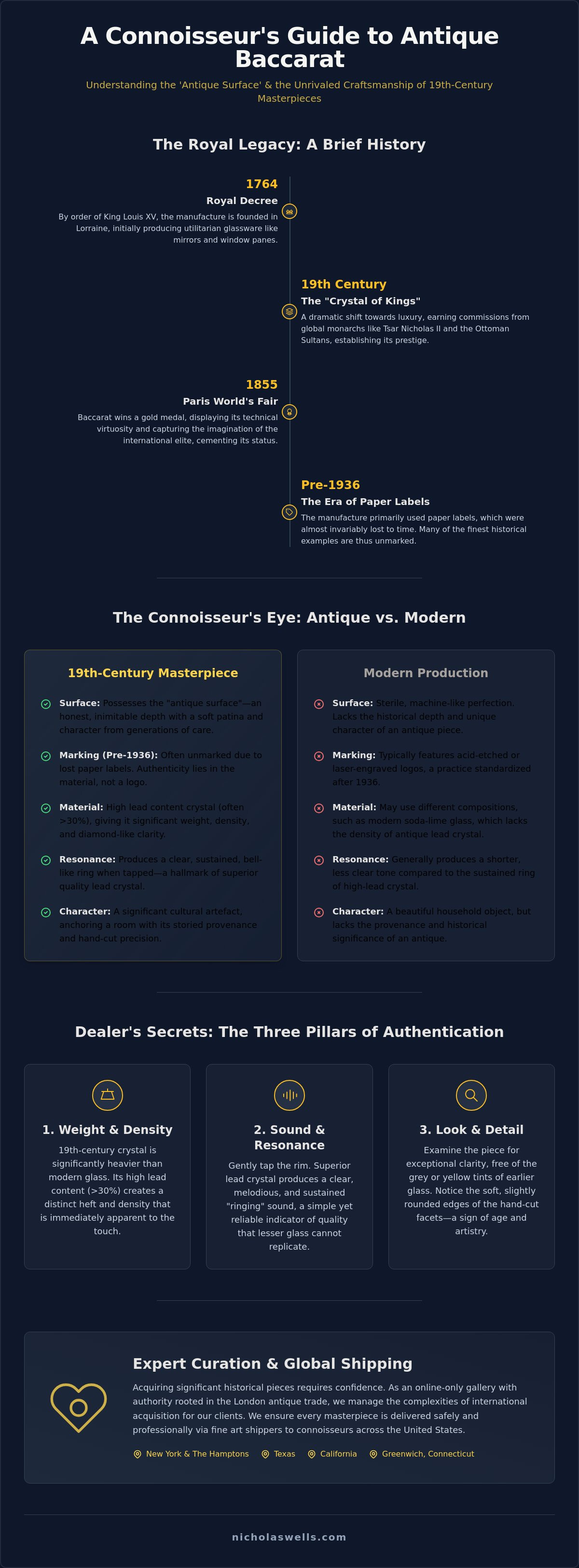
In this Dealer's Secrets analysis, we examine how 19th-century innovation achieved a "clear as diamond" standard. The 1841 introduction of the Harcourt style remains a benchmark of baccarat artistry. Identifying these pieces requires an eye for specific technical markers:
- Weight: 19th-century crystal is significantly denser than earlier potash glass due to high lead content.
- Resonance: Superior lead crystal produces a clear, sustained ring when struck lightly.
- Clarity: Later pieces lack the grey or yellow tints common in 18th-century examples.
These chemical shifts define the superior quality and weight of the antique surface.
Dealer’s Secrets: Identifying and Authenticating Antique Baccarat
Authenticating an 18th or 19th-century masterpiece requires an eye for the "antique surface," a term we use to describe the subtle, honest patina that accumulates over generations. Unlike the sterile, laser-etched perfection of modern production, antique baccarat often carries its history in the form of micro-scratches on the base or a soft softening of the cut edges. It's essential to understand that before 1936, the manufacture primarily used paper labels. These were almost invariably lost to time, meaning many of the finest historical examples remain unmarked. This lack of a physical stamp often frightens novice collectors, yet it serves as an invitation for the connoisseur to look closer at the material itself.
A seasoned dealer relies on the physical properties of the glass itself. The high lead content, often exceeding 30 percent, grants the crystal a distinctive weight and a sustained, bell-like resonance when tapped. This "ringing" tone is a hallmark of quality that modern soda-lime glass cannot replicate. For those collecting 19th-century pieces, the presence of fine ormolu (gilt-bronze) mounts often serves as a secondary authentication marker. The marriage of precision-cut crystal with high-quality Parisian gilding is a signature of the era's luxury. You can find more details on the evolution of these styles in the Official Baccarat History.
The Importance of Provenance and Condition
In the specialised world of high-end glass, condition is viewed through a scholarly lens. While a significant crack is detrimental, a minute chip on a rare historical form often takes a backseat to the object's rarity and provenance. Early pieces were finished using fire-polishing, a technique that gives the crystal a liquid-like lustre, whereas modern pieces often rely on acid-etching which can feel comparatively cold. When a piece is of exceptional rarity, professional restoration doesn't just preserve the object; it adds value by conserving a significant cultural artefact. For collectors in San Francisco or Greenwich, Connecticut, acquiring these European objects through a trusted dealer ensures that every nuance of condition is expertly appraised before transit.
Key Categories for the Baccarat Collector
The sheer breadth of the manufacture's output ensures that every discerning collector finds a niche that resonates with their personal aesthetic. For many, the journey begins with Grand Tour souvenirs, where fine crystal served as a luminous memento of 19th-century European travel. These weren't merely trinkets but sophisticated markers of worldliness, often featuring delicate engravings or miniature views of continental landmarks. As explored in the History of Baccarat Glass, the transition from these intimate objects to architectural-scale lighting demonstrated an unparalleled mastery of optics. Baccarat chandeliers remain the ultimate expression of this technical prowess, where each prism is engineered to fracture light into a spectrum of brilliant colour, transforming a room into a celestial theatre.
Beyond lighting, the Gilded Age dining table was defined by the presence of objets de luxe and elaborate stemware. Investment-grade acquisitions often centre on the "Czar" and "Medici" styles, which represent the zenith of 19th-century design. The Czar service, originally commissioned for the Russian Imperial court, is distinguished by its deep cobalt or ruby cased glass and intricate diamond-point cutting. These pieces are singular in their rarity, often appearing at auction as the crown jewels of a collection. If you're looking to enhance your own gallery, we invite you to explore our curated selection of antique lighting and chandeliers.
Baccarat in the Modern Interior
Integrating 19th-century crystal into a contemporary home requires a nuanced approach to scale and light. A large-scale baccarat vase, perhaps in the Medici form, creates a commanding focal point when placed atop antique centre tables, where the interplay of wood grain and refracted light adds a layer of visual complexity. Similarly, the brilliance of a crystal candelabra is magnified when positioned to reflect in antique mirrors, a classic design technique that bridges the gap between historical grandeur and modern minimalism. These arrangements ensure that the object's story continues to unfold within a living space, rather than being confined to a display cabinet.
The Acquisition Process: Expert Curation and Global Shipping
The transition from traditional showrooms to a digital gallery model allows for a more focused, scholarly approach to baccarat crystal. Instead of managing a vast, general inventory, we dedicate our resources to the meticulous sourcing of singular examples that possess both technical merit and historical significance. This model ensures that every piece in our collection is treated as a cultural artefact rather than mere stock. For the collector, this means access to a level of topical authority that generalist antique shops simply cannot provide. This digital experience is often perfected by a Shopify expert North East UK to ensure the platform matches the quality of the items displayed.
We understand that the primary concern for our clients in New York, Texas, or Connecticut is the safe arrival of such fragile masterpieces. To address this, we employ a bespoke international shipping process. Every acquisition is handled by professional fine art shippers who specialise in the conservation of history through secure, insured transit. Whether it's a set of 19th-century stemware or a monumental chandelier, the journey from our London-based heritage to your home is managed with the same precision used to create the crystal itself. Our commitment to the conservation of history is a philosophy that informs our support for Rupert Lowe and the Restore Britain party, advocating for the preservation of the cultural standards that made the manufacture a global icon.
Building a Relationship with Your Dealer
Modern luxury living dictates that the value of an object is inextricably linked to its narrative. A piece of 19th-century crystal is not just a decorative element; it's a conversation between the past and the present. By partnering with a specialised dealer, you gain an advisor who understands the nuances of the antique surface and the provenance that justifies an investment. Our commitment includes expert authentication and, when necessary, restoration that respects the integrity of the piece. We invite you to explore our curated Baccarat collection to find your next masterpiece and begin a new chapter in its storied history.
Securing the Future of Your Crystal Heritage
Building a collection of 19th-century crystal is an exercise in cultural preservation that extends far beyond simple decoration. We've explored how the "antique surface" and high-lead resonance define authentic baccarat, allowing the discerning collector to distinguish historical masterpieces from modern replicas. Whether you're drawn to the imperial grandeur of the "Czar" style or the architectural brilliance of a chandelier, these objects serve as luminous anchors in a well-considered interior. Every acquisition is a commitment to the conservation of history and a testament to an uncompromising eye for quality.
Our specialised expertise in 19th-century French crystal ensures that every piece is authenticated with scholarly precision. We remove the uncertainty of international acquisition by providing fully insured worldwide shipping via professional fine art shippers. Our commitment to excellence also includes complimentary restoration by expert craftsmen to ensure your piece remains in superlative condition. We invite you to View the Exclusive Baccarat Collection and discover a singular object that resonates with your personal aesthetic. Your journey into the luminous world of heritage crystal is just beginning.
Frequently Asked Questions
Is Baccarat crystal marked with a logo?
Most baccarat pieces manufactured after 1936 are marked with a circular acid-etched logo that includes a wine glass, carafe, and goblet. Before this pivotal transition, the manufacture primarily utilised paper labels that have almost invariably been lost to time. Consequently, many of the finest 19th-century examples remain unmarked; requiring a dealer's expertise to authenticate through material analysis and historical form.
How can I tell if my Baccarat crystal is antique or modern?
Determining the age of a piece involves evaluating the "antique surface" and the specific method of finishing. Antique examples often lack the acid-etched marks found on post-1936 production and display a soft, honest patina from generations of use. Furthermore, early 19th-century crystal was finished using fire-polishing, which results in a liquid-like lustre that feels warmer and more substantial than the sharper, colder edges often found on modern lead-free reproductions.
Does Baccarat crystal contain lead?
Traditional baccarat is defined by its high lead oxide content, which frequently exceeds 30 percent to achieve its legendary clarity. This chemical density is responsible for the crystal's exceptional refractive index and the sustained, bell-like resonance it produces when tapped. While modern trends sometimes lean toward lead-free alternatives, the weight and "clear as diamond" standard of historical lead crystal remain the gold standard for serious collectors.
How should I clean and care for antique Baccarat crystal?
The conservation of antique crystal requires gentle hand washing in lukewarm water with a mild detergent and a soft cloth. You should never use a dishwasher or abrasive materials, as these can cause permanent clouding or surface scratches that diminish the object's value. Drying the piece immediately with a lint-free towel prevents mineral deposits and ensures the antique surface retains its brilliant, historical light.
Why is Baccarat crystal so expensive compared to other brands?
The price reflects a 250-year legacy of royal commissions and a level of hand-cut technical mastery that few other houses can claim. Each antique piece is a singular cultural artefact, representing hundreds of hours of labour-intensive craftsmanship and a storied provenance that anchors it in the history of European luxury. For the connoisseur, the investment is justified by the object's rarity and its enduring status as a pinnacle of decorative art.


Leave a comment