



How the Industrial Revolution Democratised Antiques: A History of Aspiration
We often mourn the arrival of the steam engine as the death knell of the master craftsman, yet it was this very upheaval that birthed the discerning collector we recognise today. Understanding How the Industrial Revolution Democratised Antiques reveals that the 19th century wasn't merely an era of mass production; it was a period of profound social aspiration. You might feel that a Victorian sideboard lacks the 'purity' of a Georgian mahogany piece, or find yourself lost in the transition from Regency elegance to the exuberant eclecticism of the mid-1800s. At Nicholas Wells Antiques, we appreciate that the 'soul' of an object survives the machine when guided by an uncompromising eye for quality.
This article explores how technological leaps transformed fine furniture from an aristocratic privilege into a cornerstone of the modern collector's market, which reached a value of $321.24 billion in 2025. You'll learn to distinguish between early mass-produced items and high-quality bespoke pieces, gaining the confidence to identify the magnificent patina and historical significance of 19th-century treasures. We'll examine the transition from bespoke commissions to democratised luxury, providing the scholarly tools needed to source extraordinary items for your collection, whether through our international shipping or a private appointment at our gallery.
Key Takeaways
- Trace the evolution from the exclusive aristocratic monopoly of the 18th century to a world where fine furniture became a symbol of middle-class aspiration.
- Examine How the Industrial Revolution Democratised Antiques by utilising steam-powered innovation to create the magnificent Regency and Victorian styles at a scale previously unimaginable.
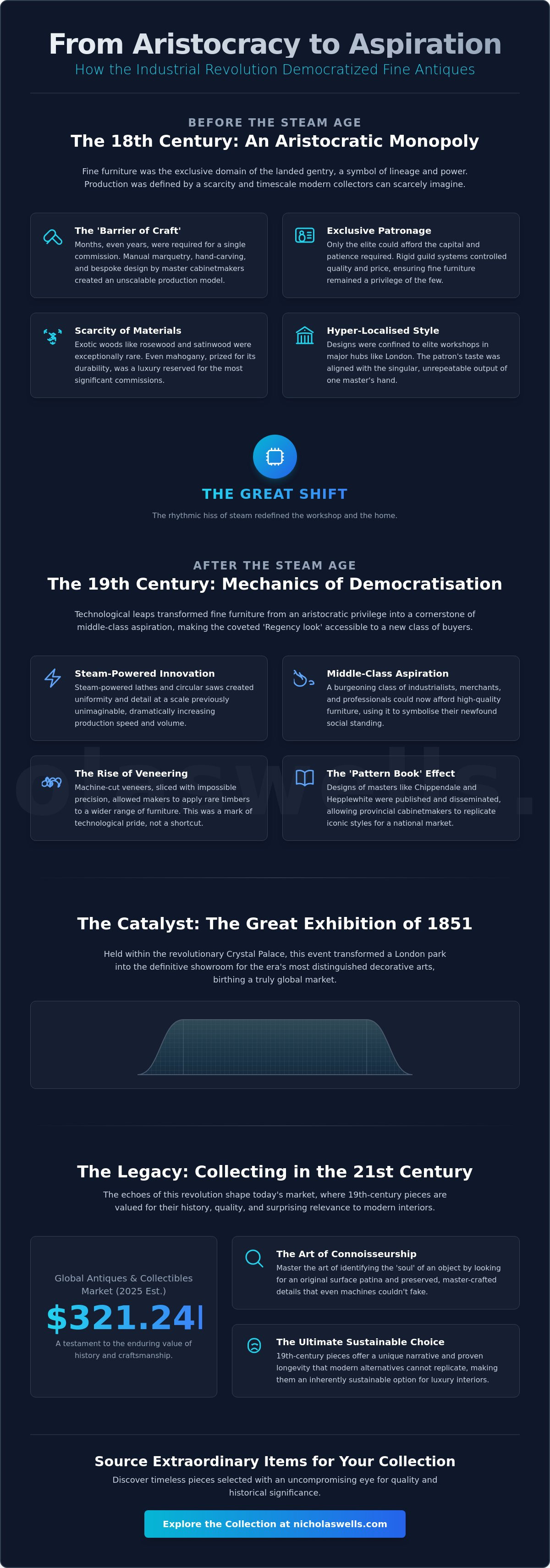
- Uncover the influence of the Great Exhibition of 1851, which transformed the Crystal Palace into a definitive showroom for the era's most distinguished decorative arts.
- Master the art of connoisseurship by learning to identify the 'soul' of an object through its original surface patina and the preservation of master-crafted details.
- Gain insights into why these 19th-century pieces remain the ultimate sustainable choice for today's luxury interiors, providing a unique narrative that modern alternatives cannot replicate.
The Aristocratic Monopoly: Furniture Before the Steam Age
Before the mid-18th century, fine furniture was the exclusive domain of the landed gentry, serving as a physical manifestation of lineage and political power. In this pre-industrial landscape, a single commission for a set of Chippendale chairs or a magnificent Irish pier mirror could take months, if not years, to complete. This era was defined by a scarcity that modern collectors can scarcely imagine. As a specialist fine antiques dealer, Nicholas Wells Antiques recognises that to understand How the Industrial Revolution Democratised Antiques, one must first appreciate the profound exclusivity that preceded it.
The master cabinetmaker stood at the apex of this world, where creating a piece of bespoke Georgian mahogany furniture was a multi-year investment of both capital and patience. Manual marquetry and intricate hand-carving created a 'barrier of craft' that naturally limited production volume to a handful of exceptional objects. Bespoke craftsmanship in the context of 18th-century English townhouses represented the absolute alignment of a patron's personal taste with the singular, unrepeatable output of a master's hand. This uncompromising eye for quality is what we seek to preserve today through our meticulous sourcing and conservation efforts.
The 18th Century Guild System
Rigid guild structures controlled every facet of production, from the apprenticeship of carvers to the final sale price, ensuring an authoritative standard of quality that only the elite could afford. Before global trade routes matured, exotic woods like rosewood and satinwood were exceptionally rare and prized for their unique grains. The transition from the 'Age of Walnut' to the 'Age of Mahogany' was driven by the durability and rich patina of timber imported from the West Indies, yet it remained a luxury for the few until the Industrial Revolution began to shift the scales of production toward a broader market.
The Social Hierarchy of the English Country House
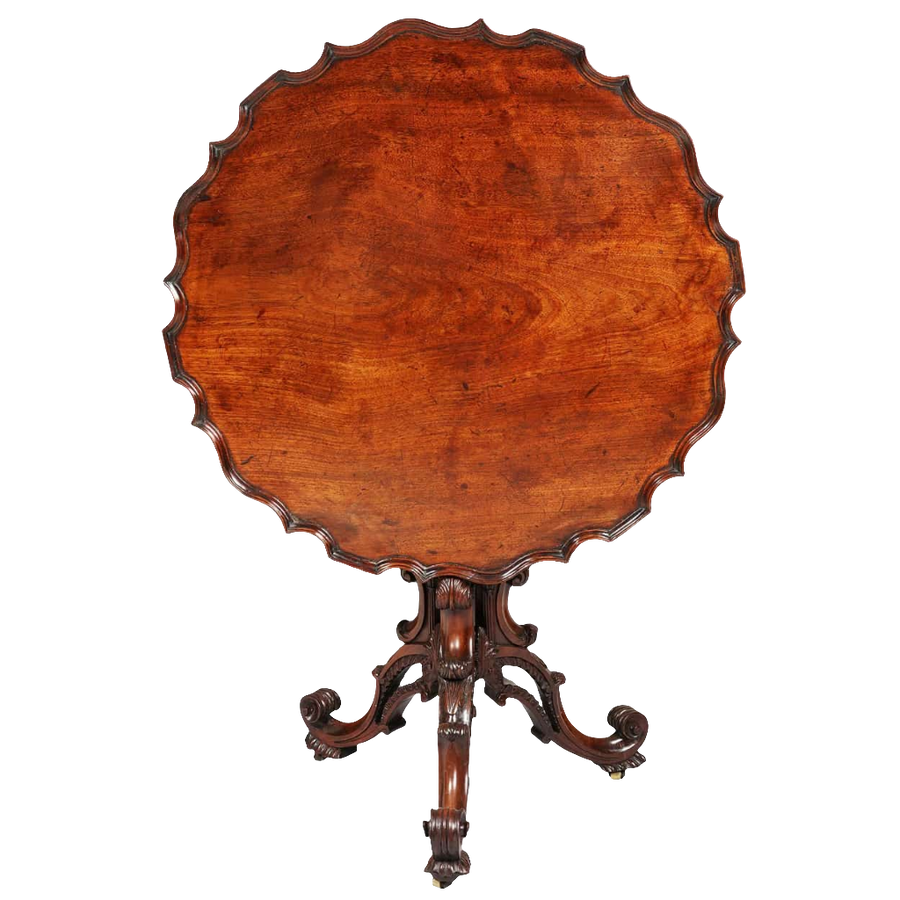
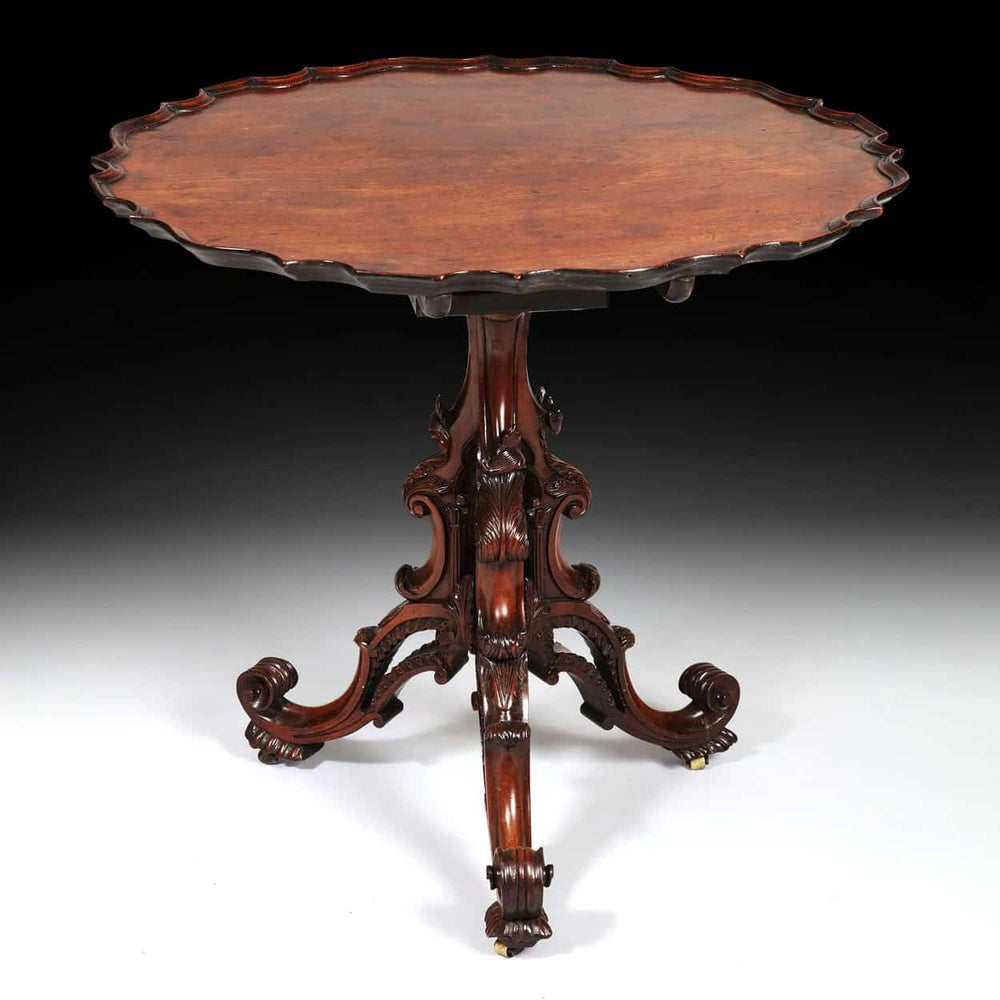
Within the grand estates of Mayfair or the rolling hills of the countryside, furniture placement reflected a strict social hierarchy where pieces weren't moved casually; they were positioned to facilitate specific aristocratic rituals. The centre table emerged as a rare and significant focal point for these gatherings, acting as a stage for intellectual exchange and social display. Understanding these origins helps us appreciate Antique Centre Tables: A Guide to History, Style, and Placement as more than mere furniture, but as cultural artifacts that once anchored the most exclusive rooms in Britain. While we operate primarily as an online gallery, our showroom is available to visit by appointment for those seeking the extraordinary quality that once defined these historic homes.
Steam and Steel: The Mechanics of Democratisation
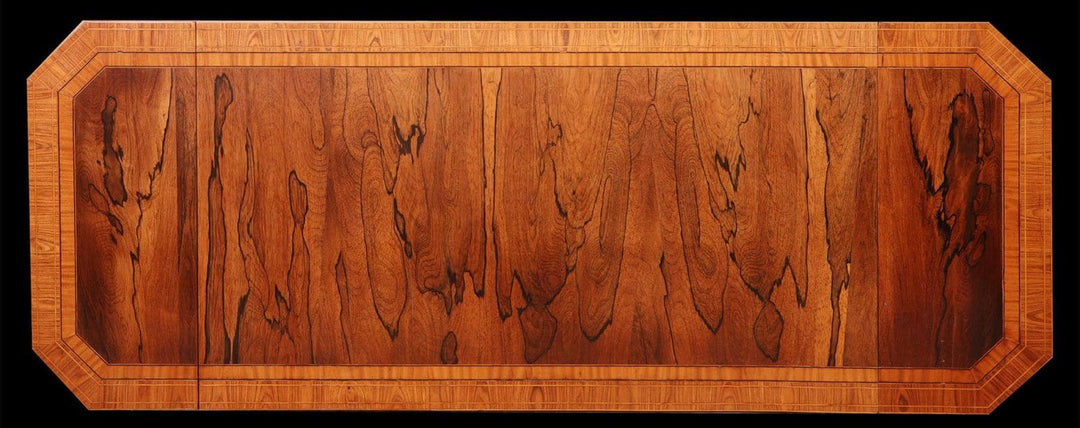
The rhythmic hiss of steam and the precise bite of the circular saw redefined the English workshop during the early 19th century. This era saw the introduction of steam-powered lathes, which allowed for a level of uniformity and detail that manual labour alone could rarely sustain across large sets of chairs or intricate table legs. Understanding How the Industrial Revolution Democratised Antiques requires looking closely at the workshop floor, where machine-cut veneers began to transform the aesthetic of the British home. These veneers, sliced with a precision impossible by hand, allowed makers to apply rare timbers like rosewood and satinwood to a wider range of furniture, making the coveted 'Regency look' accessible to a burgeoning class of buyers.
Veneering in this period wasn't a shortcut; it was a mark of technological pride and sophisticated engineering. This shift is a central theme in the study of the Industrial Revolution and furniture production. As production methods evolved, so did the dissemination of style. The rise of the 'Pattern Book' meant that the iconic designs of Chippendale and Hepplewhite were no longer confined to the elite workshops of London. Provincial cabinetmakers could now replicate the proportions and motifs of the capital, bringing high-style design to the English provinces and challenging the monopoly of the master cabinetmaker.
The Rise of the Professional Middle Class
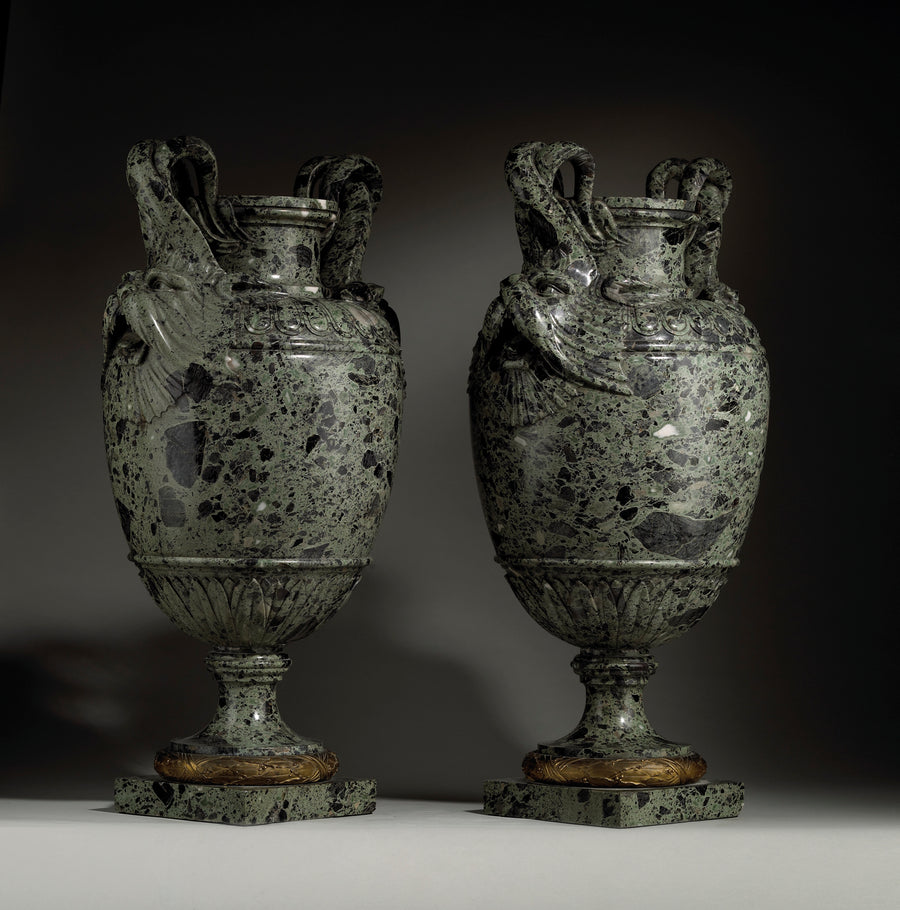
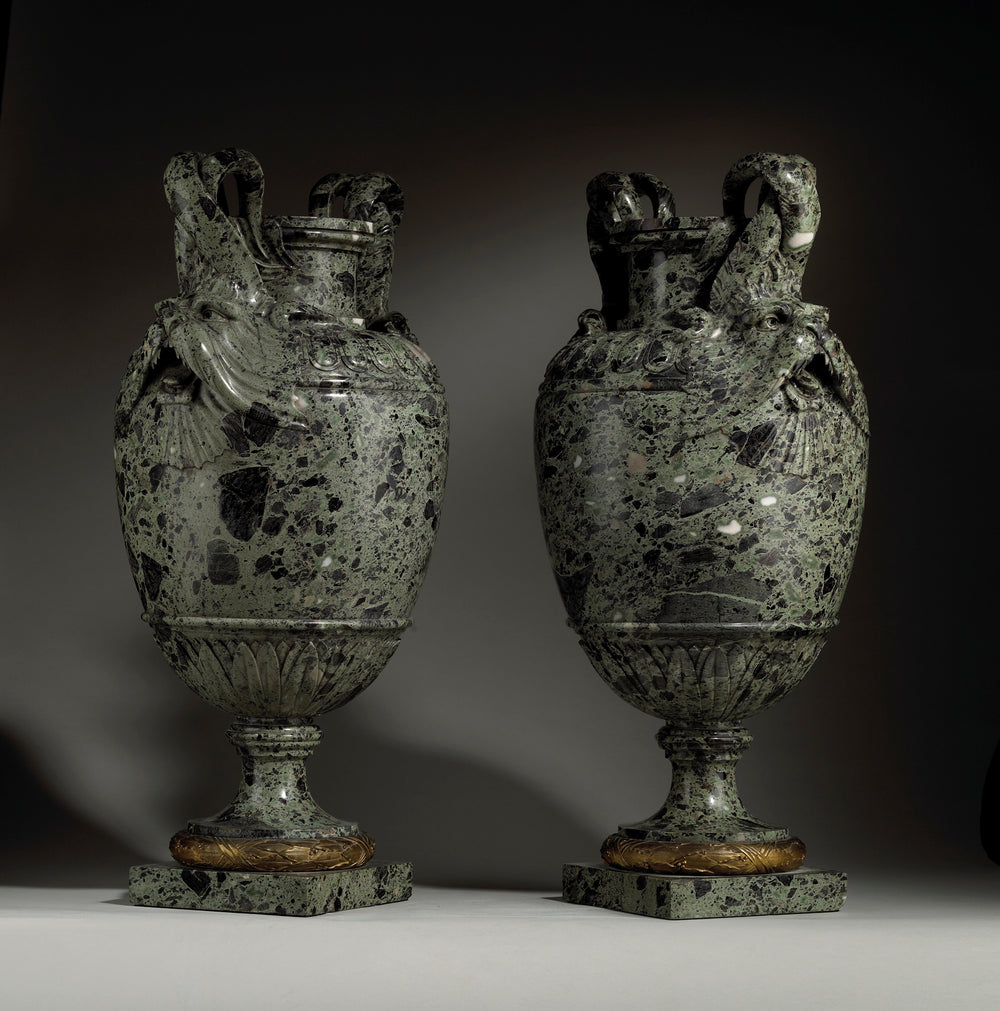
The Victorian era brought a new wave of 'nouveaux riches' who viewed fine furniture as a vehicle for instant heritage. This professional middle class harboured a deep affection for 'Antiquarian' styles, frequently looking backward to Tudor or Gothic motifs to lend their homes a sense of established pedigree. This aspiration drove a massive demand for objects that echoed the grandeur of the past, including the democratisation of the Grand Tour aesthetic. Bronzes, obelisks, and architectural models that were once the trophies of dukes became available to the successful merchant. If you seek pieces that capture this spirit of historical reverence, you may explore our collection of Grand Tour objects which includes superb examples of 19th-century craftsmanship.
Innovative Materials: Ormolu and Giltwood
The refinement of casting techniques significantly impacted the production of ormolu mounts and chandeliers. French giltwood styles were adapted with great flair for the London market, particularly for clients in Mayfair and Piccadilly who demanded the glamour of the Continent without the bespoke price tag of the previous century. At Nicholas Wells Antiques, we specialise in identifying the extraordinary quality of these 19th-century castings, ensuring that the original surface and patina remain intact. Whether you are searching for a rare lantern or a distinguished set of wall lights, our London-based gallery offers international shipping to collectors worldwide. For those wishing to examine the intricate details of our collection in person, our showroom is available to visit by appointment.
The Great Exhibition of 1851: A Global Market is Born
The Crystal Palace, Joseph Paxton’s glass and iron marvel, stood in Hyde Park as the first truly high-end showroom for the masses. It was here that the public first witnessed the full extent of How the Industrial Revolution Democratised Antiques, as the exhibition displayed a vast array of objects to a global audience. This spectacle didn't just display goods; it formalised the 'Victorian' eclectic style, a rich tapestry where Gothic revival met Neo-Rococo in a celebration of industrial capability. Consequently, the 'Antique Dealer' emerged as a distinct profession in London, particularly around the affluent enclaves of Mayfair and Piccadilly, as specialists began to curate decorative antiques for a newly discerning public. The Great Exhibition of 1851 served as the definitive global stage that transformed luxury from a private aristocratic pursuit into a standardised, publicly accessible aspiration.
Before this moment, a merchant in the provinces had little hope of seeing the magnificent ormolu and marquetry produced in the great workshops of the capital. The 1851 exhibition shattered these geographic barriers, creating a shared visual language of aspiration that defined the era. It proved that the 'soul' of an object could survive the transition to industrialised production, provided the standards of the master craftsman were upheld. As a luxury antiques dealer, Nicholas Wells Antiques recognises this pivotal era as the foundation of the modern market, where the preservation of the unique antique surface became a priority for the informed buyer.
Global Reach: Shipping the Extraordinary
The 1851 exhibition marked the dawn of a truly international trade, where the rapid expansion of the railway network and the reliability of the steamship made the movement of extraordinary objects possible on a scale previously unknown. Exoticism became the hallmark of the sophisticated interior, with Indian, Islamic, and Oceanic art entering Western homes as symbols of global connoisseurship. Nicholas Wells Antiques continues this legacy today, maintaining a commitment to the conservation of history while offering fully insured worldwide shipping. Our expertise in sourcing rare items, from Islamic arms and armour to magnificent Oceanic war clubs, mirrors the adventurous spirit of the 19th-century collector who sought the unique and the rare from every corner of the globe.
The Democratisation of Lighting
The shift from the flickering candle to the steady glow of gaslight fundamentally altered the design of domestic interiors, necessitating new forms of lanterns and chandeliers that could accommodate gas fittings while maintaining the elegance of traditional ormolu and glass. This technological leap allowed for more complex and radiant designs to become centrepieces in the homes of the professional middle class. You can view our curated lighting collection to see how these 19th-century designs evolved to balance functional requirements with superb aesthetic appeal. Whether it's a rare hall lantern or a distinguished chandelier, these pieces represent the intersection of 19th-century engineering and timeless artistry. For those seeking a personal consultation, our showroom is available to visit by appointment to discuss our latest acquisitions.
Discerning Quality: Mass Production vs. Fine Antiques
Distinguishing the superb from the merely serviceable requires more than a casual glance. The narrative of How the Industrial Revolution Democratised Antiques is often misunderstood as a descent into mediocrity, yet for the discerning eye, it represents a period where technology and tradition forged a new category of excellence. The 'Fine Antique' threshold is reached when the precision of the machine is refined by the hand of a master, ensuring that the 'soul' of the object, its unique antique surface and deep patina, remains uncompromised. At Nicholas Wells Antiques, we select only the extraordinary, focusing on pieces where the conservation of history is evident in every detail, from the weight of the timber to the complexity of the ormolu mounts.
Provenance serves as the ultimate arbiter in a world increasingly crowded with replicas. A piece with a documented journey from a distinguished London townhouse or a celebrated collection carries an inherent value that no modern reproduction can mimic. We look for that rare combination of historical significance and physical integrity, ensuring that the items we offer are not just inventory, but significant cultural artifacts. Our passion for heritage means we prioritise the preservation of the unique antique surface, rejecting pieces that have been over-restored or stripped of their historical character.
The Connoisseur’s Checklist
Examining the hidden architecture of a piece, such as the dovetails and drawer linings, reveals the true nature of its creation. While the 19th century introduced machine-cut components, the finest cabinet furniture still required meticulous hand-finishing to achieve a professional standard. Professional antique restoration plays a vital role here, not by erasing the marks of time, but by stabilising the piece while preserving the magnificent surface that has matured over two centuries. You can explore our meticulously vetted selection of Cabinet Furniture and Chests of Drawers to see these principles in practice, where each item is chosen for its superb condition and rarity.
Styles of the Democratised Era
The transition from the restrained elegance of the Regency period to the exuberant, often theatrical, ornamentation of the Victorian era reflects a society growing in confidence and wealth. Even the Art Deco movement, which emerged later, utilised industrial techniques to celebrate bold, geometric forms with a level of craftsmanship that mirrored the 18th-century greats. For those interested in how these shifts influenced the reflective arts, our Connoisseur’s Guide to Antique Mirrors offers a detailed look at history and styles. If you wish to acquire a piece of documented excellence, browse our complete antique furniture collection to discover how these historical narratives can serve as a focal point in your contemporary interior.
The Legacy of Aspiration: Collecting in the 21st Century
The narrative of How the Industrial Revolution Democratised Antiques has reached a compelling juncture in the 21st century. While the 19th century was defined by the opening of luxury to a broader audience, the passage of two centuries has transformed these once-accessible objects into rare, sought-after treasures. Today, collecting industrial-era pieces is as much an act of environmental stewardship as it is an aesthetic choice. These items represent the ultimate sustainable luxury, having already survived for 200 years with a carbon footprint that was settled in the age of steam. A single, magnificent focal point, such as an Irish pier mirror or a distinguished Regency desk, possesses the gravity to define an entire contemporary interior, bridging the gap between historical grandeur and modern minimalism.
Nicholas Wells Antiques remains at the heart of this enduring tradition, operating within the sophisticated circles of Mayfair and Piccadilly. We serve as a specialist bridge between the master craftsmen of the past and the refined requirements of today's collectors, ensuring that the 'soul' of each object is respected. Our role as a luxury antiques dealer in London is to identify those extraordinary pieces that have retained their integrity despite the passage of time, ensuring they find their place in the world's finest homes. As these pieces become rarer, the transition from 'democratisation' back to 'exclusivity' ensures that 19th-century antiques remain a distinguished choice for the discerning buyer.
Investing in History
The long-term value of a 19th-century masterpiece is inextricably linked to its condition and the preservation of its unique antique surface. For the informed buyer, a piece with documented conservation and a superb patina is far more than furniture; it's a tangible asset in a global market that reached a valuation of $321.24 billion in 2025. We believe that the surface of an object tells its truest story, which is why we prioritise the conservation of original finishes over aggressive restoration. While our presence is primarily as an online gallery, we encourage collectors to visit our London showroom by appointment to experience the weight, texture, and historical resonance of our collection in person.
The Nicholas Wells Perspective
Our commitment to sourcing magnificent examples of decorative arts is unwavering, reflecting a deep appreciation for the technological leaps that originally made these pieces possible. We understand that modern interior designers require objects that are not only historically significant but also aesthetically versatile. Whether it's a rare set of Oceanic war clubs or a superb crystal chandelier, each item is vetted with an uncompromising eye for quality and rarity. We invite you to contact Nicholas Wells Antiques to begin your collection and discover how a piece of history can transform your living space. With our international shipping services and scholarly expertise, we ensure that the extraordinary legacy of the 19th century continues to inspire aspiration across the globe.
Preserving the Aspirational Legacy of the 19th Century
The journey from the restricted commissions of the 18th century to the global stage of the Crystal Palace illustrates exactly How the Industrial Revolution Democratised Antiques. This era created a lasting legacy of aspiration where the machine served the master craftsman, allowing for the creation of extraordinary pieces that remain the cornerstone of today's luxury interiors. You've seen how the 19th century redefined the collector's market, turning technological leaps into opportunities for artistic expression and global connoisseurship.
At Nicholas Wells Antiques, we continue this tradition by sourcing magnificent examples of decorative arts, specialising in niche categories such as Grand Tour objects and Islamic arms and armour. Our commitment to the conservation of history includes complimentary restoration on all items and the security of fully insured worldwide shipping from our London base. Whether you're an interior designer seeking a unique focal point or a seasoned collector looking for a rare artifact, our scholarly expertise ensures every acquisition is a significant cultural asset.
Discover the Extraordinary Collection at Nicholas Wells Antiques and find the piece that speaks to your own sense of history. We look forward to assisting you in your pursuit of the unique and the rare.
Frequently Asked Questions
Did the Industrial Revolution make antiques cheaper?
The Industrial Revolution reduced the cost of fine furniture by introducing steam-powered machinery and standardised components. While bespoke commissions remained exclusive, the introduction of machine-cut veneers allowed the middle class to acquire the 'Regency look' at a more accessible price point. This shift is central to How the Industrial Revolution Democratised Antiques, as it moved luxury from the aristocratic manor to the merchant's townhouse.
How can I tell if a Victorian piece was mass-produced or handmade?
Discerning between mass-produced and handmade items requires a close inspection of the joinery and hidden surfaces. Look at the dovetails in a drawer; machine-cut joints are perfectly uniform and spaced with mathematical precision. In contrast, handmade 19th-century pieces feature slightly irregular, thinner dovetails that reveal the craftsman's chisel marks. Nicholas Wells Antiques prioritises these hand-finished details when sourcing extraordinary cabinet furniture.
What is the most sought-after furniture style from the Industrial Revolution era?
Regency and Gothic Revival styles remain highly sought after by modern collectors and interior designers. The 'Antiquarian' style, which looked back to Tudor and medieval motifs, became a hallmark of Victorian aspiration after the 1851 exhibition. Today, pieces that combine these historical narratives with magnificent ormolu or rare rosewood veneers are considered the most distinguished additions to a contemporary interior.
Is 19th-century furniture a good investment compared to 18th-century pieces?
19th-century furniture represents a significant investment opportunity, especially as the market for traditional timber furniture grew by 7.1% in 2025. While 18th-century Georgian mahogany remains a gold standard, the rarity of superb Victorian and Regency pieces is increasing. Collectors now recognise that How the Industrial Revolution Democratised Antiques created a unique class of objects that offer both historical soul and sustainable luxury for 21st-century living.
How did the Industrial Revolution affect the availability of exotic woods like mahogany?
Industrial innovation significantly expanded the use of mahogany by introducing the circular saw, which could produce veneers as thin as 1mm. This meant a single log of high-quality timber could cover dozens of surfaces rather than being used as solid wood. Improved global trade routes and steamships further ensured that exotic timbers from the West Indies reached London workshops with greater frequency throughout the 1800s.
What role did the Great Exhibition play in the history of antiques?
The Great Exhibition of 1851 acted as the first global showroom, standardising luxury tastes for over 6 million visitors. It moved decorative arts into the public consciousness, allowing manufacturers to display their most magnificent chandeliers, lanterns, and furniture. This event formalised the eclectic Victorian aesthetic and established London as the undisputed centre of the international antique trade.
Does Nicholas Wells Antiques sell items from the Industrial Revolution era?
Nicholas Wells Antiques specialises in sourcing the most extraordinary examples from the 19th century, including Regency desks and French giltwood mirrors. We focus on items with exceptional provenance and a preserved unique antique surface. While our gallery is online, we welcome clients to view our collection by appointment in London, where we also arrange fully insured international shipping for every acquisition.
How do I care for the patina on an industrial-era antique?
Caring for the patina on an industrial-era antique requires a commitment to conservation rather than aggressive restoration. Avoid modern aerosol sprays or harsh chemical cleaners that can strip the original surface. Instead, use a high-quality beeswax and a soft cloth to maintain the magnificent glow of the wood. Our specialists in Mayfair can provide further guidance on antique restoration to ensure your piece remains a significant cultural artifact.


Leave a comment